A note about links: If we include links to retail sites like Amazon or Bass Pro Shops, it's because they're relevant to the topic and, as anglers ourselves, we believe they're worth checking out. As an Amazon Associate we earn from qualifying purchases.
Few encounters in freshwater fishing carry the weight of hooking a lake sturgeon. These fish are living fossils, a lineage older than the dinosaurs, and when one takes your bait from the bottom of a cold river pool, the line goes tight with something that feels genuinely ancient. Sturgeon do not thrash or jump. They pull in slow, deliberate surges that telegraph real size and will test your tackle, your anchoring, and your patience all at once. In most waters where you can fish for them today, harvest is closed or severely restricted, which means landing one is a brief, reverential handshake before you put it back. That shift in stakes makes sturgeon fishing feel less like sport and more like a privilege. The IGFA all-tackle world record stands at 168 pounds, caught by Edward Paszkowski on Georgian Bay, Ontario, on May 29, 1982, using 12-pound line and a Mepps spinner, a mark that has stood for over 40 years and is unlikely to fall given how strictly these fish are protected today.
How to identify one
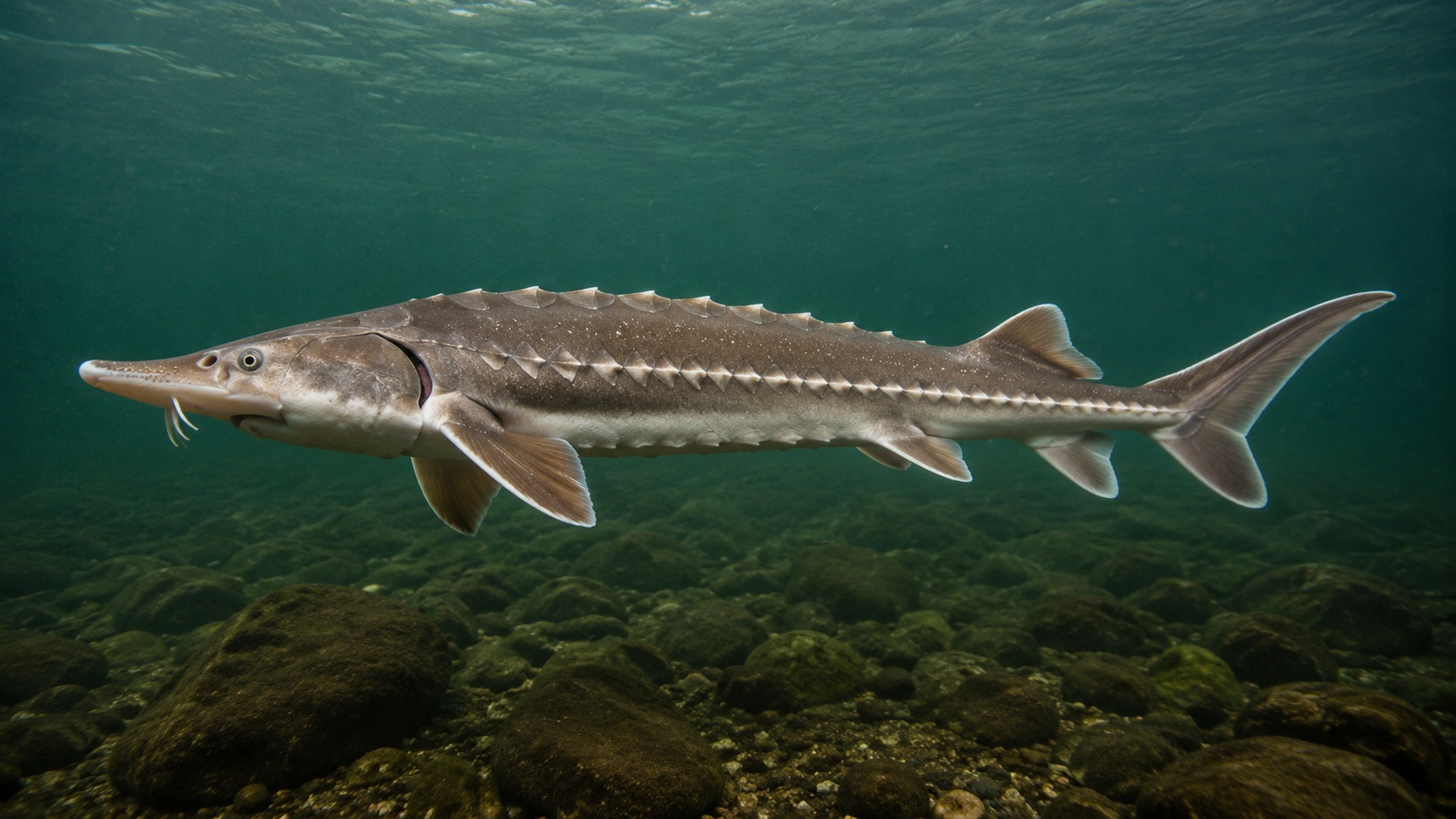
Lake sturgeon are unmistakable once you know what you are looking at, and genuinely unlike anything else in freshwater North America. The body is long and torpedo-shaped, running olive-grey to brownish on top and fading to pale on the belly. The most striking features are five rows of bony scutes, hard plate-like projections that run the length of the body: one row down the back, two rows along the sides, and two rows along the belly. These are not scales. They are remnants of armor from 150 million years ago.
The snout is long, shovel-shaped, and slightly upturned at the tip. Underneath it hang four fleshy barbels arranged in a row, positioned between the tip of the snout and the underslung, toothless mouth. The tail is heterocercal, meaning the upper lobe is noticeably longer than the lower, giving it a shark-like silhouette. There is no mistaking that tail combined with the scute rows and the barbels.
Adults typically run 4 to 6 feet and weigh 30 to 80 pounds in most encounters, but large old females can reach 7 feet and 200 pounds or more. A fish that old may be 80 to 100 years of age. Females live longer than males, and lifespans reaching 150 years have been documented. You are not catching a big fish. You are catching a very old one.
Where to find them
Lake sturgeon are native to the Great Lakes basin, the St. Lawrence River drainage, and the Mississippi River drainage as far south as Alabama. Historically they ranged throughout this entire system in enormous numbers. Today populations are greatly reduced, fragmented, and largely confined to strongholds in larger rivers and lakes where water quality and spawning habitat have been maintained or restored.
Prime waters include the St. Croix River on the Wisconsin-Minnesota border, the Menominee River between Wisconsin and Michigan, the Wisconsin River, portions of the Flambeau and Chippewa systems, Lake Winnebago and its tributary rivers in Wisconsin, the Detroit River, Georgian Bay and Lake Simcoe in Ontario, and the St. Lawrence River. Minnesota’s Rainy River supports one of the healthiest populations in the region.
Sturgeon are strict bottom dwellers. In rivers they hold in deep pools, behind large boulders, and along the edges of scour holes where current slows and bottom food concentrates. In lakes they work sandy or gravelly flats in the 10 to 30 foot range during spring and fall, moving deeper in summer. Spawning runs occur in spring when water temperatures reach 55 to 65 degrees Fahrenheit. Fish stage in the lower reaches of tributary rivers before moving upstream to rocky, fast-water spawning sites. These spawning aggregations are the most reliable time to find fish in numbers. Fall feeding runs as water cools below 60 degrees offer a second productive window.
When to go
Spring is the primary season. As ice goes out and river temperatures climb into the 50s, sturgeon begin moving upstream toward spawning habitat. The fish are active, grouped, and predictable during this window, which typically spans mid-April through late May depending on latitude. Wisconsin’s Lake Winnebago spearing season, the largest regulated sturgeon spearing fishery in the world, runs in February on the ice, giving a window into just how tightly managed these fish are.
Fall offers a second opportunity as sturgeon feed aggressively to put on weight before winter. Water temperatures in the 55 to 65 degree range in September and October concentrate fish on feeding flats in lakes and in the slower tailwater pools of rivers. Avoid fishing when water exceeds 70 degrees. Thermal stress at those temperatures increases post-release mortality, and these fish are too valuable to risk.
Summer fishing is possible but slower. Fish move deep and become less active. Winter through-ice encounters happen incidentally for anglers targeting other species in Wisconsin and Michigan.
What to throw
The approach is simple, but the execution matters. Sturgeon have no teeth and feed entirely by feel and smell, vacuuming invertebrates and organic material off the bottom with their extendable, tube-like mouth. They locate food through those barbels and a scent detection system sensitive enough to identify food sources at concentrations measured in parts per billion. Visual lures are largely irrelevant. Scent and bottom presentation are everything.
Tackle: Use a stout rod in the 7 to 8 foot range, a baitcasting reel, and braided main line in the 65 to 100 pound test range. This is not about the initial fight, though sturgeon fight hard. Heavy gear lets you land fish quickly, reducing exhaustion and injury. Light tackle leaves broken-off leaders and hooks in fish, which can impair feeding or trap them in debris.
Rig: A slip-sinker rig is standard. Thread a no-roll or bank sinker heavy enough to hold bottom, typically 2 to 5 ounces depending on current, onto your main line. Tie a barrel swivel, then add a 12 to 18 inch fluorocarbon leader in the 40 to 60 pound range. Finish with a 5/0 to 7/0 circle hook. The slip design lets fish pick up the bait and move without immediately feeling resistance, which matters because sturgeon often mouth bait tentatively before committing.
Bait: A large glob of nightcrawlers is the classic choice and remains the most reliable option on most waters. Fresh sucker meat, whole or cut into chunks, is equally productive and adds bulk for big fish. Lamprey eels where legal, crayfish, and clam or mussel meat also work. Freshness and scent load are more important than bait type. Replace bait every 20 to 30 minutes to maintain scent dispersion.
Technique: Anchor upstream of the target pool and lower your rig to the bottom, then let out just enough line to hold position. Keep the line taught but light. Sturgeon bites start as a subtle picking sensation before the line loads up with real weight. With a circle hook, do not set the hook. Simply reel down until you feel the fish and let the hook find the corner of the mouth on its own. A premature sweep-set will pull the hook out of a fish that is only mouthing the bait.
Regulations
Regulations for lake sturgeon are among the most restrictive in freshwater fishing, and this is not bureaucratic overcaution. Great Lakes populations are estimated at less than 1% of historical numbers. The IUCN lists the species as Endangered, based on an estimated reduction of more than 75% in population size over the past three generations. Three generations for a lake sturgeon spans 250 to 300 years. The fish you release today may not spawn successfully for the first time for another 20 years. A female does not reach sexual maturity until 24 to 33 years of age.
Always verify current regulations with your state or provincial agency before fishing. Rules change by water body and by year. What follows is a general summary based on 2026 information.
Wisconsin: A catch-and-release hook-and-line season runs on select waters including portions of the Namekagon River, St. Croix River, Bear River, Little Turtle River, Flambeau River, Turtle-Flambeau Flowage, and segments of the Chippewa River system. The 2026 season runs June 6, 2026 through March 7, 2027. No harvest tag is required for catch-and-release. Lake Winnebago has a separate regulated spearing season in February. Contact Wisconsin DNR for current water-specific rules.
Michigan: A catch-and-immediate-release season on the Menominee River between the Grand Rapids Dam and Sturgeon Falls Dam begins the first Saturday in June and runs through the first Sunday in March. Limited harvest seasons exist on specific waters, with a statewide limit of one lake sturgeon per angler per year (April 1 through March 31). Harvest must be registered within 24 hours. Contact Michigan DNR for specific water rules.
Minnesota: Limited catch-and-release opportunities exist on the Rainy River and some other designated waters. Harvest seasons are extremely limited and closely managed. Check with Minnesota DNR for current designations.
Ontario: Regulations vary by fisheries management zone. Many waters have closed seasons or catch-and-release restrictions. Contact the Ontario Ministry of Natural Resources for current zone-specific rules before fishing.
Federal (US): A 2026 lawsuit filed by the Center for Biological Diversity seeks Endangered Species Act listing for lake sturgeon. Monitor federal developments, as a listing would impose additional restrictions across all US waters.
Do not assume a water is open because you caught sturgeon there before. These rules are actively managed and shift as populations respond or decline.
Handling and release
Every lake sturgeon released is an investment in a recovery that operates on a generational timescale. Handle these fish as though they are irreplaceable, because they essentially are.
Keep the fish in the water. Do not lift a sturgeon out of the water if you can avoid it. Their internal organs are not supported the way a fish’s body is when floating, and lifting a large fish by the head or tail can cause internal injury. Measure and photograph the fish at the water’s surface with the fish resting on its side, supported lengthwise with both hands.
If you must lift the fish briefly: Support the full body horizontally with two wet hands, one beneath the pectoral area and one under the midbody. Never hang a sturgeon vertically by the tail, gill plate, or jaw. Keep air exposure under 30 seconds.
Use wet hands only. Dry hands strip the protective mucus coat, which defends against infection. Wet a net or unhooking mat thoroughly before contact.
Remove hooks quickly and carefully. Circle hooks are strongly preferred because they almost always lodge in the corner of the mouth and can be removed without damage. If a hook is deeply embedded, cut the leader and leave the hook. Stainless steel hooks are not appropriate for this reason. Use non-stainless or non-offset circle hooks that will corrode out within days.
Revive before release. Hold the fish upright in slow current, facing upstream, until it actively kicks free. If fishing in still water, move it gently forward and back to pass water over the gills. A fish that rolls on its side is not ready. Do not drop it and walk away.
Do not fish in warm water. When surface temperatures exceed 70 degrees Fahrenheit, the physiological stress of a fight and handling can be lethal even if the fish swims away. Shift to other species until temperatures drop.
The lake sturgeon was fished nearly to extinction across its range within about 60 years of commercial fishing pressure beginning in the mid-1800s. Populations that were stable for millennia collapsed within a human lifetime. The slow recovery underway now is the result of strict protections, habitat restoration, and stocking programs that have been running for decades. Treating every catch-and-release encounter with the same care as a hospital discharge is not an exaggeration. These fish earn that.
On the Table
Lake sturgeon produces genuinely high-quality meat, but for most anglers in most waters the honest answer is simple: put it back. Conservation regulations across the species’ range mean harvest is either outright prohibited or tightly restricted to a handful of states with special permit systems, making this a de facto catch-and-release fish for the vast majority of people who encounter one.
Taste and texture: Sturgeon flesh is white to off-white with a firm, dense, meaty texture — closer to a thick chicken breast or large scallop than to a typical flaky freshwater fish. The flavor is mild and lightly sweet with a subtle richness. It is one of the few freshwater fish that non-fish-eaters often enjoy, precisely because it does not taste strongly “fishy.”
Best preparation methods: The firm texture holds up especially well to high-heat methods.
- Grilling or searing: Thick steaks or cubes stay intact over direct heat and develop excellent caramelization. The dense flesh benefits from a simple marinade of lemon, olive oil, and herbs; do not over-marinate or the acid will begin to break down the texture.
- Pan-frying or sauteing: A butter-basted fillet in a cast-iron pan lets the mild sweetness shine. Finish with a light pan sauce rather than heavy breading, which can mask the clean flavor.
- Smoking: Low-and-slow hot smoking suits the fat content well and produces a silky, rich result. Sturgeon is one of the classic smoked fish of Eastern European and Pacific Northwest traditions for exactly this reason.
- Sashimi or crudo: Properly handled, very fresh sturgeon can be served raw or lightly cured. The texture slices cleanly and the flavor is delicate enough to stand on its own.
Handling for table quality: Bleed the fish immediately at the gills or by cutting a ring just behind the pectoral fins; blood dispersed into the white flesh will produce off-flavors. Get the fish on ice as fast as possible. Uniquely among freshwater species, sturgeon benefits from a 48-hour rest in the refrigerator before cooking — the fish goes into rigor quickly after death, and the fillets will be rubbery if cooked fresh. After the rest period, soaking fillets in milk for several hours before cooking further mellows the flavor and firms the texture. Use a sharp flexible blade and gloves; fresh sturgeon muscle can twitch and shift on the cutting board, making filleting difficult.
Legal status — critical note: Lake sturgeon is listed as threatened or endangered in Michigan, Iowa, Illinois, and several other states, and is a species of special concern in Minnesota. In states where any harvest is permitted at all (Wisconsin and parts of Michigan as of 2026), it requires a separate paid harvest tag, strict minimum lengths (60 inches in Wisconsin), and same-day registration. In most waters across the range, possession is illegal. Always verify current state regulations before keeping any sturgeon — the default assumption should be release.