A note about links: If we include links to retail sites like Amazon or Bass Pro Shops, it's because they're relevant to the topic and, as anglers ourselves, we believe they're worth checking out. As an Amazon Associate we earn from qualifying purchases.
What just bit your line?
If you just reeled up something that looks like a spiky golf ball with fins, congratulations — you have a Southern Puffer. These round, stubby little fish are one of the most common surprise catches along the Atlantic and Gulf coasts, and they have a way of making themselves unforgettable. The moment the fish clears the water, you will likely watch it do something no other fish on your line will do: it will inhale air (or water if it is still submerged), and within seconds it goes from a flat fish shape to a puffy, inflated ball bristling with tiny spines.
That inflation is not just a party trick. It is a genuine defensive response — the fish is telling you it is stressed, and it is trying to make itself impossible to swallow whole by any predator large enough to be a threat. On your hook, there is no predator, but the reflex fires anyway. The fish is not injured by inflating, but every second it spends puffed up out of the water costs it real energy. That means your job, once you identify what you have, is quick and simple: get the hook out and get it back in the water.
The Southern Puffer (Sphoeroides nephelus) is a bycatch fish. Anglers do not target it. It will eat your shrimp, your cut bait, and your live bottom baits with enthusiasm, and it will tie up your line at inconvenient moments. But it is also one of the more interesting fish you will accidentally pull out of inshore coastal waters, and it deserves a clean release every single time.
How to identify one
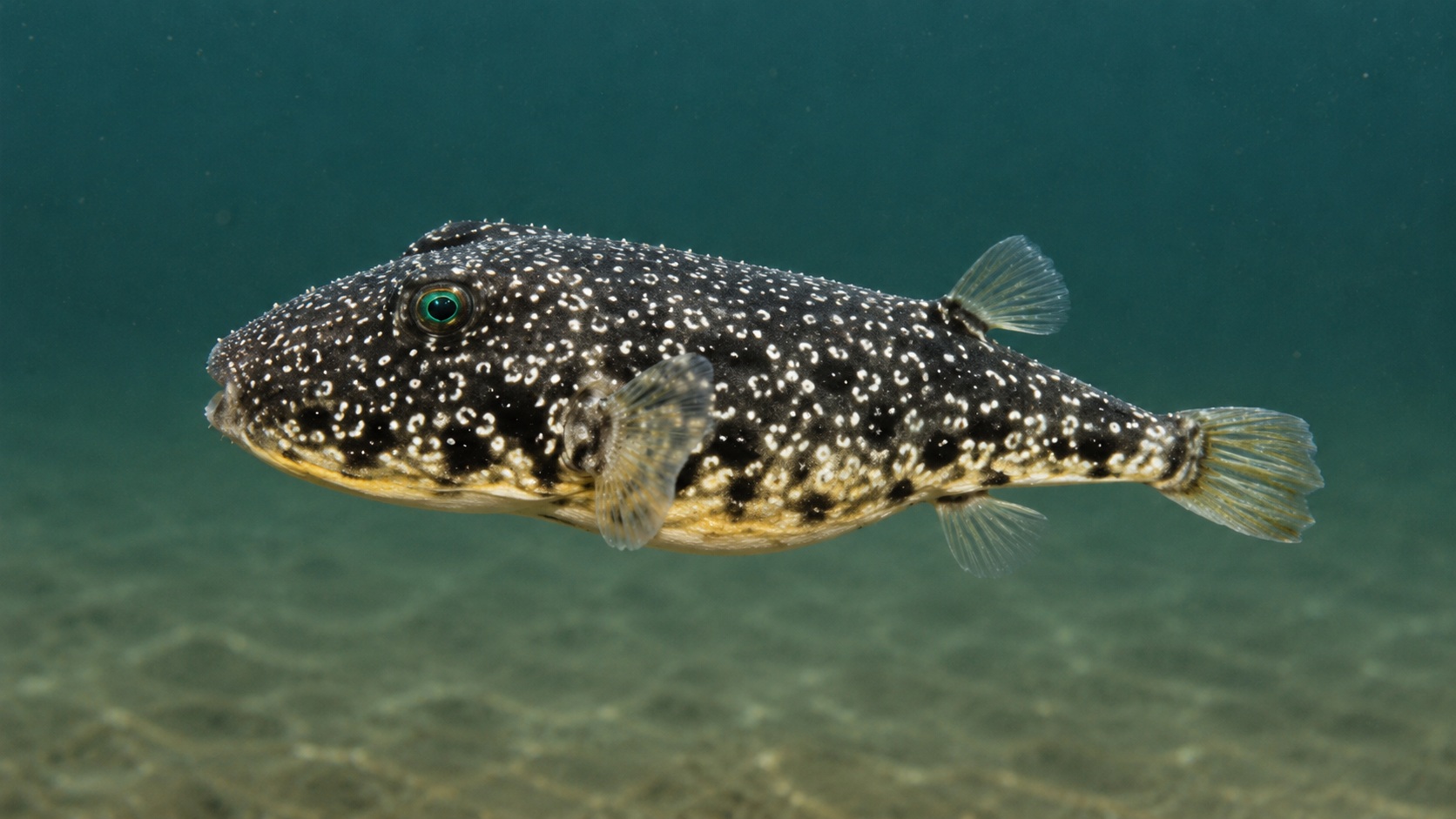
Southern Puffers are small and distinctive. Most fish you catch will run between 4 and 10 inches in total length, though the species can reach up to about 12 inches. The body shape is instantly recognizable once you have seen one: short, rounded, and thick through the midsection, tapering quickly to a narrow tail.
The skin has no true scales. Instead, it is covered in small, stiff prickles that lie flat when the fish is relaxed and stand fully erect when inflated. Run a finger along the back of a relaxed puffer and you can feel them — it is a texture somewhere between fine sandpaper and a cactus, depending on how agitated the fish is.
Coloration on the dorsal (top) surface is mottled olive-brown to grayish-brown, with irregular darker blotches, pale reticulations, and faint rings. The pattern looks roughly cloud-like or marbled, not striped or solid. The ventral (belly) surface is pale white or cream. There is often a distinctive dark spot at the base of the pectoral fins, visible when you look at the fish from the side.
The mouth is small and beak-like. The teeth of a puffer are fused into four hard tooth plates — two on top and two on bottom — that come together like a parrot’s beak. These are designed for cracking shells and crushing hard invertebrates, and they are strong enough to hurt if you get a finger near them. Keep your fingers clear of the mouth.
The Southern Puffer has no pelvic fins. Four fins are present: pectoral fins (on the sides, behind the head), one small dorsal fin far back on the body, one anal fin directly below it, and a rounded tail fin. The placement of the dorsal and anal fins so far back gives the fish its characteristically stubby, front-heavy silhouette.
Along the Atlantic and Gulf coasts you may also encounter the Bandtail Puffer (Sphoeroides spengleri), which shows a row of prominent dark spots running along its lateral line, and the Checkered Puffer (Sphoeroides testudineus), which has a more geometric, tile-like pattern on its back. All puffer species in the genus Sphoeroides should be handled and released the same way — none are safe to eat.
Is it dangerous?
Yes. This is the most important section on this page. Read it before you handle the fish.
Southern Puffers carry tetrodotoxin, abbreviated TTX. Tetrodotoxin is one of the most potent non-protein neurotoxins known to science — it is roughly 1,200 times more toxic than cyanide by weight. The toxin is concentrated in the fish’s skin, liver, gonads (ovaries and testes), and intestines. The muscle flesh contains lower concentrations, but it is not considered safe.
The critical point that surprises most people: cooking does not neutralize tetrodotoxin. Boiling, frying, grilling, baking — none of it breaks down TTX. You cannot make this fish safe to eat through heat. If you eat a Southern Puffer, you are eating the toxin.
TTX works by blocking the voltage-gated sodium channels that nerves and muscle cells use to fire. When those channels are blocked, signals cannot propagate. Nerves stop conducting. Muscles stop responding. Symptoms after ingestion typically begin within 30 minutes to 6 hours and follow a predictable progression: tingling and numbness starting in the lips and around the mouth, spreading to the face, then the extremities, then the entire body. Nausea and vomiting follow. In moderate to severe cases: muscle weakness, difficulty speaking, difficulty swallowing, loss of coordination, dropping blood pressure, and paralysis. In the most severe cases, paralysis reaches the respiratory muscles, breathing stops, and without mechanical ventilation the patient dies.
There is no antidote. There is no medication that reverses tetrodotoxin poisoning. Treatment is entirely supportive — doctors keep the patient breathing and wait for the toxin to clear the body, which can take 24 hours or longer. Even with excellent hospital care, deaths have occurred.
You may have heard of fugu, the Japanese puffer fish delicacy. The reason fugu requires a specially licensed chef with years of dedicated training is precisely because the preparation must remove every organ and tissue that carries TTX concentration without contaminating the remaining muscle. In Japan, chefs train for three or more years before they are permitted to serve fugu, and even then, preparation errors have historically been lethal. There is no equivalent licensing, training, or regulatory approval framework for puffer fish preparation in the United States.
Regarding handling: briefly handling a Southern Puffer with normal precautions is not dangerous. You do not need to panic. The toxin is not absorbed through intact skin in any meaningful amount during the brief contact of unhooking. The concern with handling is: do not touch your eyes, nose, or mouth after handling the fish without washing your hands first. The skin and body fluids of a stressed puffer can carry TTX on the surface, and mucous membranes are more permeable than intact skin. Wash your hands with soap and water after any contact. Do not stress the fish more than necessary — a fish under extreme stress releases additional toxin-laced mucus from the skin, which can irritate eyes and mucous membranes on contact.
Brief, calm handling, followed by a clean release, is not a health risk. Eating the fish is.
Where it comes from
The Southern Puffer ranges along the Atlantic coast from New York south through the Gulf of Mexico, the Bahamas, the Caribbean, and into the Yucatan Peninsula. Along the Atlantic seaboard it is most reliably encountered from the Carolinas southward, though warm-season strays reach as far north as New England. Throughout the Gulf Coast states — from the Texas bays and Louisiana marshes east through Mississippi, Alabama, and the Florida Panhandle — it is a routine inshore presence from spring through fall.
This is a shallow-water, bottom-oriented species. It is most commonly found over grass flats, on sandy or muddy bottom in estuaries and bays, around oyster bars, near mangrove edges, and over nearshore structure. It tolerates brackish water and is a common resident of tidal creek mouths, seagrass meadows, and protected coastal lagoons. Good representative habitats include the grass flats and tidal marshes of the South Carolina and Georgia coasts, the shallow bays and barrier island lagoons of the Gulf Coast, and the estuarine systems of the Carolinas through northeast Florida. Adult Southern Puffers tend to remain inshore — they do not migrate to offshore depths the way some related species do.
The diet matches the habitat. Southern Puffers eat hard-shelled invertebrates: crabs, shrimp, small clams, oysters, barnacles, small sea urchins, and other bottom-dwelling organisms. Those fused beak teeth are purpose-built for this — the fish bites down on a shell-covered crustacean or mollusk and cracks through it. That feeding behavior explains why Southern Puffers hit bottom baits readily and with apparent confidence. A puffer does not really distinguish between a small clam buried in the bottom and a piece of shrimp on a hook.
When to expect them
Southern Puffers are warm-water fish. Activity peaks when inshore water temperatures are in the range of 68 to 85°F. Below about 60°F they become sluggish and largely disappear from the catch.
What that means in practice depends heavily on where you are fishing. Along the Gulf Coast and in South Florida, puffers show up in the catch as early as March and remain active into November or December in mild years — a long productive window. In the Carolinas and the mid-Atlantic states, the season compresses: fish become active in late spring as water temperatures climb past the mid-60s, are most common through summer, and taper off by late October as water cools. The further north you fish within the species’ range, the shorter the window and the later it arrives.
Tidal movement matters regardless of location. Puffers feed actively on moving water, especially incoming tides that push baitfish and invertebrates onto grass flats and into estuary edges. Slack water tends to slow the bite across the board.
On the Table
Do not eat this fish.
That is the complete answer, and it is not a cautious overreaction. It is the correct guidance for any recreational angler in the United States who catches a Southern Puffer. There is no preparation technique available to a home cook, or even to an experienced chef without specific tetrodotoxin training, that makes this fish safe to consume.
The fugu tradition is sometimes cited as proof that puffer fish can be eaten. That is technically true, but the context matters enormously. Fugu preparation in Japan involves specific species of Takifugu puffers (not Sphoeroides), trained and licensed specialists, a strict protocol for removing every contaminated organ and tissue, and centuries of accumulated knowledge about which tissues carry toxin and at what concentrations. Even in that system, with professional preparation under regulatory oversight, fugu-related deaths still occur. The cheeks — thick blocks of muscle behind the jaw — are the primary edible cut in fugu preparation, but only when handled by someone who knows exactly which tissues must be separated and discarded.
In the United States, there is no licensing system, no regulatory approval process, and no trained specialist network for preparing American puffer fish as food. The FDA advises that domestic puffer fish should not be consumed by recreational anglers. Some states along the Atlantic coast have enacted specific harvest prohibitions or restrictions on Sphoeroides puffers in certain areas specifically because of documented poisoning cases.
Release every Southern Puffer you catch. This is not a fish that is almost safe to eat, or safe under certain conditions, or safe if you know what you are doing. For a recreational angler, it is simply not food.
Regulations
Regulations for Southern Puffer vary by state. Some states have specific harvest restrictions or closed areas for this species; others regulate it under general finfish rules. Because tetrodotoxin poisoning from wild-caught puffers is a documented public health issue in the United States, several states have taken additional protective measures beyond standard bag limit frameworks.
Always check with your state fish and wildlife agency before retaining any puffer. Given that the species is strongly recommended as catch-and-release by fisheries managers and health authorities across its range, the simplest approach is to release every Southern Puffer you catch.
What to do with it
Once the fish is out of the water and you are ready to deal with it, move efficiently.
Wet gloves are ideal if you have them — they protect your hands from the prickles on an inflated fish and reduce mucus contact. Bare hands are acceptable for a brief unhooking if you wash thoroughly afterward. Do not wear dry cloth gloves, as the prickles can snag the fabric when the fish inflates.
Grip the fish firmly but without squeezing. The best hold is just behind the head, with your thumb and forefinger positioned on either side of the pectoral fin bases. Avoid pressing on the inflated belly.
Use needle-nose pliers for hook removal. Work the hook out with the pliers rather than your fingers. If the hook is set shallowly, this takes only a few seconds. If the hook is swallowed deeply, do not dig for it. Cut the leader as close to the hook eye as you can and release the fish. Circle hooks significantly reduce deep-hooking in areas with heavy puffer activity and are worth using if you are fishing a spot where puffers are thick.
Do not squeeze the fish, shake it, or drop it onto a hard deck surface. A puffer that inflates on deck and cannot deflate quickly is under genuine physiological stress. Keep handling time under 30 seconds if you can.
Lower the fish back into the water gently. If it is still inflated, hold it just below the surface in an upright position and wait — the fish will deflate and swim away on its own once it calms. Do not force it down or throw it. A fish returned to the water upright, without being thrown, has a very good survival rate from a catch-and-release encounter.
After handling: wash your hands with soap and water before eating, drinking, or touching your face.