A note about links: If we include links to retail sites like Amazon or Bass Pro Shops, it's because they're relevant to the topic and, as anglers ourselves, we believe they're worth checking out. As an Amazon Associate we earn from qualifying purchases.
Every summer, a pulse of warm blue water pushes toward the Pacific Coast carrying one of the most sought-after sport fish on the West Coast with it. Albacore do not show up at the dock or even near the kelp beds. You earn them by running 40 to 100 miles offshore until the water turns that deep cobalt blue and the surface temperature climbs past 60 degrees. When you find the right water and a school erupts around your boat, everything happens fast. These fish crash lures, chum after live bait, and fight all the way to the rail, and after the bite is over, you go home with some of the best canning and grilling fish available anywhere on the coast.
How to identify one
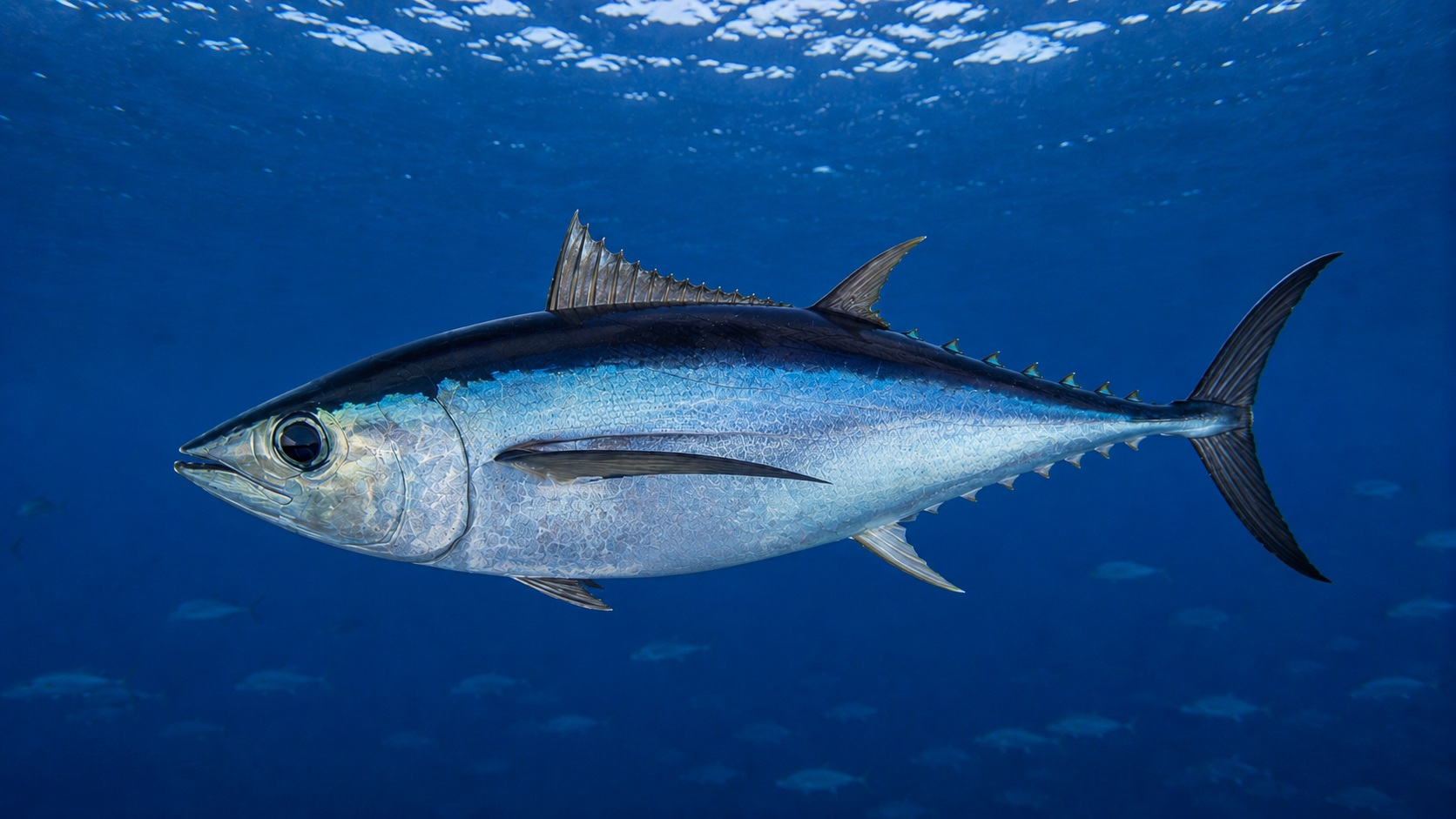
Albacore are the only tuna species with pectoral fins that extend well past the second dorsal fin, sometimes reaching nearly to the tail. That single feature is enough to separate them from yellowfin, bigeye, and bluefin in a crowded fish box. The back is dark metallic blue fading to silver-white on the belly, with a faint lateral line that can flash iridescent blue-green in sunlight. The tail has a white trailing edge that is visible when the fish is brought aboard. Juvenile albacore can look similar to small bonito, but the long pectorals are diagnostic at any size.
Where to find them
Albacore are a creature of the open ocean. On the Pacific Coast they follow the 62 to 68 degree Fahrenheit isotherm, which puts them anywhere from 40 to 200 miles offshore depending on the year and the current. The North Pacific Current pushes warm water northeast from Hawaii each summer, and albacore travel with it.
Oregon and Washington anglers typically find them first, with fish showing up off Westport, Ilwaco, Neah Bay, Newport, and Charleston in July. The fleet out of Westport is one of the most active albacore operations on the coast. Northern California ports including Fort Bragg, Bodega Bay, and Half Moon Bay pick up the run next, with Central California following. San Diego long-range boats run 100 to 200 miles offshore for larger fish in the 40 to 60-pound class, sometimes into November. The productive zone in any given week is the temperature front where blue offshore water meets greener coastal upwelling water. That color change holds bait, and albacore hold on bait.
When to go
July through October is the core Pacific albacore season from Northern California through Washington. August and September are the most reliable months across the Pacific Northwest, when fish are closer to shore and weather windows are more manageable. California anglers have a wider window, with some years producing fish into November off the southern ports.
Sea surface temperature charts from NOAA, Fishtrack, or Roffs are essential trip-planning tools. When the 62 to 65 degree water is sitting 40 to 60 miles out, day trips are practical. When it pushes past 80 miles, overnight or 1.5-day trips produce better results and more time on fish. Bird activity on the surface, especially mixed flocks working a bait ball, is a real-time indicator worth more than any chart once you are on the water.
What to throw
Cedar plugs are the foundation of any Pacific albacore spread. They have been catching albacore on this coast for more than 80 years and there is no better starting point. Run them at 6 to 9 knots in a staggered spread of four to six rods, mixing distances from 20 to 100 feet behind the boat. Chrome, pink, and natural wood finishes all produce.
Feathers and skirted trolling lures round out the troll spread. Single-hook rigged feathers in blue-and-white or pink-and-white work especially well when fish are active near the surface. Run them on 40 to 60-pound fluorocarbon leaders, 4 to 6 feet long, to prevent bite-offs without spooking fish.
Live anchovies become the primary weapon once a school is raised and working behind the boat. Keep the chum slick going with steady small handfuls of live bait and pitch free-lined anchovies on Eagle Claw circle hooks in 1/0 to 3/0. Let the bait swim naturally without any added weight. If the chum slick breaks, the school disperses, so maintain it until the bite dies.
Casting jigs close the deal on boiling surface schools. Chrome, white, and blue finish metal jigs in the 2 to 4 ounce range work well. Cast past the school and retrieve through the edge of the bait ball at a medium-fast to fast pace rather than dropping the jig into the center, which spooks fish. The Epic Casting Jig and Ahi Assault Diamond Jigs are reliable options. Have spinning rods rigged and ready before you arrive at a school because the window can be short.
Regulations
Pacific albacore tuna are managed federally under the NOAA Fisheries West Coast Highly Migratory Species Fishery Management Plan, with regulations at 50 CFR Part 660. For recreational anglers fishing north of Point Conception (34 degrees 27 minutes N latitude, near Santa Barbara) the federal daily bag limit is 25 albacore per angler. South of Point Conception in California state waters and the adjacent EEZ, the limit drops to 10 albacore per angler. There is no minimum size limit anywhere in the federal Pacific management zone.
Oregon and Washington do not impose separate state bag limits for albacore in ocean waters, so the federal limit applies. Always carry your current state fishing license and any required ocean enhancement validation. Because regulations for highly migratory species can change between seasons, verify current rules directly with NOAA Fisheries West Coast Region before your trip.
Authoritative regulation source: https://www.law.cornell.edu/cfr/text/50/660.721
Handling and release
Albacore are a targeted keep fishery with outstanding table quality. The white, mild meat is the basis for premium canned tuna and is also excellent grilled, smoked, or seared. Bleed fish immediately at boatside by cutting the gill arch and placing them in a slush ice mix. Avoid letting fish bake on a hot deck before going into the cooler. Properly bled and iced albacore hold quality for several days.
If a fish is to be released, handle it briefly with wet hands, keep it in the water as much as possible, and support the body horizontally. Albacore are built for sustained speed and recover well from short fights if returned quickly. In practice most Pacific albacore trips are keep fisheries, but any undersized or accidental bycatch should be released without hesitation.
On the Table
Albacore tuna is a world-class table fish, prized by anglers and chefs alike for its clean, mild flavor and firm, meaty flesh. It is one of the most-kept offshore species on both the Pacific and Atlantic coasts, and for good reason: fresh albacore is a completely different experience from the canned product most people know.
Taste and texture: Albacore has a mild, slightly sweet flavor with far less “fishiness” than larger tuna species. The flesh is pale pink to off-white when raw, firming up to a light tan when cooked — earning it the “white tuna” label in the canning industry. Texture is firm and dense, with a moist, meaty bite that holds up well to high heat and bold preparation.
Best preparation methods:
- Seared rare or sashimi-grade raw: Fresh albacore shines brightest as sashimi or a quick sear. The mild flavor and clean flesh reward minimal handling. Slice thin for crudo, or sear a center-cut loin 60-90 seconds per side over screaming-hot cast iron for a rare center.
- Grilling: Albacore steaks and loins grill beautifully. The dense flesh does not fall apart on the grate. A light oil rub, high heat, and a brief rest produce a moist result with good char. Avoid overcooking — albacore dries out quickly past medium.
- Smoking: Cold- or hot-smoked albacore is outstanding. The mild fat content accepts smoke readily without becoming greasy. Hot-smoked albacore makes excellent dips, spreads, and chowder bases.
- Tataki or marinade-based preparations: Because the flesh is neutral in flavor, albacore takes well to bold Japanese-style or citrus-forward marinades. A quick soy-ginger tataki treatment complements the natural sweetness without overwhelming it.
Handling for table quality: Bleeding immediately at boatside is the single most important step for albacore. Cut the gill arch or sever the tail and let the fish bleed into a bucket of saltwater for several minutes before icing. Albacore are warm-blooded fish and their core temperature spikes fast after death — get them into a slush ice brine (saltwater ice mix) as quickly as possible. Loins cut right down the lateral line off the backbone. Remove the bloodline from each loin for the mildest flavor, especially on larger fish.
Mercury concerns: Albacore tuna carries a moderate mercury load — higher than canned light tuna (skipjack), which the FDA classifies as a “best choice.” Canned albacore (white tuna) falls in the FDA’s “good choice” category. For fresh whole albacore, the FDA advises limiting consumption to one serving per week for pregnant women and children. Healthy adults eating fresh-caught albacore occasionally have little reason for concern, but large, older individuals will carry more mercury than smaller fish.