A note about links: If we include links to retail sites like Amazon or Bass Pro Shops, it's because they're relevant to the topic and, as anglers ourselves, we believe they're worth checking out. As an Amazon Associate we earn from qualifying purchases.
What is it?
The Northern Anchovy is the West Coast equivalent of the Atlantic menhaden — a small, fast-moving, schooling fish that nearly everything in the ocean wants to eat. It runs from the Queen Charlotte Islands in British Columbia south through California and down to Cabo San Lucas in Baja California, and it forms the base of the food web everywhere in its range.
Everything important in the Pacific hunts anchovies. California halibut, lingcod, white seabass, calico bass, and Pacific striped bass in San Francisco Bay all eat them. Offshore, yellowtail, albacore, and Pacific bluefin tuna pile on anchovy schools like they are on the clock. Marine mammals and seabirds work the same schools from above. If the anchovy population drops, the ripple effect goes all the way up the chain.
Commercially, anchovies have fueled two industries for over a century: reduction fisheries that convert them to fish meal and fish oil, and a live bait supply chain that runs up and down the Southern California coast. Bait receivers at marinas from San Diego to Morro Bay receive anchovy deliveries and sell them to sport anglers by the scoop. Party boats in Southern California keep hundreds of pounds of live anchovies in round bait tanks throughout every trip. In 2024, commercial landings topped nearly 10 million pounds. For a fish that rarely exceeds seven inches, that is a lot of material moving.
Northern Anchovies spawn year-round with peak activity from February through April. They rarely live beyond four years. They feed by filtering plankton, which means a healthy anchovy population tracks directly with water quality and temperature — one reason anchovies serve as an indicator species for coastal ecosystem health.
How to identify one
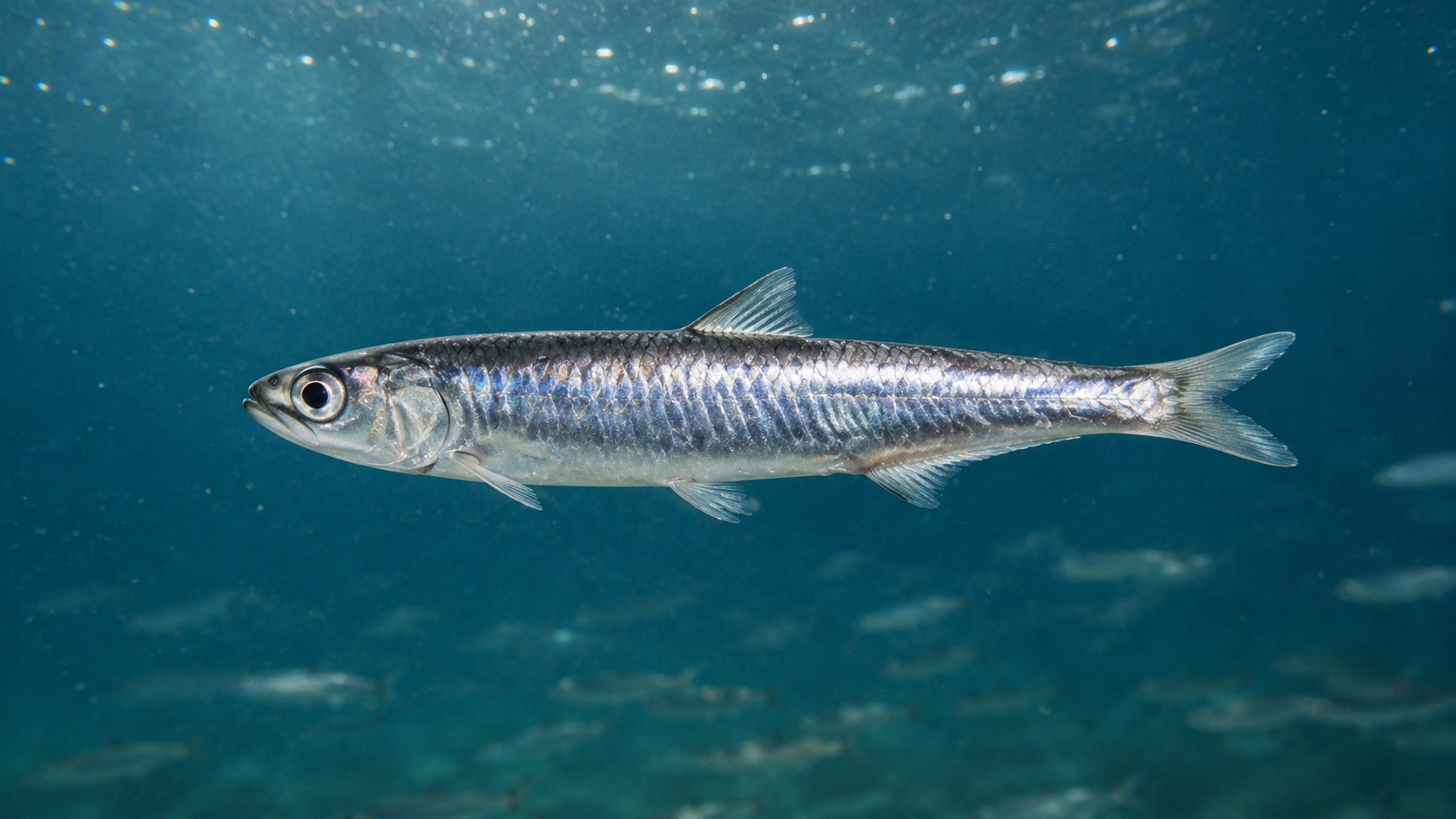
A Northern Anchovy in your hand is easy to identify once you know the two key features: the overhanging snout and the enormous mouth.
Most small silvery fish have a mouth that ends somewhere before the eye. On an anchovy, the mouth extends well past the eye — when you open it, the gape is almost comically large for the fish’s size. The snout is blunt and rounded and protrudes noticeably over the lower jaw. These two traits together separate anchovy from everything else you might confuse it with.
Color: blue-green to iridescent green on the back, fading to silver on the sides and belly. Adults often show a faint silver lateral stripe. Live fish have a metallic shimmer that fades fast once they die.
Size: most anchovies you will handle run 3 to 5 inches. Older fish can reach 7 inches, which is about the practical maximum for the species.
Body shape: round and elongated, noticeably slender compared to a sardine. If you are comparing it to a Pacific sardine, the sardine is deeper-bodied, has a smaller mouth that does not reach the eye, and shows distinct dark spots along the upper sides. A smelt looks similar in size and color but has a small adipose fin (a fleshy fin between the dorsal and the tail) and a narrower mouth. Anchovy has no adipose fin and a much larger gape.
The overhanging snout plus the huge mouth plus no adipose fin equals anchovy. That combination does not match anything else on the California coast.
How to catch your own
Anchovies school in bays, harbors, the surf line, and around structure from the surface down to mid-column. You do not need specialized gear to catch them, but you do need to find the school.
Dip net at night under lights. This is the most effective method for private boaters and pier anglers. Anchovies are drawn to light at night. Hang a lantern or run a submersible light off a dock or the side of a boat, and schools will gather below the light within 20 to 30 minutes. Use a fine-mesh dip net and scoop them up. Work quickly and gently — they die from handling stress faster than almost any other baitfish.
Cast net in bays and harbors. During daylight hours, look for the nervous water that indicates a bait ball: surface rippling, birds working, or a visible dark mass just below the surface. A 6- to 8-foot cast net with a fine mesh is the tool. Throw on the school, not behind it. Anchovies spook faster than sardines or mullet, so approach slowly.
Sabiki rigs off piers and docks. Use size 10 or 12 hooks on a multi-drop Sabiki leader. Drop to mid-column where the school is holding and jig slowly. Anchovies are not aggressive biters — you are essentially snagging them as they move through the hooks. This is more productive when the school is dense and active.
When to find them. Anchovies are present year-round in most of their range, but concentrations shift. In Southern California, bait receivers typically have them available spring through fall, with availability tightest in winter. In San Francisco Bay, late summer and fall often produce the largest inshore schools.
Party boats in Southern California provide anchovies as part of the trip — you board with live bait already in the tanks. If you are running your own boat and buying from a bait receiver, arrive early when the bait is freshest.
Keeping them alive
Anchovies are among the most fragile baitfish you will ever handle. They bruise internally from net contact, die from low oxygen within seconds, and are extremely sensitive to temperature. Keeping them alive requires attention to three things: tank shape, oxygen, and water temperature.
Circular tanks only. Anchovies are continuous swimmers. In a rectangular tank, they hit the corners and die. All party boats and serious live-bait anglers use round bait tanks that let the fish swim in uninterrupted circles. If you are keeping them in a bait bucket, use a round one.
High oxygen. Run an aerator constantly. If you are transferring them from a bait receiver to your own tank, do it quickly with an aerated scoop — do not expose them to open air. Crowding kills them fast; do not overload the tank.
Cold water. Anchovies prefer water in the upper 50s to low 60s Fahrenheit. In warmer water, they consume oxygen faster and die sooner. If you are fishing in summer, cycle fresh cool seawater into the tank periodically to keep the temperature down.
When you buy bait from a receiver, the fish arrive stressed from transport. Give them 15 to 20 minutes in your tank to recover before fishing. Use a soft mesh bait net to transfer them to the hook — bare hands warm the fish and damage the slime coat.
Dead anchovies still catch fish, particularly for bottom species. If your live bait dies, keep it on ice and use it for cut bait. Do not waste it.
How to rig it
Nose hook. The standard for all live-bait applications. Run the hook point up through the lower jaw and out the nose from below. The fish hangs naturally and swims with a kicking action that predators key on. Use a light wire hook, size 1 to 1/0. Heavy hooks bog the fish down and reduce swimming action.
Collar hook (shoulder hook). Hook through the membrane just behind the head near the pectoral fin. This produces a slightly more erratic action. Better for calico bass fishing under a float, where you want the bait working a specific depth with more movement.
Free-lined for halibut. No weight, no float. Nose-hook the anchovy and let it swim on its own. Cast upcurrent or let it drift back from the boat. California halibut respond to a live anchovy moving naturally near the bottom. Keep tension light and let the fish run before setting.
Under a float for calico bass. Set the float 4 to 6 feet above the bait. Work it around kelp edges, rocky structure, and jetty pilings. The anchovy will try to swim down and away from the float, producing constant movement.
Butterfly cut for trolling. For albacore and bluefin tuna when live bait is not available, cut the head off at an angle and open the body flat, leaving both fillets attached at the tail. Trolled slowly, this produces a wide, fluttering swimming action.
Chunk cut for rockfish and lingcod. Cut the anchovy into thirds and fish it on a dropper loop rig near the bottom. Fresh-dead anchovy is very effective for lingcod on a slow drift.
Flyline for yellowtail. No weight. Nose-hook the anchovy and cast it to a working school or let it swim free on the surface. Yellowtail will come up for a properly presented live anchovy, but the presentation needs to look unrestrained. Any added weight kills the effect.
What it catches
California Halibut. Free-lined live anchovy near the bottom is one of the top presentations for halibut in Southern California bays and nearshore areas. Keep the bait moving and give the fish time to get the anchovy fully before setting the hook.
Lingcod. Cut anchovy fished deep on a weighted rig, or a live anchovy dropped to rocky structure. Lingcod are not picky, but fresh bait consistently outperforms stale.
White Seabass. A live anchovy under a float or free-lined at night near kelp beds is a top white seabass presentation. White seabass are sensitive to boat pressure — fish quietly and keep the bait swimming naturally.
Calico Bass. Collar-hooked under a float around kelp edges and structure. Calico bass compete aggressively over anchovies near cover.
Pacific Striped Bass. In San Francisco Bay and along the Central California coast, live anchovies are a primary bait for stripers from late summer through fall. Fish them under a float in the shallows or free-lined on a slow drift.
Yellowtail. The premier live bait for yellowtail in Southern California. A flylined live anchovy into a working school produces strikes that other presentations cannot match. Kite fishing with live anchovies is also highly effective.
Albacore Tuna. Live anchovies are used for chumming and for direct presentation when albacore come to the boat. A nose-hooked anchovy pitched into a boil of feeding albacore rarely makes it three feet before getting eaten.
Pacific Bluefin Tuna. Same approach as albacore. When bluefin are boiling on bait, a live anchovy is what anglers on the boat are throwing.
On the Table
Fresh Northern Anchovy bears almost no resemblance to the salt-cured anchovy from a tin. Fresh anchovies are mild by comparison, with a clean, rich, oily flavor. The flesh is soft and delicate — think of a very fresh herring, just smaller. The intense, salty, pungent quality of canned anchovies comes entirely from the curing process, not from the fresh fish.
Fried whole. The simplest and best preparation. Gut and rinse the fish, pat dry, dredge in seasoned flour or cornmeal, and fry in hot oil for 2 to 3 minutes per side. The small bones soften in the fry and are edible — most people eat the whole fish. Serve with lemon and salt. This is how fresh anchovies are eaten across coastal Spain, Italy, and Japan, and it works just as well in California.
Marinated (boquerones style). Clean the anchovies, butterfly them open, and marinate in white vinegar or lemon juice for 2 to 4 hours until the flesh turns opaque. Rinse, dress with olive oil, garlic, and parsley, and serve cold. This is boquerones in Spain and is a genuinely excellent cold preparation.
Cured. Layer cleaned anchovies with coarse salt in a jar and refrigerate for at least 24 hours. Rinse before use. You can make high-quality cured anchovies this way — often better than commercial products because you control the freshness of the starting fish.
The key requirement for all preparations is freshness. Anchovy flesh degrades quickly after death. Fish that have been dead more than a few hours on ice can still be used as cut bait, but they will not make good eating. If you are going to keep anchovies for the table, kill them immediately and put them directly on ice. Remove the guts before cooking — they contribute bitterness. California Sea Grant notes that it is important to rinse the fish well before cooking since anchovies are filter feeders.
California anglers do not often target anchovies specifically for food, but anyone who keeps a few fresh ones and fries them whole will understand why every coastal fishing culture in the world has a tradition of eating them.