A note about links: If we include links to retail sites like Amazon or Bass Pro Shops, it's because they're relevant to the topic and, as anglers ourselves, we believe they're worth checking out. As an Amazon Associate we earn from qualifying purchases.
Stand at the water’s edge just before sunrise on a Massachusetts beach in October and you will understand why striped bass fishing is more than a hobby for hundreds of thousands of East Coast anglers. The combination of that pre-dawn chill, the crash of surf, the explosive strike of a large predator, and the raw physical demand of fighting a 30-pound fish through breaking waves adds up to something genuinely addictive. Stripers are not the easiest fish to learn, but the payoff, whether it’s a schoolie at your feet or a thick cow in the suds, builds a loyalty that keeps people coming back decade after decade. This is the defining saltwater target of the Northeast, a fish that has shaped the culture of coastal fishing from Cape Cod to the Chesapeake.
How to identify one
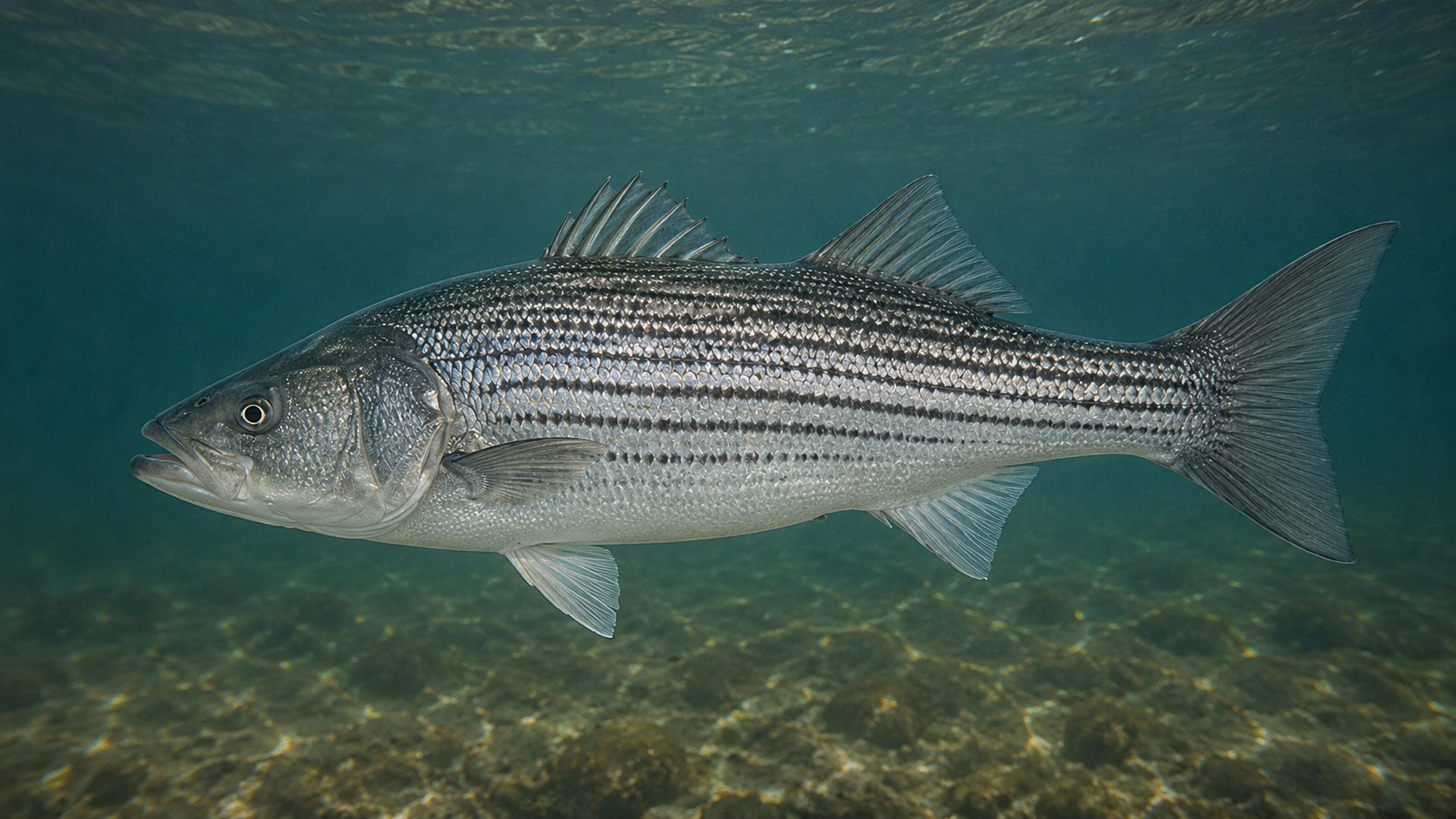
Striped bass are hard to mistake once you have seen a few. They are silver to olive-green along the back, fading to a clean white belly, with seven or eight bold horizontal black stripes running the full length of the body from just behind the gill plate to the tail. The stripes are the signature field mark and they hold true even on very large fish. The body is elongated and muscular, the jaw wide, and the two dorsal fins are clearly separated (the first has stiff spines, the second is soft-rayed). The tail is forked but not deeply so. Young stripers are sometimes confused with white perch or white bass in rivers, but neither of those species carries those continuous, unbroken horizontal lines. A hybrid striped bass (striper crossed with white bass, common in inland reservoirs) shows interrupted or wavy stripes rather than the crisp, full-length lines of a true wild striper.
Where to find them
Striped bass are anadromous, meaning they live in salt water but move into freshwater rivers to spawn each spring. The Chesapeake Bay system and its tributaries (the Susquehanna, Potomac, and Rappahannock rivers), the Hudson River in New York, and rivers across New England are the primary spawning grounds on the East Coast. After spawning, juveniles spend two to four years in estuaries before migrating to the Atlantic. Adult fish follow a seasonal north-south migration along the coast: Chesapeake fish push through Delaware Bay and New Jersey in spring, join fish from the Hudson off Long Island and New England through summer, and the whole parade reverses in fall. Prime named waters include Montauk Point (NY), the Elizabeth Islands and Cape Cod Canal (MA), Narragansett Bay (RI), the Outer Banks (NC), and the entire New Jersey surf line. The Hudson River holds a resident population that is accessible spring through late fall. Stripers hold in the suds along sandy beaches chasing sand eels and peanut bunker, congregate around rocky points and jetties where current concentrates bait, and push into tidal rivers and back bays, especially at night.
When to go
Spring and fall are the peak windows because they align with the coastal migration when concentrations of fish are densest and fish are actively feeding. On the mid-Atlantic and New England coast, the spring run typically hits from late April through June as water temperatures climb above 50 degrees F and bait (primarily menhaden, sand eels, and herring) becomes abundant. The fall run, arguably the better of the two, begins in September as water cools, bait pushes toward warmer southern water, and stripers feed aggressively to fuel their migration. October and November can produce exceptional fishing from the surf at spots like Montauk, Cape Cod, and Island Beach State Park in New Jersey. For surf fishing, low-light periods are almost always superior: the two hours around sunrise, the hour before sunset, and the full night are when large fish move in close. Tidal stage matters; a falling tide that drains a back bay or inlet concentrates bait in the outflow, and that transition is reliably productive. Midsummer fishing is slower on the open coast but remains solid in deeper, cooler inlets, nearshore reefs, and in northern New England waters.
What to throw
Live eels are the single most consistent large-striper bait and the same presentation Gregory Myerson used to set the world record. Hook a live eel through the lower jaw on a 5/0 to 7/0 circle hook, add minimal weight (enough to feel bottom but not anchor the eel), and let it swim naturally. Eels work best at night along rock piles, jetties, and reef edges.
Chunked menhaden (bunker) is the standard surf and inlet bait. A fresh chunk of bunker on a 6/0 to 8/0 circle hook under a fish-finder rig (egg sinker on a bead chain slide above a barrel swivel, then a 24-to-36-inch fluorocarbon leader to the hook) broadcasts scent across a wide area and tempts fish you would never cast a lure to. Circle hooks are now legally required when fishing natural bait in most Atlantic states.
Clam and sandworm rigs are beginner-friendly alternatives that work best on smaller schoolie fish. A high-low dropper rig with 2/0 to 4/0 hooks baited with surf clam or bloodworms is effective from sandy beaches and is an excellent starting point for new striper anglers.
Bucktail jigs are the foundational striper lure. A 1-to-4-oz white or chartreuse bucktail with a soft-plastic paddle tail trailer, worked with a slow lift-drop retrieve along the bottom, catches fish in every season and every type of water. The 2-oz AVA diamond jig and similar metal jigs excel in the surf for covering water quickly and for matching sand eel forage.
Topwater plugs are the most thrilling option and most effective from late summer through fall when bait is thick and fish are blitzing. The Daiwa SP Minnow, Yo-Zuri Mag Darter, and classic Danny-style swimmers worked on a slow, steady retrieve through the surface film draw brutal strikes. Poppers and stick baits like the Heddon Super Spook worked with a walk-the-dog retrieve are most effective during morning and evening blitzes.
Soft plastics on a weighted swimbait hook, rigged weedless and worked through current seams, are an excellent choice for back-bay and estuarine fishing. Berkley Gulp! Swimming Mullet in 5- or 7-inch white or chartreuse is a reliable producer and forgiving for beginners learning striper structure fishing.
For the surf, a 10-to-11-foot medium-heavy spinning rod paired with a 6000-to-8000-series reel, 30 lb braid, and a 40 lb fluorocarbon leader is the standard coast-wide setup.
Regulations
Striped bass are managed coast-wide by the Atlantic States Marine Fisheries Commission (ASMFC) in state waters and by NOAA Fisheries in federal waters (3 to 200 miles offshore). Federal waters were fully closed to both commercial and recreational striped bass harvest as of 2024 under rebuilding plan measures. In state Atlantic marine waters, the current coast-wide recreational regulation (in place for 2024 and 2025) is a slot limit of 28 to 31 inches total length with a 1-fish-per-day bag limit. In the Chesapeake Bay, the slot limit is 19 to 24 inches with a 1-fish bag limit. The Hudson River and other specific waters carry separate rules set by individual states. New York marine waters use the 28-to-31-inch slot, while Massachusetts, New Jersey, Connecticut, and Rhode Island all apply the same coast-wide ocean slot. Circle hooks are required by regulation when fishing with natural bait in virtually every Atlantic coastal state.
These regulations are subject to change. ASMFC has signaled that new measures are expected to take effect for the 2026 season. Always verify current rules for your specific state and water type before heading out. The authoritative sources are the ASMFC at asmfc.org and your individual state marine fisheries agency. For New England states, confirm with the respective division of marine fisheries. For Mid-Atlantic states, check with NJDEP, NYSDEC, VMRC (Virginia), or MDE/DNR (Maryland) as applicable.
Handling and release
Striped bass are a high-value table fish, with the white, mildly flavored flesh ranking among the best on the Atlantic Coast. Under current slot regulations, any kept fish must fall between 28 and 31 inches (or within the applicable slot for your water), and racks must be retained alongside no more than two fillets per legal fish in states that allow filleting on the water. For release fishing, keep the fish wet at all times and avoid squeezing the body or lifting a large fish vertically by the jaw, which stresses the spine. Support the belly horizontally. Stripers are hardy fighters but can be exhausted by a long battle; revive the fish by holding it upright in the water and moving it forward and back gently until it kicks away under its own power. If the fish was caught from very cold surf or very warm summer water, take extra time with revival. The striper population is under a formal rebuilding plan, meaning every released fish counts.
On the Table
Striped bass are genuinely good eating, though their table quality varies more than most species — size, water temperature, and how quickly the fish is handled after the catch all matter. Anglers who prioritize the best flavor keep smaller fish (in the slot where legal) and ice them immediately; large fish over 30 inches tend to develop a stronger, oilier flavor that not everyone enjoys.
Taste and texture: The flesh is white to off-white with a mild, slightly sweet flavor and a clean finish. Texture is firm and moderately flaky, similar to a light-fleshed snapper but with a bit more density. Fish from cold, clean coastal or brackish water eat noticeably better than those from warm inland reservoirs, where the flesh can pick up a muddy undertone.
Best preparation methods:
- Pan-searing or sauteing: The firm texture holds up well to high direct heat. Scoring the skin and searing skin-side down in butter or olive oil renders the fat and crisps the skin without the fillet falling apart — the skin is worth eating when done this way.
- Broiling or oven-roasting: Striper fillets roast cleanly. A light coating of olive oil, lemon, and herbs lets the natural sweetness show without masking the fish.
- Grilling: Works well for larger fillets or steaks cut from bigger fish. The firm flesh won’t fall through the grates, and light char complements the mild flavor.
- Chowder or poaching: For fish that are a bit strong-flavored or for the belly meat, a milk-based chowder or a simple court-bouillon poach tones down any richness and produces a very tender result.
Handling for table quality: Bleed the fish immediately at the gills and get it on ice — this is the single biggest factor in eating quality. Striped bass have a bloodline (a dark lateral strip of red-brown meat running along each fillet) that should be trimmed away before cooking; it carries most of the stronger flavor. Rinse fillets in cold water, pat dry, and keep cold until cooking.
Eating caveats:
- Mercury and PCBs: Striped bass — especially large fish from Atlantic coastal waters and certain rivers (Hudson River fish in particular) — have documented PCB contamination. Many state fish consumption advisories recommend limiting how often you eat striped bass, and some (notably New York) advise against eating Hudson River fish at all. Check your state’s current advisory before eating fish from inland or estuarine waters. Smaller fish and ocean-caught fish generally carry lower contaminant loads.
- Slot limits: Most Atlantic states and many inland jurisdictions use slot or minimum-size limits that restrict which fish are legal to keep. These rules are worth knowing both for compliance and table quality — the fish in the legal slot are often the best eating anyway.