A note about links: If we include links to retail sites like Amazon or Bass Pro Shops, it's because they're relevant to the topic and, as anglers ourselves, we believe they're worth checking out. As an Amazon Associate we earn from qualifying purchases.
What it is
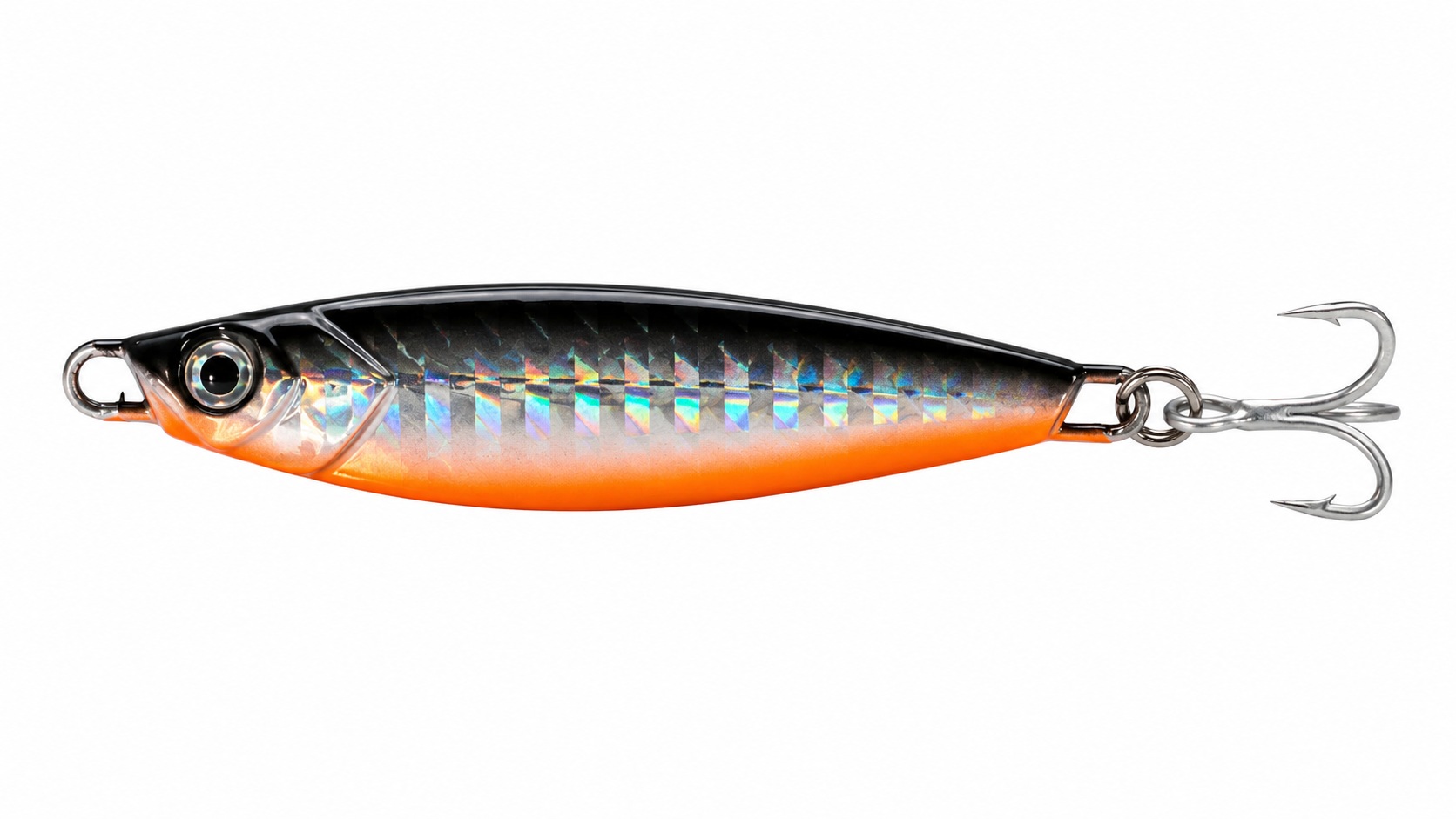
Casting metals are dense, compact lures made from lead, zinc, or stainless steel that are built to do one thing exceptionally well: get out there fast. Their weight-to-size ratio lets you cast them farther than nearly any other lure, which matters when fish are busting bait at the edge of a pier tip, 80 yards out in the surf, or just beyond where a softer lure can reach.
The category includes two main styles. Casting spoons — like the Kastmaster or Hopkins — are flat or slightly cupped metal blanks that wobble and flash on the retrieve, mimicking a fleeing baitfish. The Gotcha plug is a distinct sub-style: a lead or zinc body with a cupped plastic face and an internal rattle. The cup creates resistance and flash at the head while the rattle adds sound. Both styles share the same core appeal: they look like something shiny and hurt, and fast-moving saltwater predators are wired to eat them.
Spanish mackerel, bluefish, and jack crevalle are the primary targets, but casting metals also draw strikes from king mackerel, striped bass, cobia, and greater amberjack when the situation is right.
How to rig it
Casting metals come ready to fish — they ship with a hook attached, usually a treble at the tail. The one setup step that matters most is how you connect your leader to the lure.
Always use a split ring between your snap or line and the lure’s front tie point. Tying directly to the body restricts the lure’s side-to-side movement and kills the action. A small ball-bearing snap swivel works well and makes lure changes faster, though a plain snap also works.
For Spanish mackerel, a 20 lb fluorocarbon leader (12-18 inches) attached directly to the snap is sufficient. Fluoro is nearly invisible underwater and won’t cost you strikes the way wire can.
For king mackerel or large bluefish, switch to a short wire leader — 20-30 lb single-strand or 7-strand — in the 6-12 inch range. Their teeth will cut through mono or fluoro on a single pass. You lose a little action with wire, but with kings it is not optional.
How to fish it
The standard retrieve is fast and straight. Reel as quickly as you comfortably can. Spanish mackerel and bluefish are ambush predators that key on speed — a slow retrieve often produces follows with no strike, while a fast retrieve triggers a reaction hit.
The Gotcha plug also responds well to a jerk-and-pause cadence, especially in current. Twitch the rod tip once or twice, let the lure flutter a beat, then resume the fast retrieve. The pause mimics a stunned baitfish and often draws strikes from fish that are shadowing the lure.
When you spot birds diving or fish pushing bait on the surface, cast past the edge of the commotion, not into the center of it. Let the lure land beyond the swirl and retrieve it through the outside edge. Fish feeding in a school are tracking the bait that is trying to escape — your lure lands where the escaping bait would be.
At pier tips and inlets with current, cast uptide and retrieve with the flow. The current adds action and keeps your lure in the strike zone longer.
When to use it
Spring and fall are the prime windows for casting metals in the Southeast and Mid-Atlantic, when Spanish mackerel and bluefish push through nearshore waters and stage at inlets, pier tips, and along the surf. At locations like Sebastian Inlet and Jetty Park on the Space Coast, those runs can be dense — casting metals are often the first lure in the water when bait shows up.
Summer keeps fish active in the early morning before heat pushes them deeper. The fall run often produces the most consistent action of the year, and casting metals cover water fast enough to stay in front of roaming schools.
Wind is not a serious obstacle here. A 1-oz metal casts into a headwind when a bucktail jig or soft plastic would stall out. That range advantage is real in open surf or from jetty rocks.
Size and weight selection
| Weight | Best Use |
|---|---|
| 1/2 oz | Calmer surf, light tackle, shallower water |
| 3/4 oz | General pier and inlet fishing, moderate current |
| 1 oz | Heavy surf, long casts, strong current |
| 1.5-2 oz | King mackerel offshore, heavy current jetties |
Lighter metals sink slower and work better near the surface when fish are actively blitzing. Heavier metals reach depth faster and punch through wind and current when distance is the priority.
Color selection
| Condition | Color |
|---|---|
| Clear water, bright sun | Chrome / silver |
| Overcast or stained water | Gold or chartreuse |
| Matching local baitfish | White/silver with red head (Gotcha style) |
| Dawn and dusk | Gold |
Chrome is the baseline — it matches the flash of glass minnows, greenbacks, and scaled sardines that these fish are almost always chasing. Red-and-white or red-and-chrome patterns work especially well on the Gotcha plug, where the colored cup and rattling body produce a more aggressive signal.
Gear setup
A medium-heavy spinning rod in the 7-8 foot range handles most casting metal applications. You need enough backbone to work the rod on the jerk-retrieve and enough length to generate distance on the cast. A 3000-4000 series spinning reel spooled with 20-30 lb braided line is standard. Braid transmits the lure’s action directly to your hand, and the thin diameter adds casting distance.
Attach a 2-3 foot fluorocarbon leader via an Albright knot or FG knot. Keep the leader short — you want as much casting length as possible, and with fast-moving fish in open water you rarely need more than 2 feet of leader.
Brands worth knowing
Got-Cha makes the original Gotcha plug, which has been catching Spanish mackerel and bluefish along the Southeast coast for decades. The 1-oz and 1.5-oz versions are the workhorse sizes.
Kastmaster by Acme is a dense stainless spoon that casts exceptionally far for its size. The 3/4-oz and 1-oz models are standard surf and pier lures, and the chrome finish is a proven first choice.
Hopkins produces hammered stainless spoons with a distinctive wobble that has held up for generations of striper and bluefish anglers. The No-Eql and Shorty models are widely available.
Clarkspoon and Sea Striker round out the Southeast staples, both well-known for Spanish mackerel and bluefish inshore work. The Sea Striker Gotcha-style plug is a direct alternative to the original and is easy to find at bait shops along the Florida coast.
Ava jigs are the Northeast standard — denser and more vertical in action, popular for striped bass and false albacore along the Mid-Atlantic and New England coast.