A note about links: If we include links to retail sites like Amazon or Bass Pro Shops, it's because they're relevant to the topic and, as anglers ourselves, we believe they're worth checking out. As an Amazon Associate we earn from qualifying purchases.
Few things in surf fishing compare to the moment a bluefish blitz rolls in. One second the water is calm and the next it is a frothing, chaotic wall of silver and spray as a school of bluefish pins baitfish against the shallows. Every cast gets hit. Rods are doubled over up and down the beach. Whether you are standing on a Cape Cod beach in September, working a New Jersey inlet in October, casting from the Outer Banks during the fall mullet run, or fishing the Virginia surf as the migration sweeps south, bluefish deliver the same electric chaos. These fish are relentless fighters, fast enough to strip drag in seconds, strong enough to bulldogg back to the bottom just when you think they are done, and occasionally acrobatic enough to launch clear of the water on a light rod. They are also one of the most accessible migratory saltwater species on the Atlantic coast, schooling within easy casting distance of the surf and hitting a wide variety of lures and baits. The fall run is a legitimate seasonal event and every angler who fishes the beach should be ready for it.
How to identify one
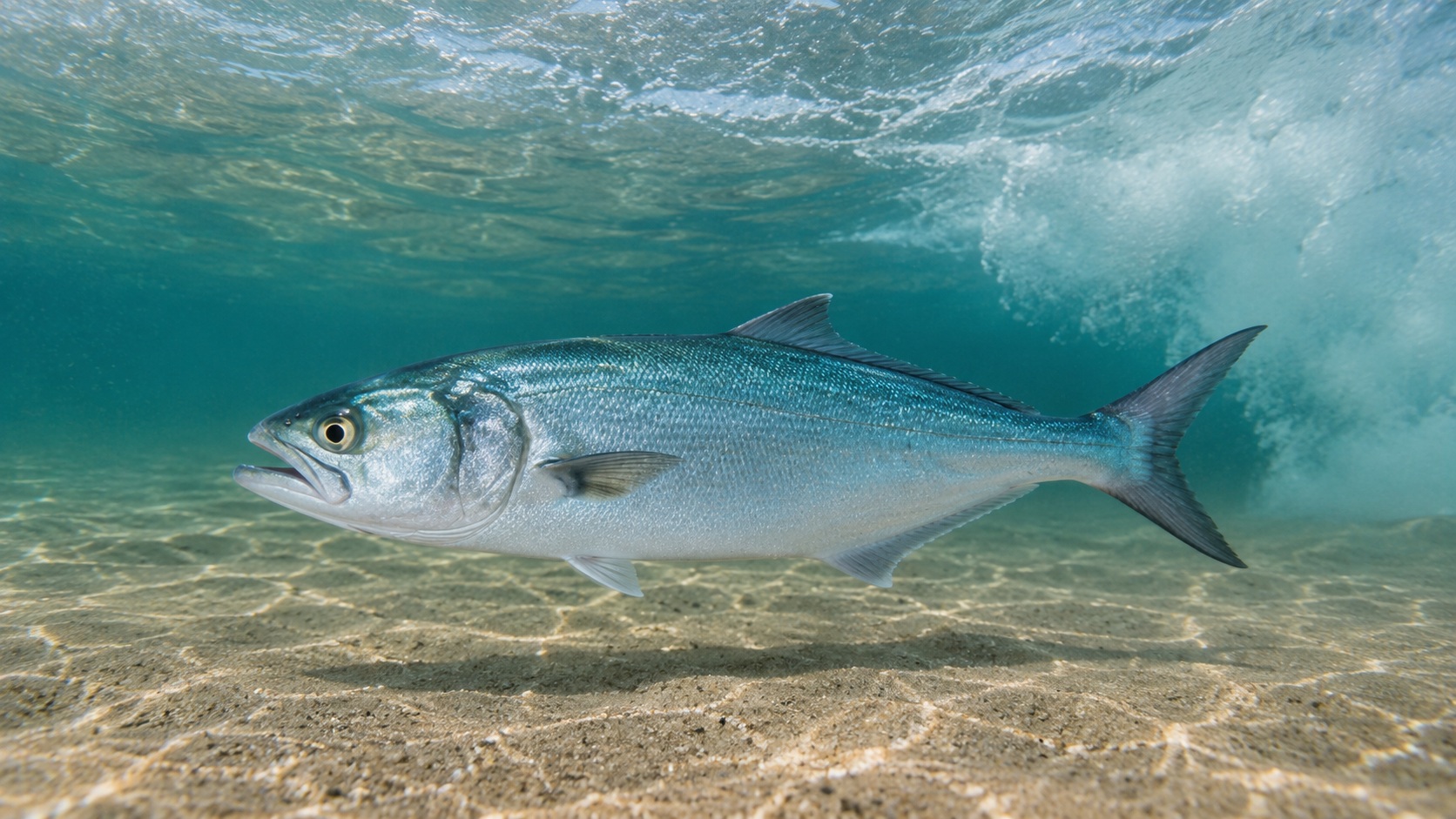
Bluefish are built for speed and violence. The body is elongated and slightly compressed, almost torpedo-shaped, with a large forked tail that delivers explosive power. The back is a distinctive blue-green fading to bright silver on the sides and belly. Look for the sharply pointed lower jaw that slightly undercuts the upper, and the unmistakable teeth: sharp, conical, and arranged in a single row that can cut monofilament like a razor blade. The first dorsal fin is short and spiny; the second is longer and soft-rayed. The combination of that blue-green coloration, powerful forked tail, and jagged single-row teeth is unmistakable once you have seen it.
Bluefish are commonly discussed in two informal size classes. “Snapper blues” are juveniles running 8 to 14 inches, and they are absolutely lethal on ultralight spinning gear. Adult fish in the surf typically run 2 to 8 pounds during the fall run, with occasional “gorilla blues” exceeding 10 to 12 pounds mixed in.
Where to find them
Bluefish are pelagic predators that follow bait. The U.S. Atlantic coast is their primary range, and the fish migrate predictably from north to south each fall, reversing in spring. A few types of locations consistently concentrate fish:
Open surf beaches: Long stretches of ocean-facing beach with troughs, cuts, and points are classic bluefish territory from southern New England to the Carolinas. The fish push baitfish — primarily menhaden, sand eels, and mullet — against the shallows and create the famous surface blitzes that surf anglers wait all year for. The Outer Banks of North Carolina, the beaches of Long Island, and Cape Cod are among the most storied bluefish surf destinations on the coast.
Inlets and jetties: Any inlet that funnels tidal flow concentrates bait and the predators chasing it. Bluefish stack up in the rips around jetty rocks alongside striped bass, Spanish mackerel, and other species. Chesapeake Bay mouth areas, Delaware Bay inlets, and the network of inlets along the New Jersey and North Carolina coasts all produce consistent bluefish action.
Nearshore structure: Offshore from the surf, bluefish hold around wrecks, nearshore reefs, and hard-bottom structure in 30 to 60 feet of water. These fish are regular targets for nearshore trollers and bottom anglers throughout the Mid-Atlantic and Southeast during fall and winter. In the Gulf of Mexico, bluefish are less abundant but show up along the Florida panhandle and Alabama coast.
When scouting for bluefish, watch for diving birds — especially terns and gannets diving aggressively in one spot. That is almost always a predator school pushing bait to the surface. A foaming, discolored patch of water moving along the shoreline is a blitz in progress. Run to it.
When to go
The fall migration is the main event. Bluefish move southward along the Atlantic coast as water temperatures drop, and the timing shifts significantly by latitude. In southern New England and the Mid-Atlantic, peak surf action typically arrives when water temps fall into the mid-60s Fahrenheit — often September through November. Further south along the Carolinas and into Florida, the fish arrive later as they continue the migration, with peak action in colder months.
During the fall, menhaden and mullet push south in massive schools along the same beaches, and the overlap between bait runs and bluefish migration creates the conditions for the famous blitzes. A strong north wind followed by calm conditions often triggers big surface feeds.
The spring migration runs in reverse — fish move north as water temps warm above 60°F, and New England and the Mid-Atlantic see excellent action from late spring through summer. The Chesapeake Bay is a particularly productive bluefish fishery through the warmer months.
Early morning and the last two hours of daylight are traditionally the most productive windows, but during an active blitz, time of day matters very little. If the fish are there, they are feeding.
What to throw
This is the best part about bluefish: during an active blitz, they are not picky. The challenge is having the right hardware so their teeth do not immediately end the party.
Wire leader first. Before discussing any lure, understand that 20 to 40 lb monofilament will be bitten through in seconds. Use a 6-inch single-strand wire leader (size 3 to 6) or at minimum 30 to 40 lb hard monofilament or fluorocarbon. Wire is the right call for active blitz conditions.
Metal spoons (1 to 2 oz): The go-to lure for bluefish blitzes. Clark spoons, Hopkins stainless spoons, and similar casting metals are nearly indestructible, cast a country mile, and flash and flutter in a way that triggers immediate strikes. Bright finishes, chrome, gold, and chartreuse all work. Cast past the bait ball, retrieve fast, and hold on.
Gotcha plugs: These elongated casting lures are an East Coast surf staple specifically because bluefish hammer them. The slim profile mimics a fleeing needlefish or glass minnow. Work them with a fast, erratic retrieve.
Poppers: When bluefish are visibly crashing the surface, a surface popper is one of the most exciting options in fishing. Match the size to the fish and chug it aggressively through the bait school.
Vertical jigs: For nearshore boats or jetty fishing, a 1 to 3 oz diamond jig or butterfly jig dropped to the bottom and jigged upward is a proven producer.
Cut bunker or menhaden on a wire rig: For targeting larger gorilla blues, a chunk of fresh-cut menhaden on a 6/0 to 8/0 hook with a heavy wire leader and a bottom rig is the approach. Cast it into a trough or in the current near jetties or inlets. This presentation is particularly effective at night and for fish over 5 pounds.
Regulations
Bluefish are a federally managed migratory species under ASMFC (Atlantic States Marine Fisheries Commission) and NOAA Fisheries jurisdiction. A 2019 ASMFC stock assessment determined the species was overfished, and bag limits have been reduced coastwide to support rebuilding.
Regulations vary by state. Each Atlantic coastal state sets its own recreational bag limits and minimum size requirements within the federal framework. Before your trip, check with your state’s fish and wildlife agency for current rules. For the most up-to-date federal management measures, visit NOAA Fisheries (fisheries.noaa.gov) or the ASMFC (asmfc.org). Do not rely on limits from a previous season — bluefish regulations have changed in recent years and may continue to change as the stock rebuilds.
Handling and release
Bluefish require respect at the lip. Those teeth are not decorative. Use long-nose pliers or a dehooking tool to remove hooks without putting fingers near the mouth, even on a fish that appears exhausted. Bluefish thrash hard and can inflict a serious cut without warning. If you are keeping fish for the table, bleed them immediately by cutting the gills; this dramatically improves the notoriously oily, dark-red meat and is the single most important step for making bluefish palatable. Eat them the same day they are caught whenever possible, as bluefish do not hold well on ice and freezing degrades the quality significantly.
On the Table
Bluefish earn a “fair” rating at the table — not because the fish is bad eating, but because quality is highly variable and depends almost entirely on how the fish is handled from the moment it hits the deck. Anglers who bleed and ice their catch immediately often rave about bluefish; anglers who toss them in a dry cooler and fillet them hours later wonder why anyone bothers.
Taste and texture: Bluefish have dark, oily flesh with a bold, rich flavor that some describe as assertive or “fishy” if handled poorly, and deeply savory when fresh. The texture is dense and meaty — closer to swordfish than to a flaky white fish. Smaller fish (under 15 inches) are noticeably milder; large bluefish (“choppers”) over five pounds develop a much stronger, more pronounced flavor that divides opinion.
Best preparation methods: Grilling works exceptionally well because the high heat chars the skin, renders excess oil, and adds smokiness that balances the bold flavor — keep seasoning simple (salt, pepper, lemon). Smoking is arguably the best use for bluefish; the low-and-slow process mellows the intensity while leaning into the fish’s richness, and smoked bluefish pate is a Northeast coastal staple. Blackening in a cast-iron pan with a spice crust handles the oiliness by creating a flavorful bark that keeps the flesh moist without feeling greasy. Marinating in an acid-forward mixture (citrus juice or vinegar) before broiling or pan-frying helps cut the fat and brighten the flavor.
Handling for table quality: Bleeding is the single most important step — cut through the gills immediately after landing and hold the fish head-down over the gunnel for 30 to 60 seconds. Follow immediately with a saltwater ice slurry in the cooler (not dry ice alone; the circulating cold water pulls heat out faster). Never rinse bluefish fillets with freshwater — the flesh absorbs water and turns mushy. Plan to eat bluefish within 24 to 36 hours of the catch; even with perfect handling, the high oil content means quality degrades faster than most other species. When filleting, trim away all dark lateral-line meat, which is the strongest-flavored portion and where contaminants concentrate.
Eating caveats: Multiple state health advisories flag bluefish for PCB and mercury accumulation, particularly in larger, older fish. Pregnant women, nursing mothers, and young children should avoid bluefish entirely based on most state guidelines. Other adults should limit consumption — many advisories recommend no more than one meal per month, and some states (Connecticut, New York, Virginia) have issued specific advisories for bluefish caught in coastal waters. The risk scales with size: fish over 50 cm fork length carry measurably higher mercury levels, so keeping smaller fish is both a flavor and a safety win.