A note about links: If we include links to retail sites like Amazon or Bass Pro Shops, it's because they're relevant to the topic and, as anglers ourselves, we believe they're worth checking out. As an Amazon Associate we earn from qualifying purchases.
What it is
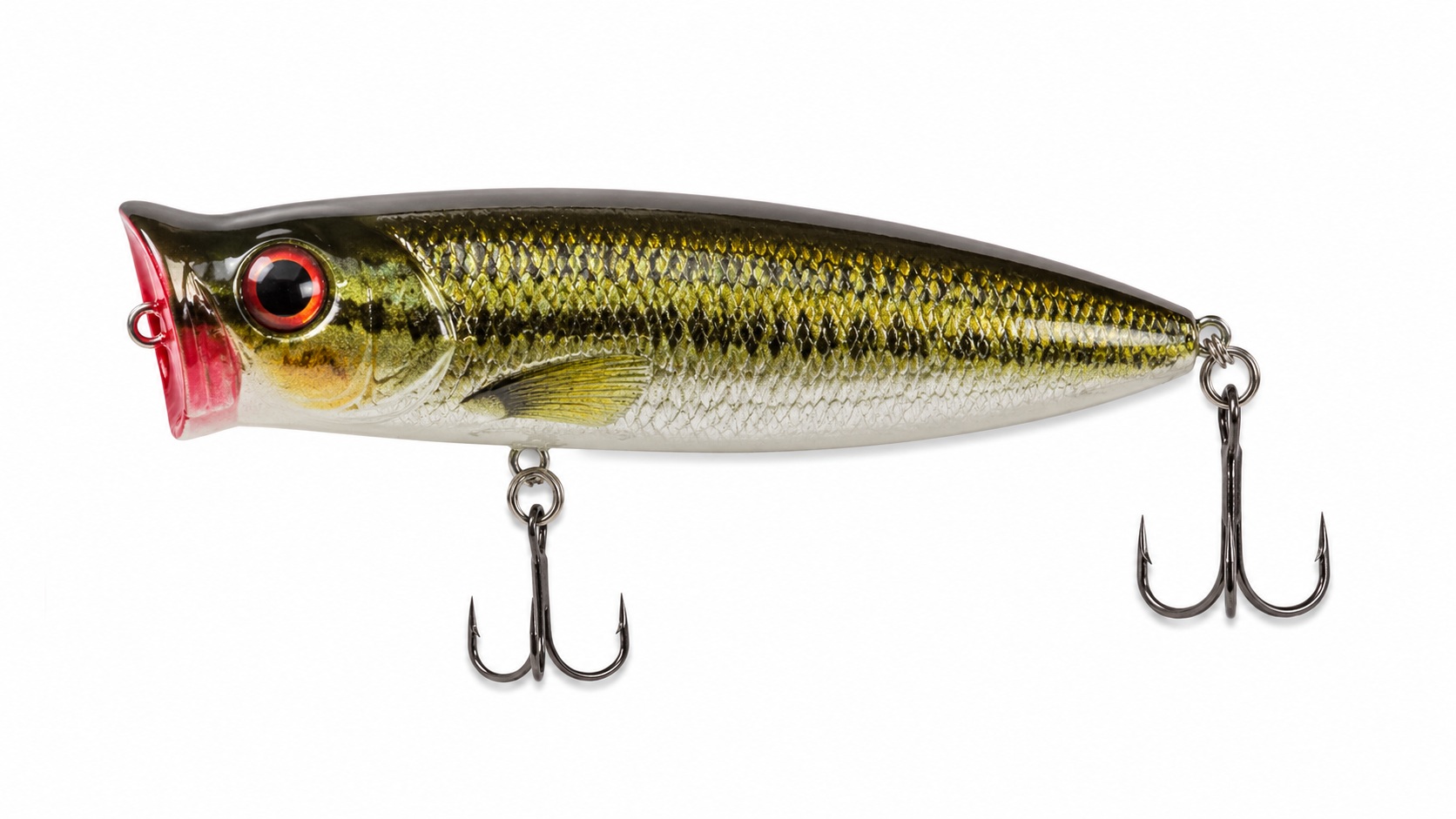
The topwater popper is one of the most straightforward lures in fishing: a hard-bodied plug with a cupped or concave face that scoops water and spits it forward on every rod twitch. That spit — the chug — is the whole mechanism. It generates sound, surface disturbance, and a visible water plume that triggers strikes from largemouth bass in freshwater ponds all the way to bluefish blitzing on open inshore flats.
Unlike the topwater walker, which drifts side-to-side in a “walk-the-dog” motion while traveling across the surface, the popper stays roughly in place and announces itself loudly on each pop. It sits still on the pause. That distinction matters: the popper is a lure you work to a fish, not across a zone. It is the right tool when fish are holding tight to cover and you need to pull them out with repeated, localized commotion rather than covering open water.
The concept is simple enough that beginners can fish a popper effectively within minutes. The refinements — pause timing, cadence, size selection — take more time and pay off noticeably once you develop a feel for them.
The setup
Poppers come ready to fish out of the box. They are hard-bait lures with two or three treble hooks, a through-wire or screw-eye hook attachment, and either built-in rattles or a solid body depending on the model. There is no rigging step in the way a soft-plastic setup requires.
What matters is terminal tackle and knot choice:
- Snap or loop knot: A small snap or a loop knot (non-slip mono loop) lets the lure swing freely at the connection point, which improves the popping action versus a tight clinch knot that can dampen movement.
- Leader in salt: For snook, redfish, and bluefish, add a short section of 20–30 lb fluorocarbon leader (12–18 inches) connected via a small swivel or back-to-back uni. Bluefish will cut monofilament; wire is not necessary but a heavier fluoro leader reduces bite-offs.
- Hook upgrades: Entry-level poppers sometimes ship with mediocre trebles. Upgrading to Gamakatsu or VMC trebles in the same size improves hookup ratio, especially with fast-striking saltwater fish.
How to fish it
The standard retrieve is chug-chug-pause. Point the rod tip down toward the water and jerk the rod with short, sharp downward strokes while reeling up slack between pops. The cupped face catches water on each jerk and spits it forward with an audible pop or chug. The pause after every two or three pops is where strikes happen most often — the lure goes still, and fish that were tracking it commit.
Vary the pause length before everything else. On active fish in warm water, short pauses (one to two seconds) keep the lure moving and draw reaction strikes. On sluggish or pressured fish, a five- to ten-second pause — sometimes longer — is what it takes. Learning to slow down is the single biggest adjustment most beginners need to make with a popper.
Cadence options:
- Rhythmic chug: Two pops, two-second pause, repeat. Good default in most conditions.
- Aggressive blowup cadence: Rapid-fire popping without much pause, then a long still period. Works during feeding blitzes or when fish are actively chasing.
- Single pop and wait: Pop once, let the lure sit for five to ten seconds. Effective over wary fish in clear, calm water.
The strike on a popper is one of the more memorable moments in fishing. You will see it before you feel it. Let the fish fully take the lure before sweeping the hookset — a reflexive hookset the instant you see the swirl will pull the lure away from the fish more often than not.
When to use it
Early morning and late evening: Low light hours are prime topwater time. Fish are shallow, feeding actively, and less spooked by surface lures. The first hour after sunrise and the last hour before dark consistently produce on poppers.
Around cover in freshwater: Work a popper along dock edges, over submerged points, against riprap, and into the shade of overhanging trees. Largemouth bass relating to shallow cover respond well to a lure that stays in one place and keeps calling to them.
Calm or slightly rippled water: Choppy conditions make it harder for fish to locate the lure by sound and sight. Flat calm is ideal; a light ripple is fine. Avoid poppers when surface chop is heavy.
Inshore saltwater — specific conditions:
- Snook along mangrove edges at dawn or dusk; work the popper parallel to the root line
- Redfish tailing on shallow flats; land the cast well ahead of the fish and pop gently to avoid spooking
- Bluefish blitzing at the surface; match the popper size to the baitfish being chased
Spring through fall: Poppers are warm-water lures. Water temperature below 55°F slows surface activity significantly. The peak window is late spring through early fall.
Color and size
| Size | Weight | Best use |
|---|---|---|
| 2–2.5 inch | 1/4 oz | Bass, spotted seatrout, panfish |
| 2.5–3 inch | 3/8 – 1/2 oz | All-around bass, inshore trout |
| 3–4 inch | 1/2 – 3/4 oz | Redfish, snook, striped bass |
| 4+ inch | 3/4 oz+ | Bluefish, large snook, trophy bass |
Color guidelines:
- Bone or white: The most universal popper color in both fresh and salt. Mimics injured baitfish.
- Chartreuse: Strong choice in stained or tannin-colored water where visibility is low.
- Natural baitfish (shad, mullet, threadfin): Best in clear water where fish get a long look at the lure.
- Black or dark: Low-light and night fishing; the silhouette reads clearly from below.
Gear setup
Rod: A medium or medium-heavy power rod in the 6’6” to 7’ range with a moderate-fast tip works well. You want some tip flex to generate the popping action without snapping the rod; a broomstick-stiff rod produces a more erratic, harder-to-control chug.
Line: 15–17 lb monofilament is the traditional choice and remains excellent — mono floats, which helps the lure sit higher and pop cleanly. Braided line (20–30 lb) is increasingly common and gives better feel, but add a fluorocarbon leader to prevent the braid from interfering with the lure’s action at the knot. In salt, braid-to-fluoro setups are standard.
Reel: A 2500–3000 size spinning reel works for lighter freshwater poppers. Move to a 3000–4000 size for inshore applications. Baitcasting setups in the medium-heavy range handle larger poppers well and give experienced anglers better casting control.
Brands worth knowing
Rebel Pop-R: The benchmark freshwater popper. Affordable, widely available, and consistent. The 1/4 oz Pop-R has caught largemouth bass in virtually every lake in North America.
Heddon Chugger: Another long-running freshwater classic, slightly larger profile than the Pop-R and known for a louder, deeper chug.
Lucky Craft Sammy (popper models): Premium Japanese-made hard baits with excellent hardware and finish quality. A step up in cost but a noticeable step up in fit and components.
Storm Rattlin’ Chug Bug: Built-in rattle chamber adds sound between pops; effective in stained water where extra noise helps fish locate the lure.
Rapala Skitter Pop: A versatile size range that crosses over well from bass to inshore applications. Widely available and reliable.
For inshore saltwater, brands like Hogy, MirrOlure, and live-bait-profile poppers from DOA and Z-Man round out what most coastal anglers reach for — match size to the baitfish in your area and the species you are targeting.