A note about links: If we include links to retail sites like Amazon or Bass Pro Shops, it's because they're relevant to the topic and, as anglers ourselves, we believe they're worth checking out. As an Amazon Associate we earn from qualifying purchases.
Picture a copper-colored fish, bigger than your forearm, head-down in 18 inches of water with its tail waving above the surface while it roots for a fiddler crab in the grass. That is a tailing redfish on a flat, and seeing it for the first time is the moment a lot of anglers decide they are inshore fishing people.
Redfish are found from the Gulf Coast of Texas all the way up the Atlantic seaboard to the Carolinas and beyond. They fight hard (long runs, not jumps), they grow large, and they live in water that is accessible from shore, from a kayak, or wading in sneakers. The slot limit regulations that rebuilt their populations over the past 30 years are a genuine conservation success story, and today’s fishery is healthy and abundant across most of their range.
How to identify one
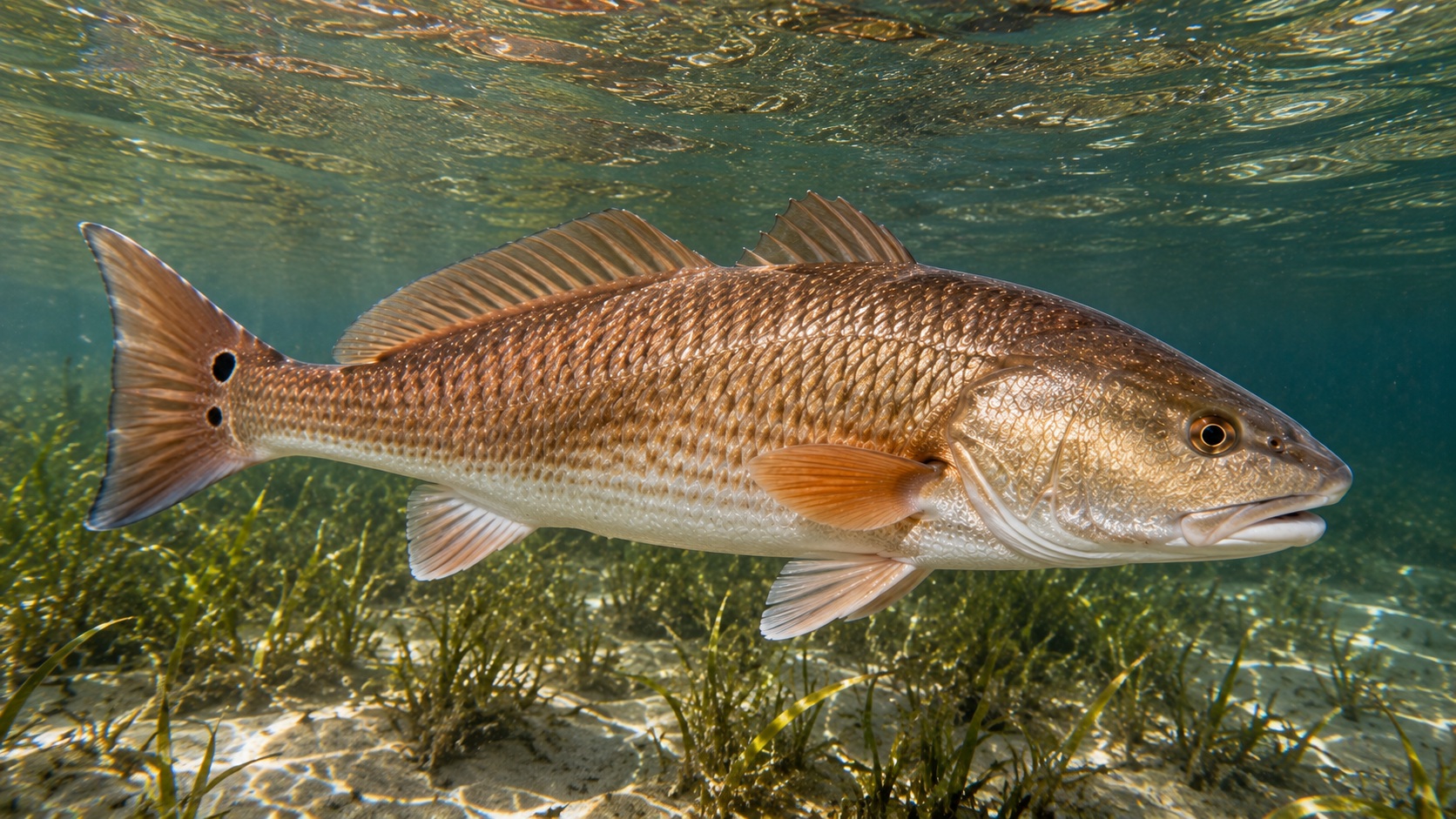
The black spot at the base of the tail is the signature. Nearly every red drum has at least one, most commonly a single large spot on each side of the tail base, ringed with a lighter halo. That “eye” mark gave the species its scientific name, ocellatus, from the Latin for “little eye.” The body runs coppery bronze to silver depending on habitat, with a belly lighter than the sides. The mouth points slightly downward, built for rooting along the bottom for crabs and shrimp.
If you are uncertain whether you have a redfish or a black drum: check the chin. Redfish have a smooth chin. Black drum have whiskers (chin barbels). Spot plus no whiskers equals redfish. Every time.
Puppy drum vs. bull reds: two different targets
Most anglers fishing inshore grass flats, oyster bars, and tidal creeks are targeting puppy drum: redfish from roughly age 0 to 4, typically 18 to 28 inches and 3 to 12 pounds. Puppy drum spend their entire early lives inshore, rarely traveling more than a few miles from their nursery habitat. They are accessible, aggressive, and the backbone of inshore redfish fishing in every state they inhabit.
Around age 4 and 30 inches, fish begin transitioning away from inshore waters toward the nearshore Gulf or Atlantic. By the time they exceed 40 inches, they are primarily offshore residents spending most of the year in deep water. These “bull reds” return to coastal passes and surf zones each fall to spawn, and targeting them during the fall run is a distinct fishery with its own tactics and locations.
Understanding which life stage you are after shapes where you go, what you bring, and what constitutes success.
When and where to find them
Warming water is the trigger for sight-fishing season. When water temperatures climb into the low-to-mid 70s°F, baitfish and crustaceans push onto shallow grass flats, and redfish follow. On low incoming tides in the morning, fish tip head-down in less than two feet of water with their tails breaking the surface, rooting for crabs and shrimp. Across the Gulf Coast — from the Lower Laguna Madre in Texas to the shallow bays of Louisiana and Mississippi — and up the South Atlantic coast through Georgia and the Carolinas, this flat-water sight fishery runs through the warmest months of summer. In Gulf Coast states that tend to be earlier (May through August); in the Carolinas and mid-Atlantic region it peaks closer to July and August. Water temperature matters more than the calendar.
Finding tailing fish requires stealth. Pole or wade to within casting range, position ahead of the fish’s path, and drop the bait a foot or two to the side. A cast that lands directly on the fish almost always spooks it. Let the fish find the bait; do not drag it to them.
The outgoing tide concentrates fish year-round. As tide drops, shrimp, crabs, and small fish get funneled out of the grass and marshes through narrow creek mouths, around oyster bars, and over channel edges. Redfish position at these pinch points and intercept the moving food. This pattern holds whether you are fishing the marsh systems of coastal Louisiana, the tidal creeks of South Carolina, the sounds and back bays of North Carolina, or the bay systems of coastal Texas. Learning where the funnel points are in your local water is the single most transferable skill in inshore fishing.
The fall bull run is a seasonal event worth planning for. As water temperatures drop in the 60s°F, mature red drum stage at coastal passes and surf zones to spawn. This happens earlier in the North (September along the mid-Atlantic) and extends into November and December along the Gulf Coast. Schools of 20- to 40-pound fish appear in the beachfront surf and at pass mouths. The Outer Banks of North Carolina — where the world record was set — is one of the most storied destinations for fall surf fishing for big drum. This is spectacular, hard-fighting fishing that draws anglers specifically for the run every year.
Cooler water slows things down. Redfish retreat from the shallows as water temperatures fall below the mid-50s°F and hold in deeper channels, creek holes, and structure. The bite stays possible but requires finding the deeper concentration points and slowing down the presentation to match the fish’s pace.
What to throw
Live shrimp is the universal inshore bait and the right starting point if you do not know what the fish are keyed on. Under a rattling popping cork in stained water, free-lined on a flat with minimal weight, or pitched near an oyster bar. It works across conditions and seasons.
Weedless gold spoon is the classic artificial for sight-fishing and covering water on flats. Gold reflects better than silver in the warm, slightly turbid water that characterizes most inshore habitat. The slow wobble imitates a fleeing mullet. Cast past the fish or the likely holding area and retrieve the spoon into their view. This is the lure in a lot of anglers’ best-redfish stories.
Soft plastic under a popping cork is the most consistent year-round inshore artificial rig across the Gulf and South Atlantic. Chartreuse, white, root beer, or new penny on a 1/4 oz jig head. The cork calls fish in from beyond visual range. A two-pop, three-second-pause cadence mimics a feeding fish on top; the pause lets the plastic sink and flutter at the depth where the fish are holding. Productive whether the water is clear, stained, or rough.
Fiddler crabs or small blue crabs produce reliably around oyster bars, dock pilings, and shell flats when fish are rooting the bottom. Hook the crab through a leg socket and fish it with minimal weight along the bottom. When fish are specifically dialed in on crabs, the natural presentation beats any artificial.
Live or fresh-cut mullet on a free-line or light bottom rig is the choice for targeting larger fish and during the fall bull run. The scent carries a long distance in tidal current, and a substantial live bait is what draws the larger fish out of a school.
Slot limits and why they matter
Red drum are managed with slot limits across most Gulf and South Atlantic states: a minimum size (typically around 18 inches) and a maximum size (often in the 27-to-30-inch range, varying by state). Fish outside the slot must be released. The specific limits and bag limits vary by state and sometimes by region within a state; always check current regulations with your state fish and wildlife agency before keeping fish.
The science behind the slot is straightforward. Small fish are protected so they can spawn at least once before harvest. Large females are protected because a big female produces dramatically more eggs than a small one. The slot limit strategy, implemented across Gulf states starting in the late 1980s, is credited with recovering red drum populations from severe depletion. The results are well-documented: populations in most managed states now exceed management targets. It is a direct example of regulation working as intended, and the slot limits are widely supported by the inshore fishing community because the fishing is substantially better than it was before.
Regulations
Red drum regulations vary by state. Each Gulf and Atlantic coastal state sets its own slot size, bag limit, and season. There is no uniform federal bag limit for inshore red drum; management is handled at the state level for inshore and nearshore fish.
To fish legally and responsibly: look up your state fish and wildlife agency’s current regulations before your trip. The rules are not complicated, but they differ — what is a legal keeper in one state may be over or under the slot in another. Red drum have no federal (NOAA) minimum size for recreational anglers fishing inshore waters, but some states impose additional restrictions in specific areas or during spawning aggregations.
Handling and release
Red drum can live 40 to 50 years. The world-record fish likely lived well over 15 years. A fish that exceeds the slot limit must be released, and it deserves care:
- Keep air exposure to 20 seconds or less. This matters more than anything else.
- Wet your hands before handling; a dry hand strips the protective slime coat.
- Support the fish horizontally with both hands.
- Revive in the water until the fish swims out of your grip with purpose, not just when it stops flopping.
Shallow-water redfish do not experience barotrauma (no depth-pressure issue as with deep-water species), so standard gentle handling and release is all that is required. With proper technique, mouth-hooked redfish survive catch-and-release at over 90 percent according to NOAA Fisheries research.
On the Table
Redfish (red drum) are widely regarded as excellent table fare, and most inshore anglers in the Gulf and South Atlantic consider a slot-sized fish a genuine prize for the table. The species’ reputation was cemented in the 1980s when blackened redfish became one of the defining dishes of American Creole cuisine, and demand was so intense it briefly threatened wild populations.
Taste and texture: Redfish have white, moderately firm flesh with a mild, slightly sweet flavor. Smaller fish (under 20 inches) are noticeably more delicate and flaky; fish in the typical slot range deliver a firmer, meatier bite that holds up well to high-heat cooking. Larger “bull reds” above the slot become progressively coarser and stronger-flavored, which is why most anglers release them rather than keep them.
Best preparation methods:
- Blackening — The classic preparation. The firm white flesh holds together under an extremely hot cast-iron pan, and the mild flavor lets a bold spice crust (paprika, cayenne, thyme, garlic) do the work without competing with the fish. Chef Paul Prudhomme made this method famous specifically because redfish suited it perfectly.
- Grilling on the half-shell — A Gulf Coast staple. Leaving the skin and scales on one side acts as a natural heat shield, keeping the fillet moist while the flesh above steams and chars slightly at the edges. Works especially well for larger slot fish.
- Pan-frying or sauteing — A simple flour dredge or light breadcrumb coating over medium-high heat lets the sweet, clean flavor of a smaller fish come through without overpowering it.
- Ceviche — Smaller, very fresh redfish are well-suited to citrus cure. The firm texture holds up without turning mushy, and the mild flavor pairs well with lime, cilantro, and serrano.
Handling for table quality: Redfish destined for the table benefit from being kept alive on a stringer or livewell until you are ready to kill them, then immediately bled by cutting the gill arch. Place the fish directly on ice, not in standing water. The skin is thick and the scales are large; a sharp fillet knife and scoring or removing the skin entirely before cooking improves the eating experience. The lateral line runs through a thin strip of darker, stronger-flavored meat — trimming this out during filleting produces a milder, more uniform piece.
Eating caveats: Redfish are subject to strict slot limits in most states. Those regulations exist because the fish is most valuable as a wild fishery resource, and keeping only slot-sized fish also happens to produce the best-eating fillets. Bull reds over the slot are best released.