A note about links: If we include links to retail sites like Amazon or Bass Pro Shops, it's because they're relevant to the topic and, as anglers ourselves, we believe they're worth checking out. As an Amazon Associate we earn from qualifying purchases.
What it is
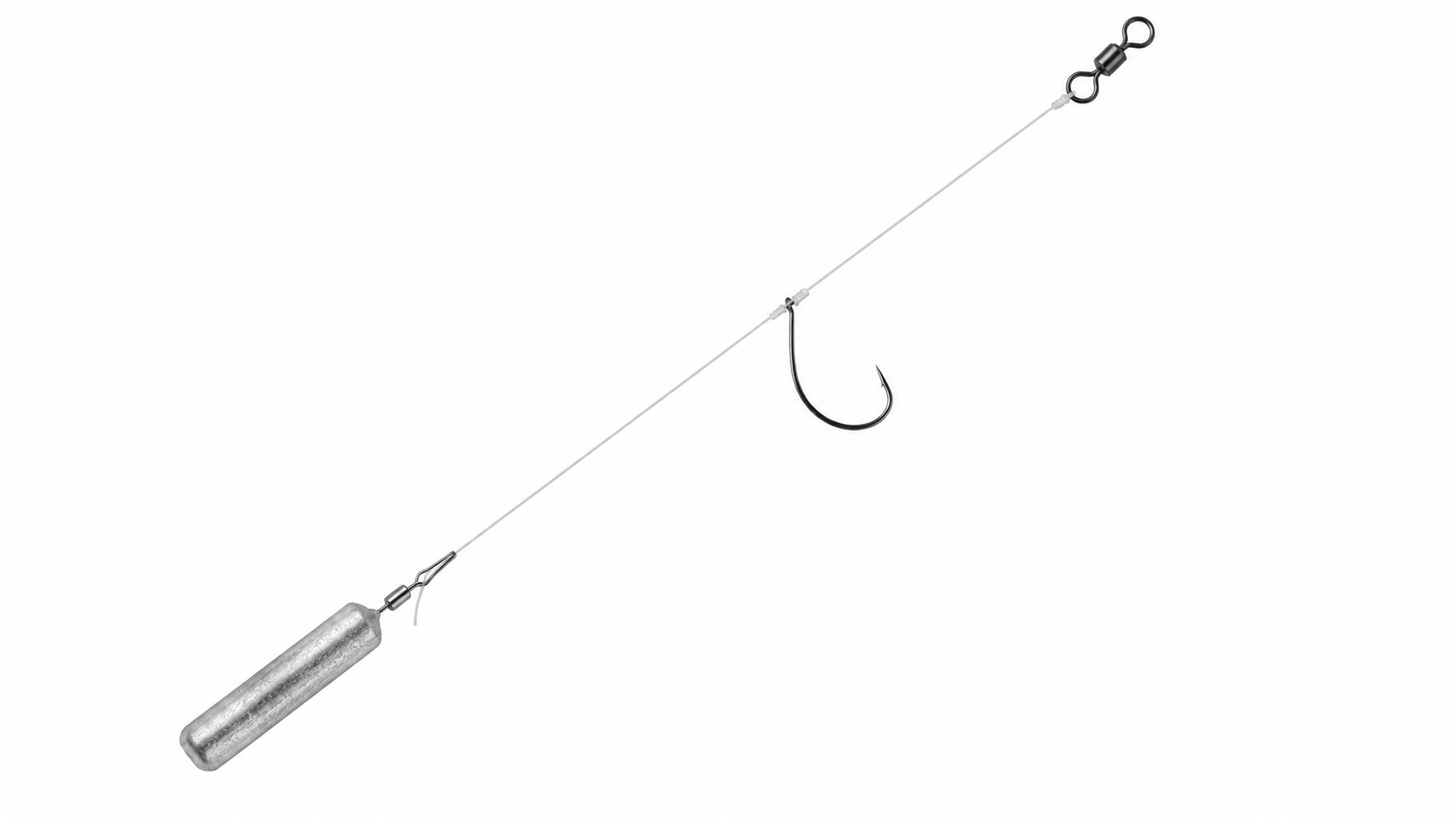
The drop shot is a finesse rig designed around one insight: sometimes fish won’t come down to get a bait off the bottom, but they will eat a bait that hovers in front of their face. The hook and bait are tied above the weight on a tag end of line, suspending the soft plastic at a set distance above the bottom — typically 6 to 18 inches. The weight stays on the floor. The bait floats at a precise height and moves only when you move it.
Originally developed in Japan for clear-water bass in deep reservoirs, the drop shot arrived in the US and quickly became the technique of choice for tournament anglers facing pressured, finicky bass. It has since proven effective coast to coast for largemouth, smallmouth, spotted bass, walleye, and a range of other species.
How to rig it
The drop shot is tied differently than most rigs — the hook is not at the end of the line.
Palomar knot method (recommended):
- Cut approximately 3 feet of line. Double 12 inches of it and pass the loop through the hook eye.
- Tie a simple overhand knot with the doubled line above the eye, leaving the hook hanging from the loop.
- Pass the loop over the hook point and pull both ends tight. This is the Palomar knot.
- Leave the tag end of the line long — this is the section that will connect to the weight.
- Trim the tag end to your desired leader length (6–18 inches).
- Attach a drop shot weight to the tag end. Drop shot weights use a small cinch loop that allows quick weight changes without cutting the line.
Hook position: The hook should face upward after tying. Check that the eye of the hook is pointing toward the rod tip, not down.
Rigging the bait:
- Nose hook (most common): Hook the soft plastic straight through the nose (tip of the head) with a light-wire hook. The bait hangs naturally and moves freely.
- Wacky-style: Hook through the middle of a finesse worm for a different action.
- Texas-style (weedless): For fishing in cover, skin-hook the bait onto the hook for a weedless setup.
How to fish it
Vertical (deep water from a boat)
Lower the rig straight down over a graph-identified target — a school of bass on a hump, fish suspended over a deep channel, fish visible along a submerged timber structure. When the weight hits bottom, pick up slack. Begin a subtle, in-place shake using small rod-tip movements. The bait trembles and vibrates without moving horizontally. Strikes often come as the rod hand twitches or during brief pauses. Reposition the boat as you work through the area.
Casting (from shore or covering flats)
Cast to your target zone. Let the weight sink to the bottom on a semi-taut line. Once on bottom, use slow rod-tip shakes and pauses, moving the rig a few feet at a time with a slow drag. The bait stays at a fixed height above bottom the whole retrieve. This is a good technique for rocky points, deep docks, and submerged roadbeds.
Suspended fish
If sonar shows fish suspended in open water (common in summer and winter), lower the rig to that depth and use minimal movement. The ability to put the bait at a precise depth and hold it there is the drop shot’s biggest advantage over other rigs.
When to use it
Tough conditions: Post-cold-front, high-pressure bluebird days, clear water, heavily fished lakes — any situation where fish are finicky. The drop shot gets bites when aggressive presentations get ignored.
Summer deep-water: As fish move deep in summer, the drop shot follows them efficiently. Vertical fishing over marked fish is one of the highest-percentage summer techniques across the country.
Cold water: In winter, fish move very slowly. The drop shot can be held in front of them with minimal movement for as long as needed. Cold-water drop shot fishing in 10–25 feet of water over structure is extremely productive.
Clear water: Finesse presentations on light line dominate clear reservoirs. The drop shot’s natural action and light line diameter (6–10 lb fluorocarbon) are built for this environment.
On the salt
The drop shot is not a freshwater-only rig — the same “suspend the bait at a precise height and hold it there” advantage translates straight to inshore saltwater, and it shines with live bait.
Inshore live-bait drop-shotting: Gulf and Atlantic anglers fish a live shrimp (or live/cut mullet) on a drop shot for speckled trout, redfish, flounder, sheepshead, and snook around bridges, passes, reefs, and oyster bars in moving water. The pitch is that, unlike a Carolina rig, nothing drags on the bottom to deaden your feel — the bait hangs in the strike zone and you feel every bite. The build is beefed up for salt: a heavier bank or teardrop weight (often around 1 oz) on the tag end, a stouter mono leader, and a live-bait or even small treble hook in place of the light-wire finesse hook.
West Coast structure: Anglers also drop-shot soft plastics — and live sardine or anchovy — for rockfish, lingcod, and calico/sand bass over rocky structure, and for halibut along the bottom. It’s one good option here rather than the dominant one: dropper-loop and three-way rigs are still the deep-water rockfish standard, so reach for the drop shot when you want finesse and precise depth control over a reef.
Leader length guide
| Leader (hook to weight) | Use when |
|---|---|
| 6 – 8 inches | Fish are tight to the bottom; cold water; slow conditions |
| 10 – 12 inches | Standard all-around; most situations |
| 14 – 18 inches | Fish are suspended above bottom; active conditions; warmer water |
| 24 + inches | Open-water suspended fish; targeting fish that don’t want to look down |
Bait selection
Drop shot baits should be small, natural-looking, and have action even when barely moved.
- Finesse worms (4–6 inch): The standard. Roboworm Straight Tail Worm is the most famous drop shot bait — its tail quivers at the slightest movement.
- Minnow-style baits (2–4 inch): Slim profile; excellent in clear water and for smallmouth
- Small swimbaits / paddle tails (2.5–3 inch): More action; good in stained water or when fish are more active
- Creature baits / craws (2.5–3 inch): For fishing the drop shot in heavier cover with a weedless hook
Gear setup
Rod: Medium-light to medium power, fast action spinning rod, 6’6” to 7’. The spinning setup is essential for using light line efficiently. A fast action tip picks up line quickly on the hookset.
Line: 6–10 lb fluorocarbon is standard. In very clear, pressured water, some anglers drop to 4–6 lb. If fishing around cover or in stained water, 10–12 lb is acceptable.
Reel: 2500 to 3000-class spinning reel with a smooth drag. The drag gets used — bass on light line run, and a smooth drag prevents break-offs.
Brands worth knowing
Hooks: Gamakatsu Drop Shot Hook (the standard, in sizes 1 to 1/0), Owner Mosquito Hook (excellent light-wire option), and VMC Spinshot Hook are widely used.
Weights: Drop shot weights use a clip system for quick changes. Reaction Tackle and Hammer Lures both make quality, widely available drop shot weights. Tungsten is preferred over lead for better bottom feel.
Baits: Roboworm Straight Tail Worm, Z-Man Finesse WormZ, Strike King Dream Shot, and Berkley MaxScent Flat Worm are among the most-used drop shot baits. Roboworm’s “hand-poured” finish has a particularly lifelike texture and color.