A note about links: If we include links to retail sites like Amazon or Bass Pro Shops, it's because they're relevant to the topic and, as anglers ourselves, we believe they're worth checking out. As an Amazon Associate we earn from qualifying purchases.
What it is
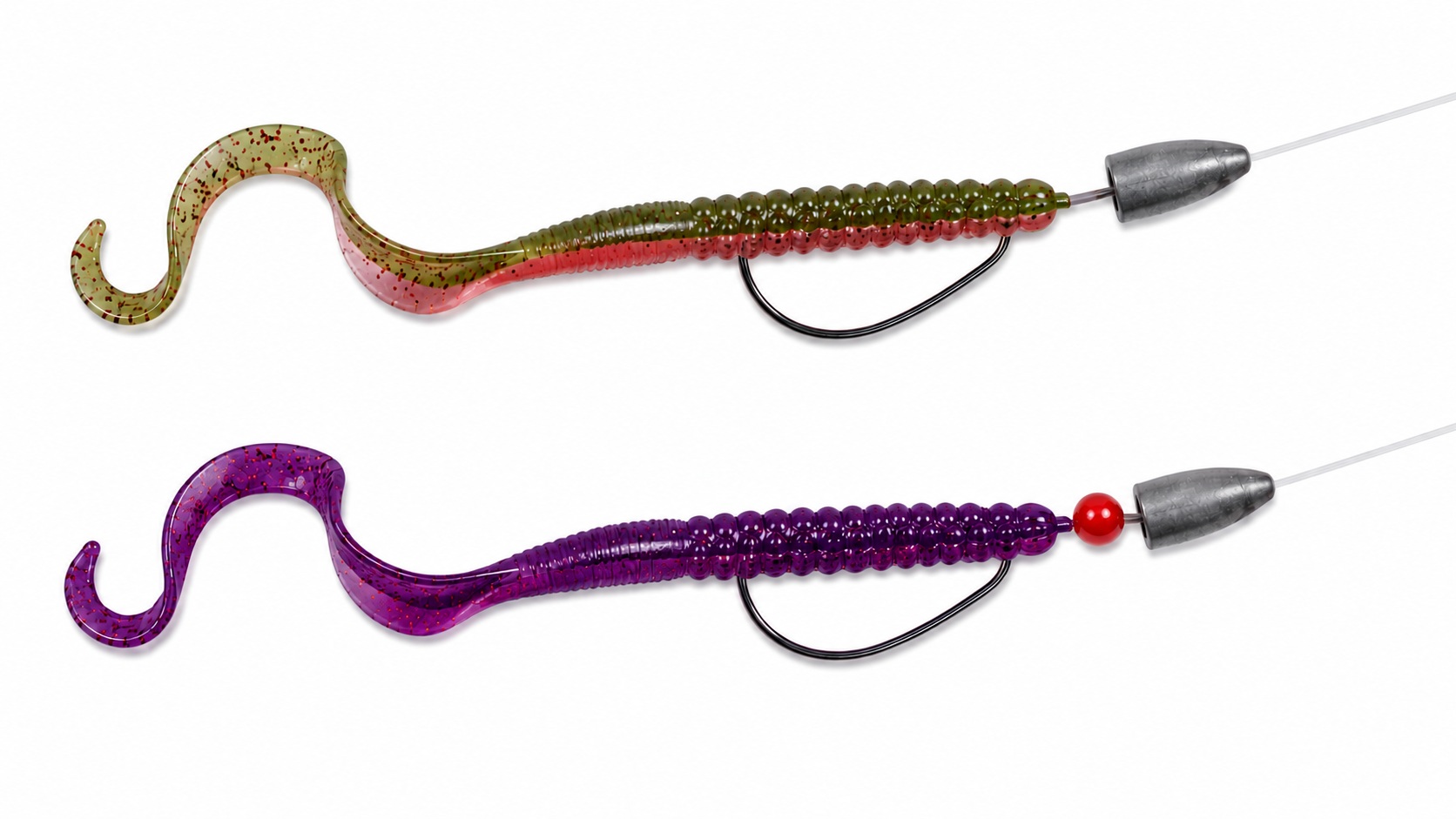
The Texas rig is the most widely used soft plastic rig in freshwater fishing. It consists of three components: a brass or tungsten bullet weight threaded onto the line, a soft plastic bait (worm, creature, craw, or lizard), and an offset worm hook. The hook point is tucked back into the plastic — a feature called “skin-hooking” — making the entire setup weedless. The Texas rig slides through grass, wood, and rocks that would catch and hang virtually any other presentation.
If you learn one soft plastic rig, this is the one. It is effective in every season, in every type of freshwater cover, for every bass species, and on almost any soft plastic bait you can buy.
How to rig it
- Thread the bullet weight onto your mainline with the point facing the hook. Tungsten weights are denser than lead — a 3/16 oz tungsten feels and sounds like a 1/4 oz lead — and transmit bottom feel better.
- Tie on an offset worm hook. The offset design is the right-angle bend behind the eye that gives soft plastics their natural straight posture on the shank.
- Hold the hook with the point facing up and the eye toward the bait. Push the hook point into the head of the bait about 1/4 inch straight in, then bring it out the side.
- Slide the bait all the way up to the eye so the head is seated at the hook’s top bend.
- Rotate the hook 180 degrees and push the point gently back into the body of the plastic — “skin-hooking” — so it lies flat with no bulge.
- Check alignment: the bait should hang perfectly straight with no twist. A twisted bait spins on the cast and will not fall correctly.
Pegging the weight: For open water, leave the weight free-sliding — it separates from the bait on the hookset for better action. For punching through grass mats or heavy cover, peg the weight tight to the bait using a bobber stop or toothpick so it punches through as one unit.
How to fish it
The Texas rig shines when worked slowly on or near the bottom.
Basic drag and hop: Cast to the target, let the bait hit bottom, take up slack, and begin a slow drag with pauses. Every pause is a strike opportunity — fish often hit the bait while it sits still. Lift the rod, let it fall back on a semi-slack line, and repeat.
Flipping and pitching: In heavy cover — dock pilings, laydowns, grass edges, boat docks — use a short line and pendulum-pitch the bait to precise targets. Lower it vertically, let it fall, pop it once or twice, and move to the next target.
Do-nothing / deadstick: In clear water or post-front conditions, simply cast and let the bait sink on a slack line with no movement. The fall is the action. This presentation is devastating on pressured fish that have seen every retrieve in the book.
Punching mats: With a 1 oz or heavier pegged weight and a heavy fluorocarbon leader, punch through thick floating vegetation to reach bass holding underneath. Heavy flipping tackle and 50-65 lb braided line are the standard setup for this technique.
When to use it
The Texas rig works in every season because it can be slowed down or sped up to match fish activity. Some peak scenarios:
- Post-spawn / summer: As bass retreat to deeper structure, a slow-dragged Texas rig along main-lake points and humps consistently produces.
- Post-cold-front: After a front pushes fish tight to cover and shuts down their movement, the do-nothing approach on a Texas rig in the thickest cover you can find is one of the few presentations that still works.
- Winter: Fish extremely slowly — a Carolina rig or drop shot often outperforms in very cold water, but a small Texas-rigged finesse worm crawled along the bottom is still productive.
- Spring spawn: A lizard or creature bait Texas-rigged and worked around spawning beds is a proven spawning bass tactic.
On the salt
The Texas rig is not just a freshwater bass rig — the same weedless design makes it a genuine inshore-saltwater tool. The skin-hooked point that slides through freshwater grass and wood does the exact same job over marsh grass, mangrove roots, oyster and shell beds, and dock pilings, where an exposed treble would foul on every cast. Inshore anglers Texas-rig soft plastics for redfish, snook, spotted seatrout, and flounder on shallow flats and in the backcountry.
The one difference is bait choice: alongside worms and craws, saltwater anglers commonly Texas-rig paddletails and soft jerkbaits to imitate mullet, menhaden, and pilchards. Lean toward the lighter end of the weight range — a 1/16 to 1/4 oz bullet weight, or a weighted weedless hook — to keep the bait gliding slowly over grass rather than plowing into it, and work it with the same slow drag-and-hop or a steady swimming retrieve.
Weight and hook selection
Match the weight to the depth, cover, and wind:
| Weight | When to use |
|---|---|
| 1/16 – 1/8 oz | Calm conditions, shallow water (0–6 ft), finesse applications |
| 3/16 – 1/4 oz | Standard all-around; most lake situations |
| 3/8 – 1/2 oz | Deeper water, wind, current; keeps better contact with bottom |
| 3/4 – 1 oz | Punching heavy matted vegetation; fast-falling drop shots into deep structure |
Match hook size to bait size:
| Bait size | Hook size |
|---|---|
| 4” worm | 1/0 – 2/0 |
| 6–7” worm | 3/0 – 4/0 |
| 10” worm | 5/0 |
| Creature / craw | 3/0 – 5/0 |
Bait choices
Nearly every soft plastic bait can be Texas-rigged. Common starting points:
- Stick worms (4–5 inch): natural fall action; effective on a do-nothing approach
- Finesse worms (4–6 inch): subtle action; good for pressured fish and clear water
- Ribbon-tail worms (7–10 inch): big profile with a throbbing tail; proven in warm water
- Creature baits / craws (3–4 inch): bulky, realistic profile; excellent for flipping and pitching
- Lizards (6–8 inch): classic spawning-season bait; big displacement
Brands worth knowing
Hooks: Gamakatsu EWG (Extra Wide Gap) is the most popular offset hook in bass fishing. Owner Rig’N Hook and Strike King Tour Grade are strong alternatives. For heavy flipping, Gamakatsu Heavy Cover and Owner Beast are purpose-built.
Tungsten weights: Reaction Tackle, Dirty Jigs, and V&M all make quality tungsten in a full size range. Avoid painted lead — the paint chips and dulls the sliding action.
Soft plastics: Zoom (Trick Worm, Mag Trick, Ultra-Vibe Speed Craw), Yamamoto (Kut Tail Worm, Flappin’ Hog), Strike King (Rage Tail series), Berkley Powerbait MaxScent (Flatworm, The General), and Z-Man Finesse TRD are all proven performers.