A note about links: If we include links to retail sites like Amazon or Bass Pro Shops, it's because they're relevant to the topic and, as anglers ourselves, we believe they're worth checking out. As an Amazon Associate we earn from qualifying purchases.
There is a particular kind of fishing that does not ask much of you. You drive to the bank, rig up a simple bottom rig, hurl it out as far as it will go, prop the rod against something sturdy, and wait. The rod tip twitches. The rod tip bends hard. You pick it up and the line is pulling against something real. That is channel catfish fishing, and it is available at essentially every lake, river, reservoir, and large pond across North America. Channel cats are not hard to find, not fussy about gear, and not subtle about the bite. They also end up as some of the best fish fry you will eat all year. If you have never caught one, the only reason is that you have not tried.
How to identify one
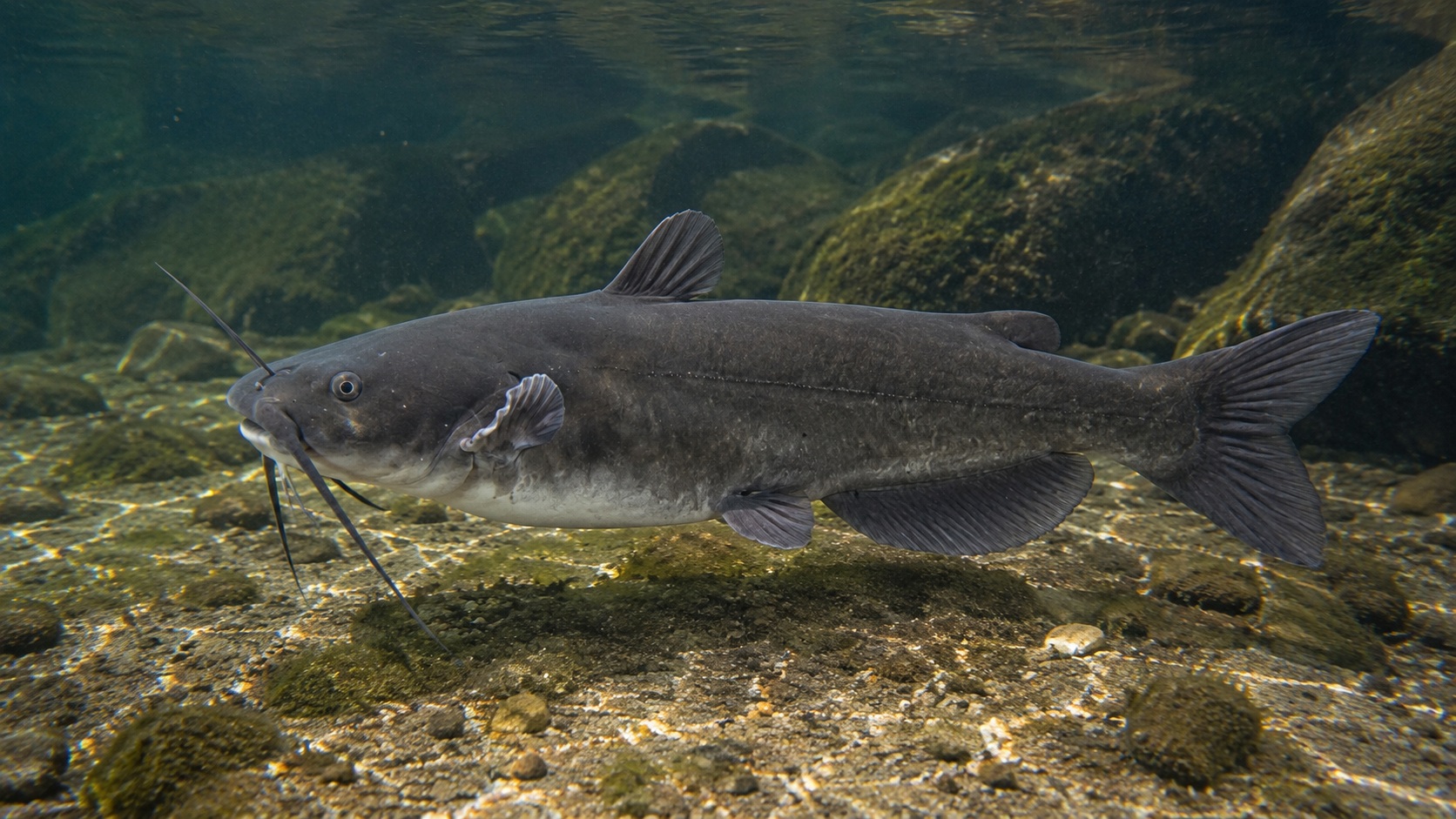
Channel catfish are hard to misidentify once you know the four key features. First, the whiskers: eight barbels arranged around the mouth, four on each side of the chin. These are sensory organs, not just cosmetic. Second, the adipose fin: a small, soft, fleshy lump sitting between the dorsal fin and the tail on the fish’s back. Third, the tail: deeply forked, more so than any of the other North American catfish species. Fourth, the spots: scattered dark dots on the back and sides, most visible on juvenile and sub-adult fish and often fading on larger adults.
The body color runs blue-gray to olive across the back with a lighter silver-white belly. Males darken noticeably during spawning and develop a thickened, padded forehead.
Two relatives are worth knowing. The flathead catfish (Pylodictis olivaris) is a genuinely large animal with a flattened, shovel-wide head and a square or slightly notched tail rather than a deep fork. The brown bullhead (Ameiurus nebulosus) is smaller, more rounded in the tail, and lacks the scattered spots. Where channel cats and blue catfish (Ictalurus furcatus) share water — common across the South and Midwest — the blue cat is distinguished by a straight-edged anal fin and a more uniformly slate-blue body without spots.
One handling note before you hold one: the pectoral and dorsal fins each have a stiff, sharp spine at the leading edge. Do not grab there. Hold the fish by gripping the body firmly from behind those pectoral fins, or use a jaw grip. The spines can cause a painful puncture and sometimes produce an uncomfortable inflammatory reaction.
Where to find them
The honest answer is almost everywhere. Channel catfish are present in virtually every major river drainage in North America east of the Rockies, and have been stocked widely west of them as well. The species’ native core runs from the Missouri and Mississippi River basins through the Ohio Valley, the Great Plains, and south to the Gulf Coast — but introductions have put channel cats in reservoirs and rivers from coast to coast.
For specific targeting, think deep and soft-bottomed. In lakes and reservoirs, the deepest basin you can reach from the bank is your starting point. Channel cats work the bottom, using those barbels to locate food by smell and vibration, and they prefer areas where there is some current or water movement nearby even in still-water environments. Submerged creek channels within reservoirs, drop-offs near dam structures, and the deep outside bends of river channels are all prime locations.
In rivers, focus on the outside bends where current has scoured depth into the bank, and on holes immediately downstream of tributary mouths. The Mississippi River system and its tributaries — the Missouri, Ohio, Tennessee, Arkansas, and their feeder rivers — hold some of the heaviest channel cat populations in the country. Large impoundments across the Great Plains and Midwest produce consistent populations as well, and tailwaters below major dams are well-known catfish destinations across the South and Midwest.
In the Gulf Coast states, channel cats are common in slow-moving coastal rivers, bayous, and reservoirs throughout the region. Across the mid-Atlantic and Southeast, major river systems from the Chesapeake Bay drainages through the Carolinas and Tennessee hold strong wild populations alongside stocked fish in smaller impoundments.
Dock pilings, bridge abutments, and any hard structure near deep water serve as congregation points, especially at night.
When to go
Channel catfish are a warm-water species that fishes best once water temperatures climb above 65 degrees Fahrenheit, with peak activity typically between 70 and 85 degrees. When water temperatures drop below 50 degrees, activity slows considerably and feeding becomes sparse.
What that means in practice depends on where you are fishing. In the Gulf states and the Deep South, the productive window opens early — often February or March — and extends well into fall. In the Midwest and mid-Atlantic, prime fishing typically runs from late April or May through September. In the Great Lakes region and the northern tier of the range, the window compresses further, with peak activity concentrated in June through August.
The single most important timing variable is darkness. Channel cats are most active after sunset. Summer nights from around 9 PM through 2 AM represent the prime fishing window, and it is not even close. The barbels are chemical and tactile sensors that allow these fish to hunt effectively in complete darkness. Night fishing from a bank with a lantern, a few rods propped on rod holders, and a cooler is how most experienced catfish anglers operate.
That said, dawn and dusk produce fish throughout spring and fall when temperatures are in a comfortable mid-range. Overcast days with dropping barometric pressure before a summer storm can turn channel cats on in the middle of the afternoon.
What to throw
The guiding principle for channel catfish bait selection is simple: the smellier, the better. These fish locate food by smell before anything else.
Commercially prepared stink baits are the single most effective catfish bait available and are completely beginner-friendly. Dipbait (a paste you dip a treble hook or sponge hook into) and punch bait (a thicker, stickier formula you punch the hook into) are sold at virtually every tackle shop and big-box retailer across the country. They are messy, they smell terrible, and they catch fish.
Chicken liver is the classic natural option. Fresh is better than frozen, and liver from a grocery store works just as well as anything sold in a tackle shop. It is soft and tends to fall off a hook, so either thread it carefully on a treble hook or wrap it loosely with a bit of thread or netting.
Fresh-cut bait is the preferred option for larger fish. Fresh-cut shad, skipjack herring, or other oily baitfish cut into chunks and fished on the bottom puts out an oil slick that channel cats track from a long distance. Cut bait fished on a circle hook is the most common approach in rivers and canals where you expect fish over five pounds.
Nightcrawlers catch channel catfish reliably, though they are not as consistently productive as scent-heavy baits. They work well as a supplement bait when you have multiple rods out.
The standard rig for all of these baits is a Carolina rig: slide a 1 to 2 ounce egg sinker onto your main line, tie on a barrel swivel, attach an 18 to 24 inch fluorocarbon or monofilament leader, and tie on your hook. Use a treble hook (size 2 to 4) for stink baits and a circle hook (3/0 to 5/0) for cut bait and liver. Cast to the deepest water you can reach, set the rod in a holder, and watch the tip.
In rivers and canals, a productive variation is to drift cut bait slowly along the outside bends of channel edges. Keep the weight light enough that the current moves the presentation along the bottom. This covers more water than a stationary rig and is especially effective in any river with a defined channel and moderate current.
Regulations
Regulations for channel catfish vary significantly by state. Most states manage them as a nongame or rough fish species with liberal or no bag limits, but some states impose size or daily bag limits, and specific waters — including designated trophy fisheries and management areas — often carry their own local rules.
There is no federal management of channel catfish. Check your state fish and wildlife agency’s current regulations before you go, as rules can differ not just by state but by individual body of water. A valid freshwater fishing license is required in all states where channel catfish are present.
Handling and release
If you plan to keep fish for the table, channel catfish are an excellent choice. The white fillets are firm, mild, and hold up well to deep frying, baking, or blackening. Skin the fish rather than scaling: catfish skin is tough and strong-tasting, and removing it produces a far better fillet. A set of skinning pliers makes the job straightforward.
If you are releasing the fish, wet your hands before handling to protect the slime coat, keep the fish horizontal and support the body, and return it to the water promptly. Channel cats are hardy and recover quickly from a typical catch-and-release encounter. Keep your grip behind the pectoral fins and hold the fish firmly so it cannot thrash against you.
On the Table
Channel catfish are one of the most popular freshwater table fish in North America, and for good reason: they are mild, versatile, and consistently good eating when handled properly from catch to cooler.
Taste and texture: The flesh is white to off-white, firm, and moist with a mild, slightly sweet flavor. Smaller fish (under 5 pounds) tend to be the most delicate; larger fish remain good eating but develop a denser, more pronounced flavor. Channel catfish have far less “muddy” taste than their reputation suggests — that off-flavor almost always traces back to poor handling or warm-water holding, not the fish itself.
Best preparation methods:
- Batter frying: The classic preparation for a reason. Channel cat’s firm, moist flesh holds up perfectly in hot oil without falling apart, and a cornmeal crust adds texture the mild fish benefits from. Works best with smaller fillets or strips cut from larger fish.
- Blackening: The bold Cajun seasoning complements rather than overwhelms the mild flesh. Use a cast-iron skillet screaming hot with butter. The firm texture prevents it from breaking apart during the high-heat sear.
- Grilling or smoking: Larger, denser fillets from fish over 3 pounds take smoke beautifully. A light wood like apple or cherry keeps the flavor from overpowering the mild flesh. On the grill, skin-on fillets hold together better and can be peeled after cooking.
- Pan-frying (flour dredge): For smaller fish, a simple seasoned flour dredge and shallow fry in butter or oil lets the natural sweetness of the flesh come through without the heavier cornmeal crust.
Handling for table quality: Channel catfish are sensitive to temperature. Ice immediately after landing — do not hold in a warm livewell for hours if you plan to eat them. Bleeding the fish at the time of catch by cutting the gills noticeably improves the flavor of the flesh. When filleting, remove the lateral line (the dark strip of fat running along the side) from larger fish; this tissue carries stronger flavor and is worth trimming out. Skinning is straightforward once you have the fish filleted — catfish skin is not eaten and should always be removed.
Eating caveats: In some river systems and reservoirs with industrial history, PCB or other contaminant advisories may apply to bottom-feeding fish like catfish. Check your state’s local fish consumption advisories before keeping fish from unfamiliar or urban waters. Size-based advisories are more common for catfish than for most freshwater species, so this step is worth doing.