A note about links: If we include links to retail sites like Amazon or Bass Pro Shops, it's because they're relevant to the topic and, as anglers ourselves, we believe they're worth checking out. As an Amazon Associate we earn from qualifying purchases.
What it is
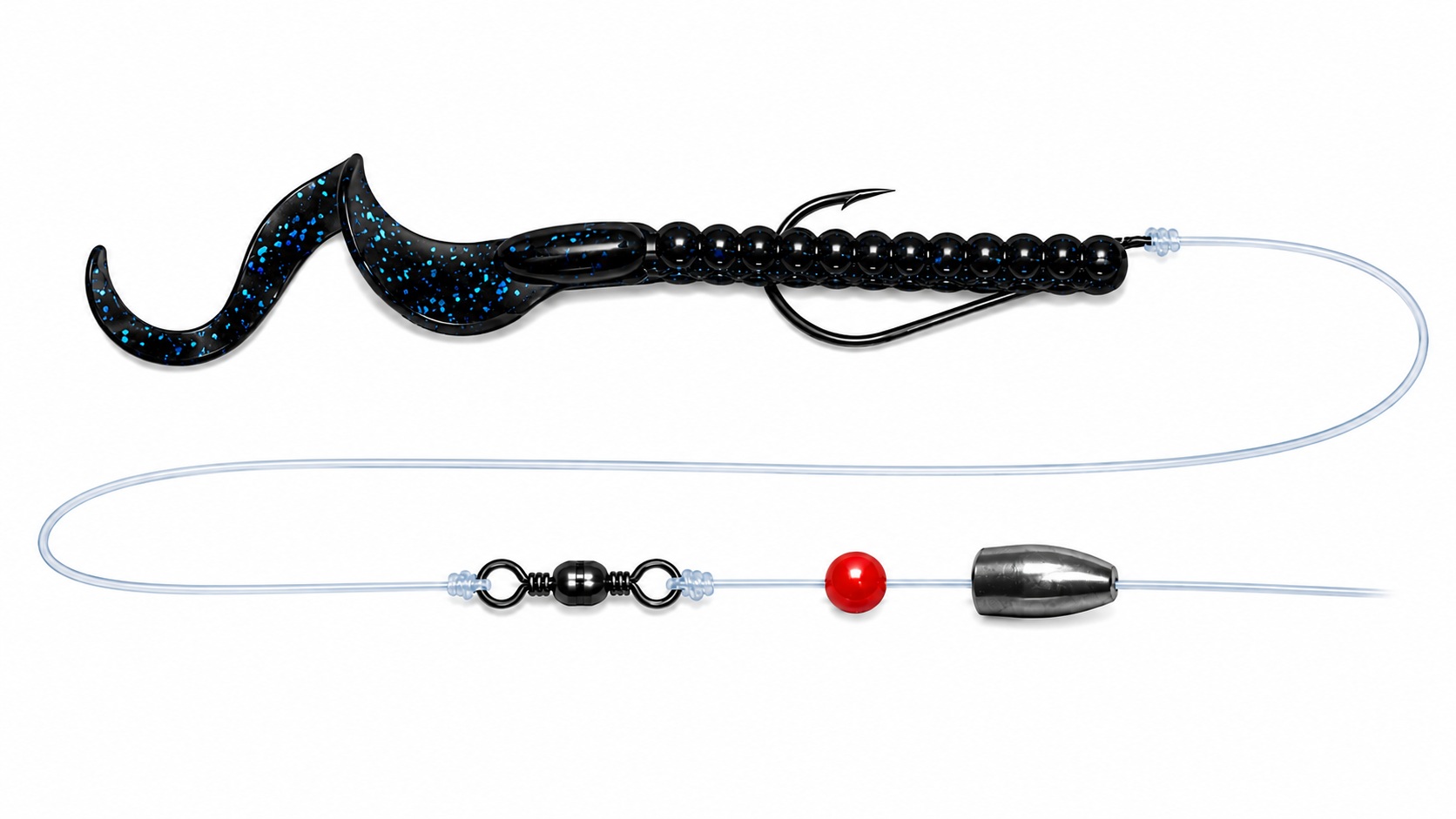
The Carolina rig puts the weight and the bait on separate parts of the line — that is the entire idea. A heavy sinker drags along the bottom and stirs up silt while the soft plastic bait floats behind it on a leader, hovering just above the bottom in the disturbance zone. The separation between weight and bait is what makes it different from the Texas rig, and that separation is what makes it work in specific situations the Texas rig does not cover as well.
The Carolina rig is a searching tool. Its heavy weight lets you cover open-water flats, deep main-lake points, and large structure efficiently, and the dragging weight gives off sound and vibration that attract bass from a distance.
How to rig it
Components needed:
- Heavy egg sinker or bullet weight: 1/2 to 1.5 oz (1 oz is standard)
- A glass or plastic bead (adds clicking sound as weight contacts swivel)
- Barrel swivel (size 7 or larger)
- Fluorocarbon leader: 18–36 inches of 15–20 lb
- Offset EWG hook or straight worm hook: 2/0 to 4/0
- Soft plastic bait
Assembly:
- Slide the sinker onto your mainline, then the bead, then tie on the barrel swivel using an improved clinch or Palomar knot.
- Cut a 18–36 inch section of fluorocarbon for your leader. Tie it to the other eye of the swivel.
- Tie the hook to the end of the leader. For soft plastics rigged snug, an improved clinch or Palomar knot is the strong standard — the Palomar holds onto roughly 95% of your line’s strength. If you want the hook to swing freely — which gives a live bait, or a loosely-rigged plastic, a more natural, lifelike movement — tie a non-slip loop knot instead. It trades a little knot strength for a lot more action, and it is a perfectly acceptable, often preferred, choice on the hook end of a Carolina rig.
- Rig the soft plastic Texas-style (weedless) on the hook.
Leader length: Shorter leaders (18 inches) work in colder water when fish are less aggressive — the bait stays closer to the weight and the bottom. Longer leaders (30–36 inches) give the bait more float and movement in warmer water. When the bite is slow, try shortening the leader; when fish are active, try lengthening.
How to fish it
The Carolina rig is a drag-and-pause presentation. Cast it to your target, let it sink to the bottom, and drag the rod slowly from the 10 o’clock position back to 2 o’clock, keeping bottom contact the whole time. Reel up slack, pause for 3–5 seconds, and drag again.
The key is feeling the bottom change: As you drag, notice when the weight hits harder bottom (rock, gravel) versus softer bottom (mud, sand). Bass often position at these transition zones. When you feel the bottom change, pause longer.
Watch for line movement on the pause: Because of the long leader, a strike on the Carolina rig often shows as the line moving sideways or slowly tightening during the pause rather than a sharp thump. Sweep the hookset rather than slamming it — you have time.
Covering water: The Carolina rig works best when you move it deliberately in one direction — parallel to a long point, across a flat, down a sloping drop-off. Unlike the Texas rig (which often works a single piece of cover), the C-rig covers territory.
When to use it
Post-spawn (late spring into summer): After bass finish spawning, they migrate to main-lake structure — deep points, humps, submerged creek channels. The Carolina rig follows this pattern better than almost any other rig.
Summer deep-water: When fish are sitting on structure in 12–25 feet of water, a heavy Carolina rig gets to them and covers the depth efficiently.
Pre-cold-front conditions: On warming trends with stable weather, bass spread across open flats and the Carolina rig’s search capability shines.
River systems: In rivers with moderate current, the heavy weight keeps the rig on bottom in current and the floating bait looks natural as it drifts behind.
Fishing it with live bait
The Carolina rig is not just a soft-plastic bass rig — it is one of the best live-bait rigs there is, on the salt and in freshwater alike. The sliding sinker pins the bottom while your bait swims freely on the leader above it, looking natural and staying right in the strike zone. Experienced inshore anglers reach for it constantly.
Inshore saltwater: A Carolina rig with a live shrimp, finger mullet, pinfish, or mud minnow is a go-to for redfish, spotted seatrout, and flounder around grass edges, oyster bars, and channel mouths. Scale the components to the salt: a 1/2 to 1 oz egg sinker, a bead, a barrel swivel, an 18 to 24 inch fluorocarbon leader, and a 2/0 to 4/0 circle hook. Let the current do the work, and when a fish takes, reel down tight and let the circle hook find the corner of the jaw rather than swinging on it. (This is essentially the same idea as the saltwater fish-finder rig.)
Freshwater: The same rig fishes a live shiner or a nightcrawler for largemouth bass, or live and cut bait on the bottom for catfish. Lighten the leader and hook to match the bait.
Knot tip for live bait: tie the hook with a non-slip loop knot so the bait can move freely on the leader — that extra bit of freedom makes a live bait look a lot more alive. Save the snug Palomar for when you are rigging soft plastics, where the plastic itself supplies the action.
Bait selection
The Carolina rig works best with baits that float or have natural buoyancy on the leader, so they lift off the bottom and hover attractively rather than dragging along the floor.
- Lizards (6–8 inch): Classic Carolina rig bait; the legs create movement and the body floats well
- Floating worms (10+ inch): Made with foam or air pockets to maximize float
- Creatures and craws with appendages: Natural, realistic movement when floating on the leader
- Finesse worms (6 inch): Less water displacement; better in clear water
Avoid: Very heavy plastics (stick worms loaded with salt) tend to sink on the leader rather than float, which defeats the purpose of the rig.
Gear setup
Rod: Heavy power, 7–7’6” medium-fast or fast action. The longer rod helps cover more water on each drag sweep and provides better hookset leverage at longer distances.
Line: 17–20 lb monofilament or fluorocarbon mainline to the swivel. Heavier line is acceptable because the weight, not the bait, is the main casting mass. Use 15–17 lb fluorocarbon for the leader.
Reel: Mid-range baitcasting reel in the 6.2:1 to 7.1:1 ratio. Fast retrieve helps pick up slack line quickly on the hookset.
Brands worth knowing
Hooks: Gamakatsu EWG and Owner Rig’N Hook are the standard choices. For lizards and large creature baits, step up to a 4/0 or 5/0.
Weights: Brass egg sinkers produce the loudest click against a glass bead; tungsten egg sinkers are more compact and transmit bottom feel better. Both are widely used.
Plastics: Zoom Brush Hog, Zoom Lizard, Berkley Powerbait craws, and Strike King Rage Craw are among the most used Carolina rig baits on tournament circuits nationwide.