A note about links: If we include links to retail sites like Amazon or Bass Pro Shops, it's because they're relevant to the topic and, as anglers ourselves, we believe they're worth checking out. As an Amazon Associate we earn from qualifying purchases.
What it is
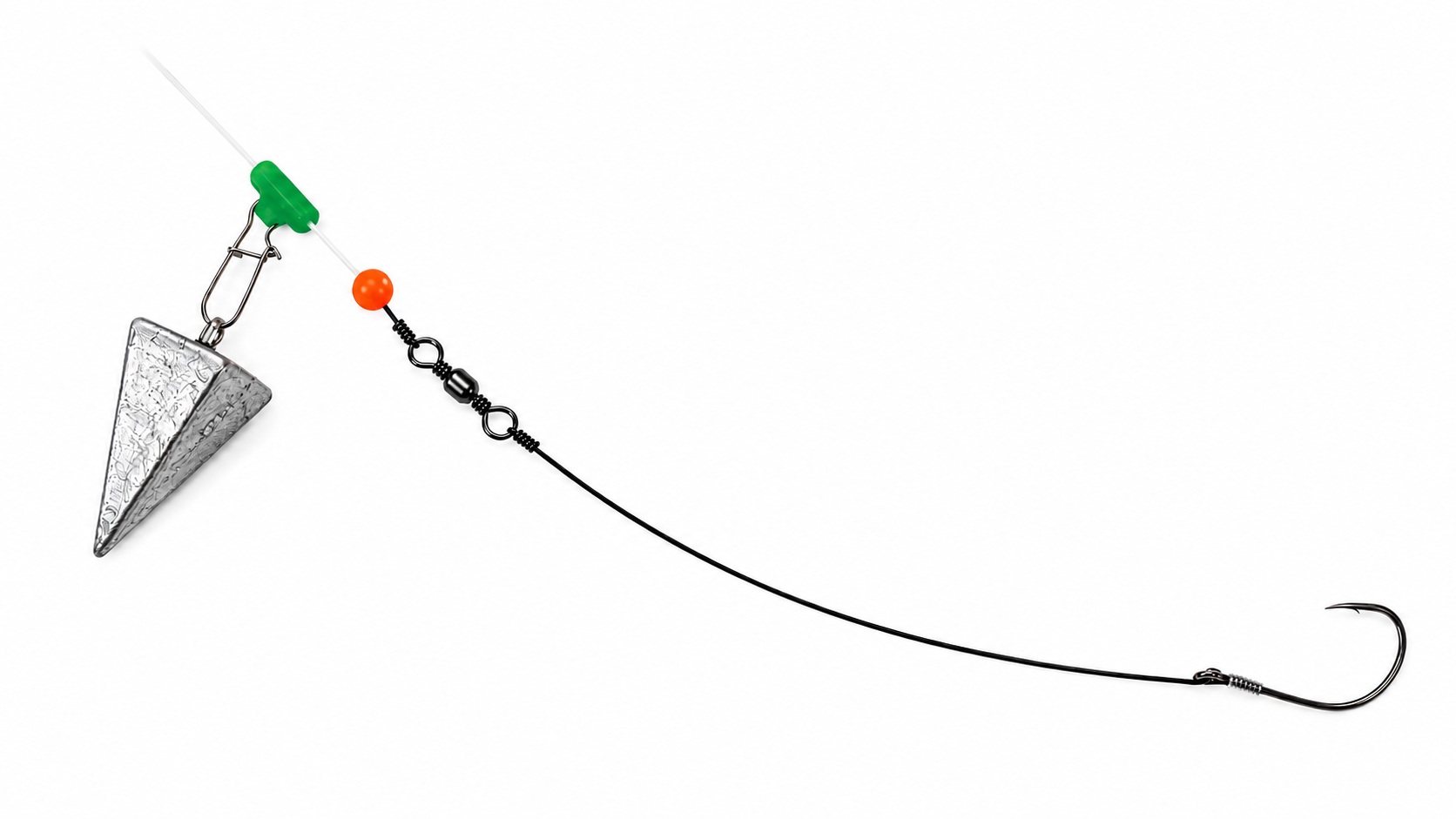
The fish-finder rig is a bottom rig built around one idea: let a fish pick up the bait and move without feeling the weight of the sinker. The sinker rides on a sleeve or snap swivel that slides freely along the main line. When a big fish grabs the bait and turns to run, the line feeds through the sinker with no resistance. The fish commits. You set the hook.
That sliding sinker design is what separates the fish-finder from rigs like the carolina rig, where the sinker is stopped a fixed distance above the hook and the fish feels some drag as it moves. The fish-finder is built for situations where the fish are large, cautious, and get one chance to commit — bull redfish working a trough behind a sandbar, black drum rooting around a jetty base, or striped bass holding in an inlet current at night.
This is a surf fishing staple up and down both coasts. But it also works in inlets, nearshore from a boat, and anywhere you need a bait pinned to the bottom with a long, free-moving leader.
How to rig it
The assembly is straightforward. You need four components: a sinker slide or egg sinker, a barrel swivel, a fluorocarbon leader, and a circle hook.
- Thread your main line through a sinker slide (or through the eye of an egg sinker directly). The sinker slide clips to your sinker and lets you swap weights without cutting the line — worth using in the surf where you change sinker sizes based on current.
- Tie a barrel swivel to the end of your main line. The swivel serves as the stop — the sinker slides down and hits the swivel, it goes no further.
- Attach your leader to the other eye of the barrel swivel. Use 18 to 36 inches of fluorocarbon. Shorter leaders (18 inches) work in heavier current where a longer leader will tangle; go 24 to 36 inches in calmer water or when targeting spookier fish.
- Tie your circle hook to the end of the leader. Size depends on target: 5/0 to 7/0 for bull reds, black drum, and large stripers; 3/0 to 4/0 for bluefish and snook.
Sinker choice: Use a pyramid sinker in the surf — the four-sided shape digs into sand and holds bottom against wave action and longshore current. Switch to an egg sinker for calmer inshore water or when you want the rig to roll slowly with a tidal current instead of staying fixed.
Leader material: 30 to 60 lb fluorocarbon covers most situations. Go heavier near structure or when targeting common snook and tarpon where a short bite could cut lighter material.
How to fish it
The fish-finder is a dead-stick rig. Cast it out, set the rod in a sand spike or rod holder, put the reel in free spool with the clicker on (or set a light drag), and watch the rod tip.
When a fish picks up the bait and moves, you will see the tip load up steadily — not a single tap, but a building bend. That is the fish running with the bait, taking up slack through the sliding sinker. With a circle hook, do not snap-set. Let the rod load, then sweep it forward in a long, smooth arc. The circle hook rotates and catches the corner of the mouth on its own. Yanking straight back pulls the hook out of the fish’s mouth before it can seat.
Resist the urge to move the bait. If you are fishing for big redfish or black drum, the bait sitting still on the bottom is the presentation. These fish are looking for something dead or injured that is not going anywhere.
When to use it
The fish-finder rig earns its place in rough conditions and for large target species. It shines when:
- Surf is running 2 to 4 feet and you need 4 to 8 oz of lead to hold bottom
- You are targeting big, bottom-feeding fish that will mouth a bait and pause before committing
- Current is strong enough that a free-drifting bait will get swept off the feed zone
- You are fishing overnight — the dead-stick approach lets you fish multiple rods and wait
It is a four-season rig in most coastal markets. Bull reds run the surf in fall; black drum stack up in inlets in spring; striped bass work beaches in fall and spring. In summer, the same rig with fresh-cut mullet or a whole crab will pull bluefish and occasional tarpon in pass and inlet situations.
Bait selection
| Target species | Recommended bait | Hook size |
|---|---|---|
| Bull redfish | Fresh-cut mullet, whole blue crab | 5/0–7/0 circle |
| Black drum | Clam, fiddler crab, shrimp | 4/0–6/0 circle |
| Striped bass | Bunker chunk, clam strip | 5/0–7/0 circle |
| Bluefish | Cut mullet, mackerel chunk | 4/0–5/0 circle |
| Common snook | Live mullet, live pinfish | 3/0–5/0 circle |
Fresh bait outperforms frozen in the surf. If you are cutting mullet, keep pieces palm-sized — big enough to stay on the hook through a long cast, small enough that a fish can get the whole thing in its mouth.
Gear setup
A medium-heavy to heavy surf rod in the 9 to 12 foot range gives you the casting distance to clear the breakers and the backbone to move big fish through the wave zone. Match it with a 5000 to 8000 series spinning reel spooled with 20 to 30 lb braided main line. Braid’s low diameter lets you cast heavy sinkers farther and gives you direct feel of the rod tip when a fish is loading up.
Add a 3 to 5 foot mono shock leader above the barrel swivel if you are casting 4 oz or more — it absorbs the snap of the cast and protects the braid from abrasion at the rod guides.
For inshore and inlet fishing from a boat, a 7 to 8 foot medium-heavy rod and a 3000 to 4000 reel handles the lighter sinker weights that work in calmer water.
Brands worth knowing
Eagle Claw makes widely available pre-rigged fish-finder rigs with a sinker slide, barrel swivel, and hook already assembled. They are a practical starting point if you want to learn the rig before building your own.
Owner and Gamakatsu are the go-to names for circle hooks. Owner’s Mutu Light circle hooks are sharp out of the package and thin-wire enough to penetrate easily on a sweep set. Gamakatsu’s Octopus Circle in 5/0 to 7/0 is a surf standard for big red drum.
For sinker slides, most surf anglers use simple plastic-sleeve slides or brass safety-pin slides — there is no premium option that outperforms a $1 piece of hardware here. The investment is in the hook and the leader material, not the hardware.