A note about links: If we include links to retail sites like Amazon or Bass Pro Shops, it's because they're relevant to the topic and, as anglers ourselves, we believe they're worth checking out. As an Amazon Associate we earn from qualifying purchases.
There is a particular moment that hooks black drum anglers for life: the rod propped against the rocks or the sand spike, a chunk of blue crab soaking on the bottom, and then the rod just loads. Not a tap, not a bounce — a load. Then the fish runs. Black drum are not acrobatic. They do not jump. What they do is pull with the slow, powerful authority of a fish that was designed to crush oysters for a living, and on that first big run, heavy tackle and all, it is more than enough. From the barrier island surf of Virginia and the Carolinas to the marsh-lined bays of Louisiana and Texas, black drum reach over 50 pounds and are accessible to any angler who can find a bottom rig and a piece of crab. They stack up in inlets, along jetties, and in oyster-bar estuaries within easy reach of shore anglers across hundreds of miles of coastline. If you fish the surf, the jetties, or the inshore bays and have never specifically targeted black drum, you have been walking past one of the coast’s best accessible fisheries.
How to identify one
Adult black drum are hard to mistake. The body is heavy and deeply arched, almost hump-backed through the shoulders, with a blunt, downturned snout built for rooting along the bottom. The color runs from dark gray to nearly black on the back, fading to a lighter belly, though very large fish can look almost uniformly charcoal. The fins are dark, and the tail is broad and squared off.
The single most useful field mark is the chin barbels, a cluster of fleshy whiskers on the underside of the lower jaw. No other common inshore fish on the Atlantic or Gulf coast looks quite like it, and that one feature separates black drum from redfish instantly. Redfish have no whiskers at all.
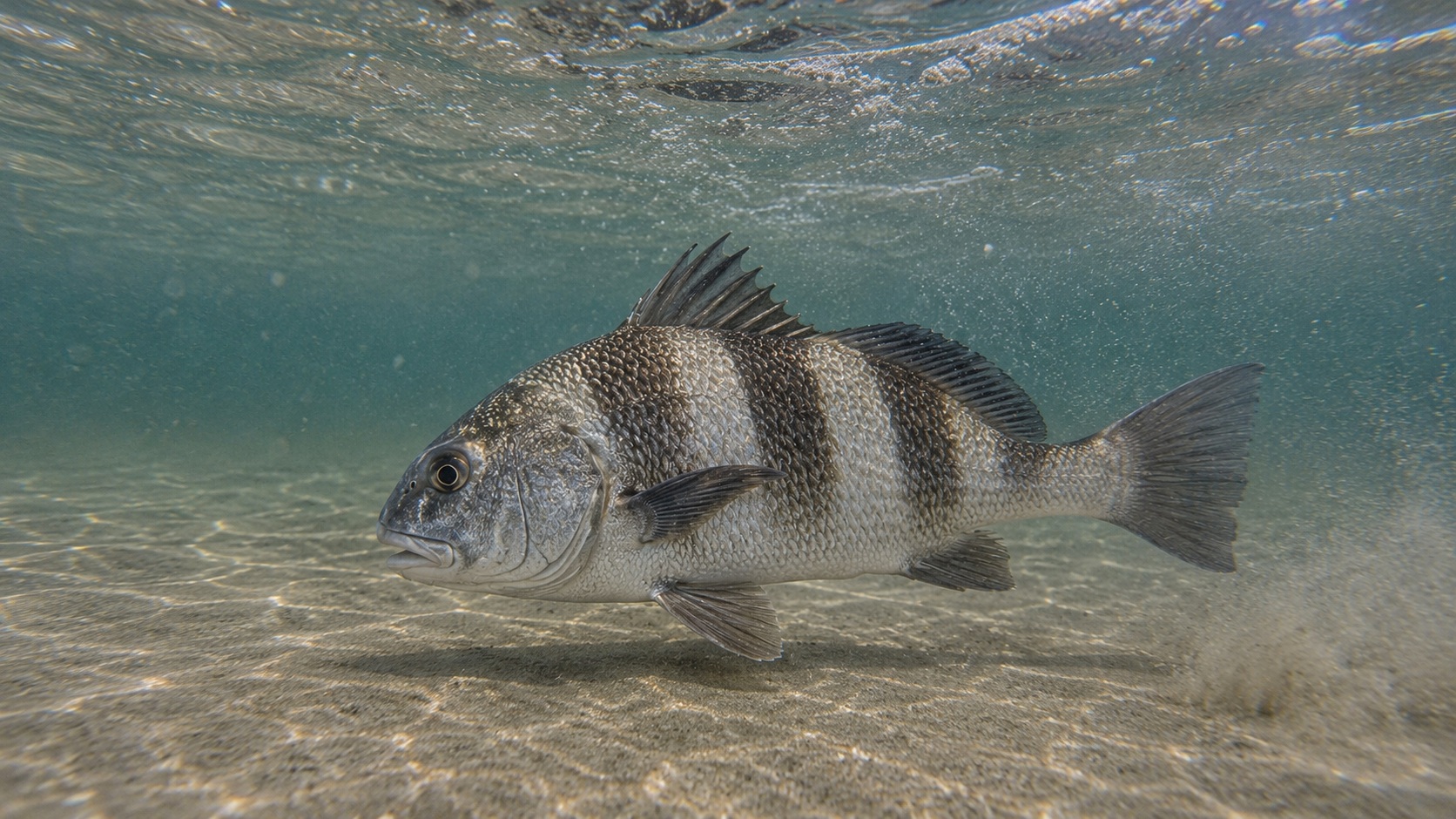
Juvenile black drum (generally fish under 12 inches) look entirely different. They carry four or five bold vertical black bars on a lighter silver body, which earns them the nicknames “striped drum” or “junior drum.” The bars fade with age, and by the time a fish hits 15 inches the stripes are usually gone. If you catch a striped fish with whiskers on an oyster bar, it is a juvenile black drum, not a sheepshead.
Sheepshead are the most likely lookalike. Both have vertical bars when young, both lurk around structure, and both have heavy teeth. The difference: black drum have chin barbels, sheepshead do not. Sheepshead also have very sharp, human-looking incisor teeth visible at the front of the mouth. Black drum have grinding plates set further back in the throat.
Where to find them
Black drum are a structure fish. They follow hard bottom, shell hash, oyster beds, and any substrate that produces the mollusks and crustaceans they eat. That pattern holds from Massachusetts to Mexico, and the types of spots worth fishing are consistent across the range.
Inlet jetties are the premier destination for large fish throughout the range. The rocks hold barnacles, mussels, and crabs year-round, and jetty channels funnel big drum into confined areas where they can be targeted efficiently. Fish the base of the rocks on an incoming tide with bait on the bottom. North Carolina’s Hatteras Inlet and Oregon Inlet, Virginia’s Chesapeake Bay bridge-tunnel structures, and the major Texas Gulf Coast jetties all produce trophy-class fish by this same formula.
Estuaries and back bays hold fish throughout the season, particularly where oyster reefs concentrate their food. The Chesapeake Bay and its tributaries are major spring staging areas for mid-Atlantic fish. The vast marsh systems of Louisiana and coastal Georgia hold drum in oyster-bar habitat most of the year. Dock pilings, bridge abutments, and shell-hash bottom in any of these systems are worth fishing.
Surf fishing produces drum in troughs and cuts along the beach wherever sand dollar beds or shell material concentrate near structure. The Outer Banks of North Carolina have a strong tradition of surf fishing for black drum, and the long barrier island beaches of South Carolina, Georgia, and the upper Gulf Coast offer similar access.
When reading water, look for current edges along structure — the point where moving tide pushes past a rock pile, a reef corner, or a channel edge is where drum tend to hold and intercept drifting food.
When to go
The timing of peak black drum fishing shifts significantly by latitude. Water temperature is a more reliable guide than calendar month: drum feed most actively in water between roughly 55 and 72 degrees Fahrenheit, and they move inshore and become accessible when temperatures drop into that range in fall, then retreat to deeper water or offshore as summer heat builds.
In the mid-Atlantic states (Virginia, Maryland, the Carolinas), the best fishing typically runs from late March through May in spring, then again in October and November in fall. Large spawning aggregations of drum concentrate in the lower Chesapeake Bay region each spring, drawing surf and jetty anglers from a wide area.
In the Gulf Coast states (Mississippi, Alabama, Louisiana, Texas), the season is longer. Fish are accessible from roughly October through April, with peak action in the cooler months. Large drum are present year-round in many Gulf back bays, though summer heat pushes them off the shallows.
In the South Atlantic states (Georgia, the Carolinas, and Florida), drum are present year-round but most targeted from fall through spring, when large fish move into inlets and along the beach.
One useful tip for jetty fishing across the range: fish an incoming tide when cooler oceanic water is being pushed into the inlet. Black drum tend to stack on the incoming, and on strong tidal movements you can find them holding in defined pockets along the rocks rather than scattered.
What to throw
Black drum feed exclusively on the bottom. They do not chase bait through the water column and they are not a topwater or mid-column fish. Every rig you throw should be a bottom rig.
Cut blue crab is the top bait, and it is not particularly close. Blue crab contains the scent compounds that trigger drum hardest, the shell provides durability on the hook, and the pieces are heavy enough to hold position in current without excessive weight. Cut a crab into quarters, leave the shell on, and put it on a circle hook. When large drum are in the jetties, fresh blue crab is the bait to have in the cooler.
Fresh or frozen shrimp works well for slot fish and is much easier to source than live crab. Hook it through the tail and let it sit. Shrimp produces plenty of drum, especially in estuaries and on beaches with lighter current. It also attracts redfish, sheepshead, and flounder, which makes it useful when you are not sure exactly what is holding on a piece of structure.
Clams are a traditional drum bait, particularly in the mid-Atlantic surf, and they work throughout the range. They are especially useful on sand beaches where crab may be hard to keep on the hook in current.
Sand fleas (mole crabs) are worth threading onto the hook when you can harvest them in the surf. Drum actively forage on sand fleas in the wash zone, and fresh-caught sand fleas produce fish in the troughs.
For the rig: a standard fish-finder rig or a Carolina rig works well. Use a 2-4 oz egg sinker depending on current (heavier for jetty channels, lighter inside back bays), a short section of 25-30 lb fluorocarbon leader, and a 3/0-5/0 circle hook. Circle hooks are strongly recommended. Black drum pick up bait, move with it, and then stop. Do not try to set the hook. Put the rod in a holder, point the tip toward the water, and wait for the fish to load the rod on its own. When the rod doubles over, pick it up and reel. The circle hook will find the corner of the mouth.
Heavy spinning tackle (4000-5000 series reel, 20-30 lb braid) or a medium-heavy conventional rod handles the jetty fish well. Match your drag to the weight of fish you might encounter: a 40-pound drum on light tackle near rocks is a lost fish.
Regulations
Black drum regulations vary by state. Most Atlantic and Gulf Coast states impose a size or slot limit along with a daily bag limit, and several states protect large brood-stock fish through either an upper slot limit or a special trophy permit system. Do not assume one state’s rules apply to the next — always check with your state fish and wildlife agency before keeping fish.
The slot limit concept matters ecologically regardless of where you fish. The very largest drum are the most reproductively important fish in the population. A 40-pound female produces vastly more eggs than a slot fish, and those large fish took decades to grow. If you are specifically targeting trophy-class fish, plan to release most of what you catch.
- Texas: Contact Texas Parks and Wildlife Department (tpwd.texas.gov) for current limits.
- Louisiana, Mississippi, Alabama: Contact your respective state wildlife agency.
- Georgia, South Carolina, North Carolina, Virginia: Contact your respective state fish and wildlife agency.
- Florida: Contact Florida Fish and Wildlife Conservation Commission (myfwc.com).
- Maryland and northward: Contact your state’s Department of Natural Resources or equivalent.
Handling and release
Black drum are durable fish that handle catch-and-release well. Wet your hands before touching them, support the belly on larger fish rather than hanging them vertically by the jaw, and minimize time out of the water. Very large fish (over 20 pounds) should not be held horizontally by the jaw alone. Return them headfirst into the current and give them a moment to recover before releasing your grip.
On the Table
Black drum is solid, underrated table fare when you target the right size fish — smaller drum in the 2-15 lb range are genuinely good eating, while large specimens become coarse, strongly flavored, and are far more likely to carry worm parasites.
Taste and texture: The flesh is white, lean, and firm with a mild, slightly sweet flavor and a faint briny undertone that reflects the fish’s diet of crabs and shellfish. Smaller drum have a clean, delicate profile often compared to a lighter version of redfish or grouper. Fish over 15 lbs can develop a noticeably stronger, murkier flavor and a dense, fibrous texture that is harder to cook well.
Best preparation methods: Blackening is the classic choice and suits drum perfectly — the firm flesh holds up to high-heat cast iron, and Cajun spice complements the mild sweetness without overwhelming it. Grilling on the half-shell (scale side down, skin and scales left on) works especially well for fish in the 3-8 lb range: the scales act as a heat shield, steaming the flesh from below while the top gets a light char. Pan-searing in butter produces a clean golden crust on skinless fillets and lets the natural flavor show. For very small puppy drum (under 3 lbs), light battering and frying in a neutral oil yields a crisp, mild fillet that holds together well.
Handling for table quality: Bleed the fish immediately after landing by cutting the gills or throat — this step has an outsized impact on flavor, especially in warm water. Place on crushed ice, not in standing water, to prevent waterlogging the fillets. Skin the fillets rather than scaling; black drum skin can carry a muddy flavor. Inspect fillets for spaghetti worms (thin white strands near the tail end) and remove any visible ones during prep.
Eating caveats:
- Worm parasites (spaghetti worms): Roughly 40% of black drum carry larval tapeworms (genus Poecilancistrium) in the flesh. These are harmless to humans — they are shark parasites using the drum as an intermediate host and cannot develop in warm-blooded animals. Thorough cooking or freezing kills them entirely. They are more common and more numerous in large fish, which is another reason to favor smaller drum for the table.
- Size selection: Slot limits in many states effectively push harvest toward the smaller, middle-size range — exactly the size class that eats best. Stick to that window and you will consistently get quality fillets.