A note about links: If we include links to retail sites like Amazon or Bass Pro Shops, it's because they're relevant to the topic and, as anglers ourselves, we believe they're worth checking out. As an Amazon Associate we earn from qualifying purchases.
What it is
Shrimp are the dominant forage species across most inshore and estuarine systems on the Southeast and Gulf coasts. Nearly every predator that lives in these waters eats shrimp — redfish, spotted seatrout, common snook, sheepshead, flounder, black drum, and mangrove snapper all key on them throughout the year. Soft plastic shrimp imitate that forage in a form that is durable, castable, and easy to fish.
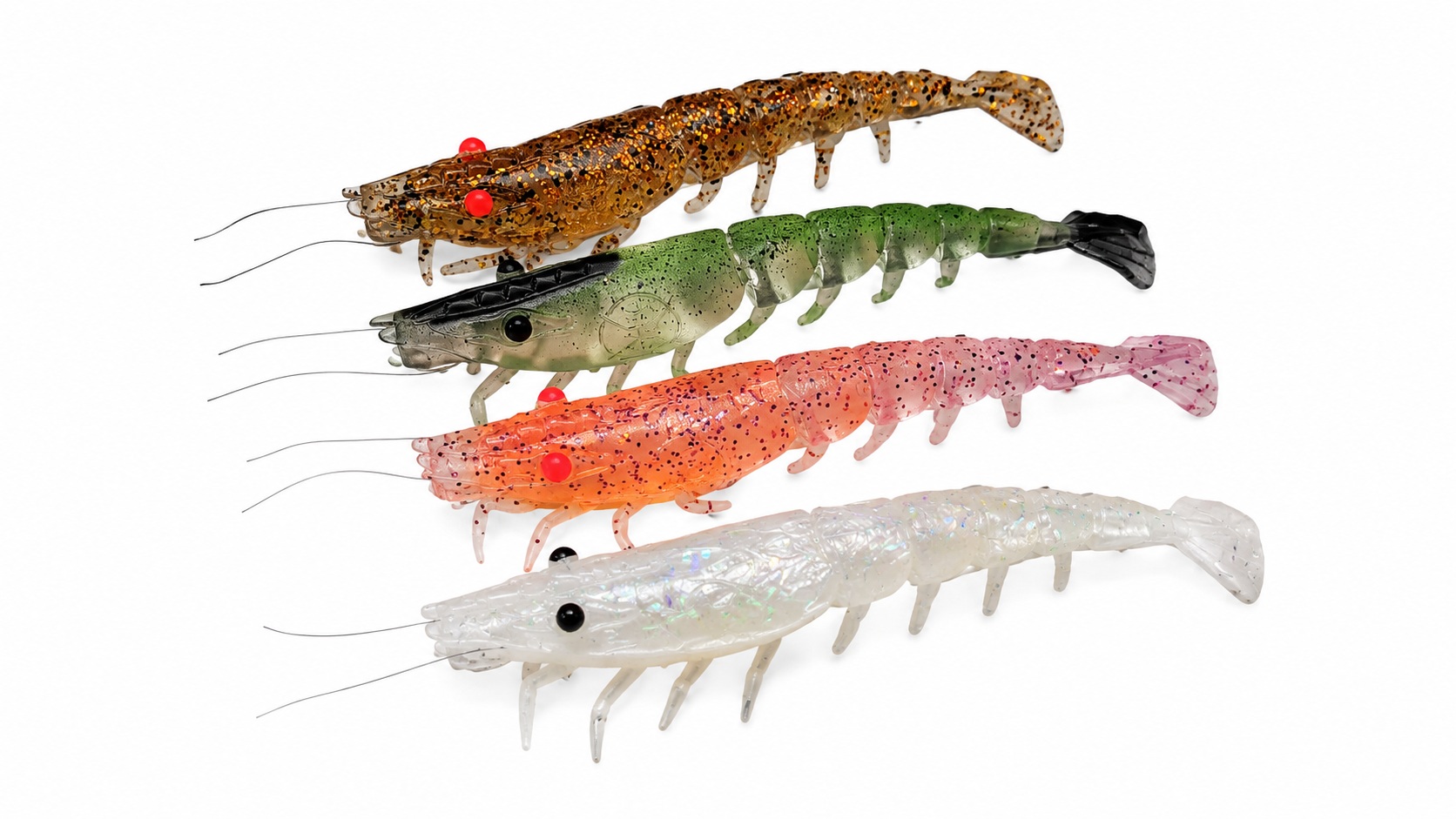
The appeal is straightforward: a well-designed soft plastic shrimp looks and moves like the real thing. Modern versions like the DOA Shrimp use lifelike body detail and a balanced hook position that causes the lure to fall tail-first, exactly as a live shrimp does when it drops into the water column. Berkley Gulp! Alive shrimp add a scent field that disperses through the water, giving the artificial a measurable edge over unscented plastics in low-visibility or cold conditions when fish rely less on sight.
This is one of the most beginner-friendly inshore lures available. It does not require a specialized retrieve, it works across a wide range of rigs and setups, and it catches fish year-round.
How to rig it
The three most common presentations are under a popping cork, on a jig head, and free-lined with no weight.
Popping cork: Thread the leader through the cork, then tie to a 1/0 or 2/0 kahle or J-hook and hook the shrimp through the tail or the body near the tail. The cork suspends the shrimp at a fixed depth — typically 12 to 24 inches — and the popping action draws attention. This is the default rig for trout and reds over grass flats.
Jig head: A 1/8 oz jig head is the standard choice for inshore depths. Run the hook point through the nose or the head of the shrimp. This rig gives you direct depth control and works well when you want to keep the presentation near the bottom for flounder or let it fall through the water column.
Free-lined: Hook the shrimp through the tail with minimal or no weight and cast it near structure — dock pilings, bridges, lighted piers at night. Current and buoyancy do the work. This is the preferred approach for common snook after dark.
How to fish it
Under a popping cork, the retrieve is a rhythmic pop-pause-pop. Give the cork two or three sharp pops with the rod tip to push sound and water disturbance, then let it sit for a count of two to five. Most strikes come on the pause while the shrimp is settling. Keep moving across the flat until you locate fish; grass flats with scattered pot holes are the classic setup.
On a jig head, use a slow lift-and-drop retrieve. Lift the rod tip from the 9 o’clock to the 11 o’clock position, reel down the slack, and let the lure fall back to the bottom on a semi-tight line. The descending fall triggers most strikes. A short twitch-and-glide variation also works well — three quick twitches followed by a pause lets the lure dart and then suspend.
Free-lining requires almost no retrieve. Cast upcurrent and let the shrimp drift naturally. If there is no current, a slow, steady pull with occasional pauses is enough.
When to use it
Soft plastic shrimp produce fish in every season, which is part of what makes them worth learning well. Shrimp are present in inshore systems year-round, though the populations peak in warmer months and push onto the flats in spring and summer. Fall migrations concentrate shrimp along shorelines and in passes, and the fish stack up behind them.
In cold conditions, fish slow down and a slow-moving shrimp imitation — particularly a scented one like Berkley Gulp! — is often more effective than faster lures. Spring and summer are the high-activity seasons for this bait; surface water temperatures above 68°F push trout and redfish onto the flats aggressively.
Use a popping cork when fish are scattered over shallow grass and you need noise to get their attention. Switch to a jig head when fish are holding near bottom structure or are visible and not responding to commotion. Free-line around dock lights or under bridges whenever snook or mangrove snapper are the target.
Size and color selection
| Size | Best applications |
|---|---|
| 2–3 inch | Sheepshead, smaller spotted seatrout, finicky fish |
| 3–4 inch | Redfish, common snook, larger trout, flounder |
| Condition | Color choice |
|---|---|
| Clear water, bright sun | Natural/clear, white, pearl |
| Stained or murky water | Gold, chartreuse, new penny |
| Low light / overcast | Pink, root beer, motor oil |
| Shrimp-moving conditions (nights, outgoing tides) | Brown/pink with gold flake |
When shrimp are actively moving through a system — typically on outgoing tides or during full-moon nights — match the local shrimp color as closely as possible. Browns and pinks with gold are consistent producers in these scenarios.
Gear setup
A light to medium-light spinning outfit is the standard choice. A 7-foot, fast-action rod rated for 1/4 to 5/8 oz handles popping cork and jig head setups without being overbuilt. Pair it with a 2500 to 3000 series spinning reel.
For main line, 10–15 lb braided line gives sensitivity and casting distance. Add a 24–36 inch fluorocarbon leader in 15–20 lb for visibility-shy fish in clear water. Fluorocarbon is the right call in most inshore scenarios; clear monofilament works as a budget substitute but is more visible in the water.
When free-lining around structure for snook, bump the leader to 25–30 lb to handle the fish near pilings and handle occasional contact with hard edges.
Brands worth knowing
DOA Shrimp is the benchmark. The 3-inch and 4-inch versions are the most widely used inshore artificials in the Southeast. The body design and hook position produce a natural tail-first fall without any modification. DOA also makes a shrimp with an internal rattle for extra sound in stained water.
Z-Man EZ ShrimpZ uses Z-Man’s ElaZtech material, which is tougher than standard soft plastic and survives multiple fish before tearing. The buoyant material keeps the shrimp riding correctly on a jig head.
Berkley Gulp! Alive Shrimp in natural and new penny are the top scented options. The Gulp! scent dispersion is measurably different from unscented plastics and gives a real advantage when fish are sluggish or visibility is limited.
Vudu Shrimp by EGRET Baits is another proven option with a realistic body profile and a pre-rigged jig head that keeps the shrimp oriented correctly.
Bass Assassin makes a shrimp-tail soft plastic that crosses over well for snook and trout and is widely available at regional tackle shops in the Southeast and Gulf states.