A note about links: If we include links to retail sites like Amazon or Bass Pro Shops, it's because they're relevant to the topic and, as anglers ourselves, we believe they're worth checking out. As an Amazon Associate we earn from qualifying purchases.
What it is
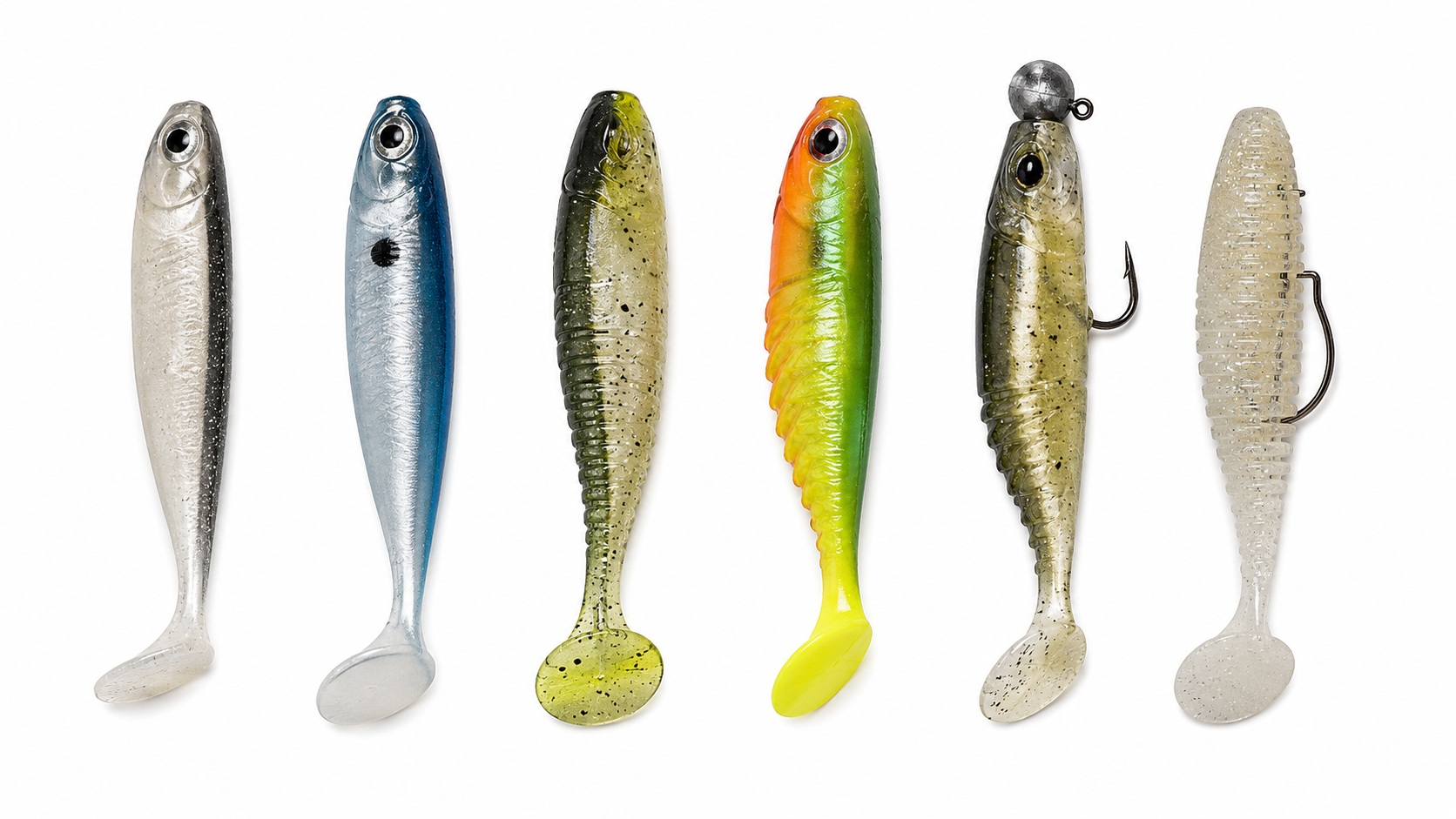
A paddletail swimbait is a soft plastic bait shaped like a small baitfish, with a flat, shovel-shaped tail that flaps back and forth on a straight retrieve. That tail does the work — it produces a consistent side-to-side thump that mimics a swimming shad, mullet, or finger mullet at almost any speed you choose.
The design is simple, which is exactly why it works. You cast, retrieve, and the bait looks alive. There is no special action required, no pauses you have to time precisely. That makes it one of the most beginner-friendly lures you can own, while still being a go-to for experienced anglers targeting everything from largemouth bass in a freshwater lake to redfish on a tidal flat.
Saltwater anglers in particular have leaned on paddletails for decades. On the Space Coast and throughout the Southeast, it is often the first bait tied on when fish are feeding on bait schools. It crosses cleanly from clear-water flats to tannin-stained lagoons to nearshore reefs without needing any modification beyond swapping the color or head weight.
How to rig it
The standard setup is a jig head with an exposed round or pointed hook — a “swimbait hook” or standard ball-head jig. Thread the hook through the nose of the bait, exit out the top of the body just ahead of the belly, and make sure the body is perfectly straight on the shank. A crooked bait will spin and twist your line rather than swim.
| Depth / Condition | Jig Head Weight |
|---|---|
| Shallow flats, calm water | 1/8 oz |
| Mid-depth, light current | 3/16 oz |
| Deeper water or wind | 1/4 oz |
| Nearshore, strong current | 3/8–1/2 oz |
Match the head weight to how deep you need to fish and how fast the water is moving. A head that is too heavy will drag the bait through the bottom. Too light and you lose contact in any wind. In current, go heavier than you think you need.
For grass-heavy environments, you can also rig a paddletail on a weighted wide-gap hook weedless, though you sacrifice some tail action at very slow speeds.
How to fish it
The basic retrieve is a steady wind at medium speed, keeping the bait just above the bottom or in the middle of the water column depending on where fish are holding. The tail generates action automatically — you do not need to pump or twitch the rod.
Vary your retrieve speed until fish respond. Faster retrieves push the tail harder and draw reaction strikes from aggressive fish. Slower retrieves put the bait in the strike zone longer when fish are sluggish.
A few presentations worth knowing:
- Swim and drop: Cast past the target, let the bait sink on a semi-slack line, then begin a steady retrieve as it approaches the zone. This works well around dock pilings and channel edges.
- Grind the bottom: Reel just fast enough to feel the tail kick, letting the bait occasionally tick the bottom. Effective for flounder and bottom-holding fish.
- High-speed burn: A fast, near-surface retrieve triggers instinct strikes from bluefish, striped bass, and aggressive spotted seatrout.
When to use it
Paddletails produce year-round, but they shine brightest when baitfish are present. If you see mullet schools, glass minnows, or shad flickering on the surface, a paddletail that matches their size is usually the right call.
In the morning, topwater often outfishes everything else. Once the sun climbs and fish pull off the surface, switching to a paddletail on a jig head extends productive fishing through mid-morning and into the afternoon.
The bait works in virtually every environment: clear-water freshwater lakes, tannin-stained coastal rivers, grass flats, dock lines, nearshore reefs, and open beaches. Season matters less than bait presence and water temperature — when water is below 55°F, slow your retrieve significantly.
Color selection
Color choice is straightforward once you understand the water clarity rule.
| Water Condition | Color |
|---|---|
| Clear flats, bright sun | Pearl, white, clear with silver flake |
| Tannin or tea-stained water | Root beer with gold or red flake |
| Dark pockets, dock shadows | Chartreuse belly, darker back |
| Low light, overcast | Darker naturals, black back |
Match baitfish color in clear water. Go louder and more contrast-heavy in stained water. Chartreuse is rarely wrong in dark or shaded areas.
Size selection
| Bait Size | Best Use |
|---|---|
| 3–4 inch | Finesse inshore, pressured fish, smaller bait schools |
| 4–5 inch | Bigger target species, larger bait profiles |
| 5–7 inch | Trophy bass, cobia, large striped bass |
Start with a 4-inch bait as your default. Downsize when fish are picky or bait is small. Size up when targeting larger species or when fish are eating bigger forage.
Gear setup
A medium or medium-light spinning rod in the 7-foot range handles most paddletail situations. Pair it with a 2500–3000 size reel spooled with 10–20 lb braided line and a 12–20 lb fluorocarbon leader. Fluorocarbon is nearly invisible underwater and has less stretch than mono, which improves hooksets and sensitivity.
For freshwater bass, 10–15 lb braid with a 10 lb fluoro leader is a clean all-around setup. For inshore saltwater or nearshore work, bump the leader to 20–30 lb if cobia or large snook are a possibility.
Brands worth knowing
Z-Man MinnowZ and DieZel MinnowZ are the standard for inshore saltwater. Z-Man’s ElaZtech material is buoyant, nearly indestructible, and holds up through multiple fish without tearing apart. The DieZel is a larger profile built for bigger fish.
DOA CAL Shad has a long track record in Florida inshore fishing. The soft, supple plastic gives it a natural swimming action at very slow retrieves, which makes it effective in cold water when fish are lethargic.
Berkley PowerBait Swim Shad adds scent into the equation, which can help trigger hesitant fish into committing. A solid freshwater option.
Bass Assassin Sea Shad is a proven inshore workhorse available in a wide range of colors, including several color patterns built specifically for the Gulf and Atlantic coasts.
Savage Gear 3D Minnow offers a more realistic profile with detailed finishes, useful in clear-water situations where fish get a close look before striking.