A note about links: If we include links to retail sites like Amazon or Bass Pro Shops, it's because they're relevant to the topic and, as anglers ourselves, we believe they're worth checking out. As an Amazon Associate we earn from qualifying purchases.
What it is
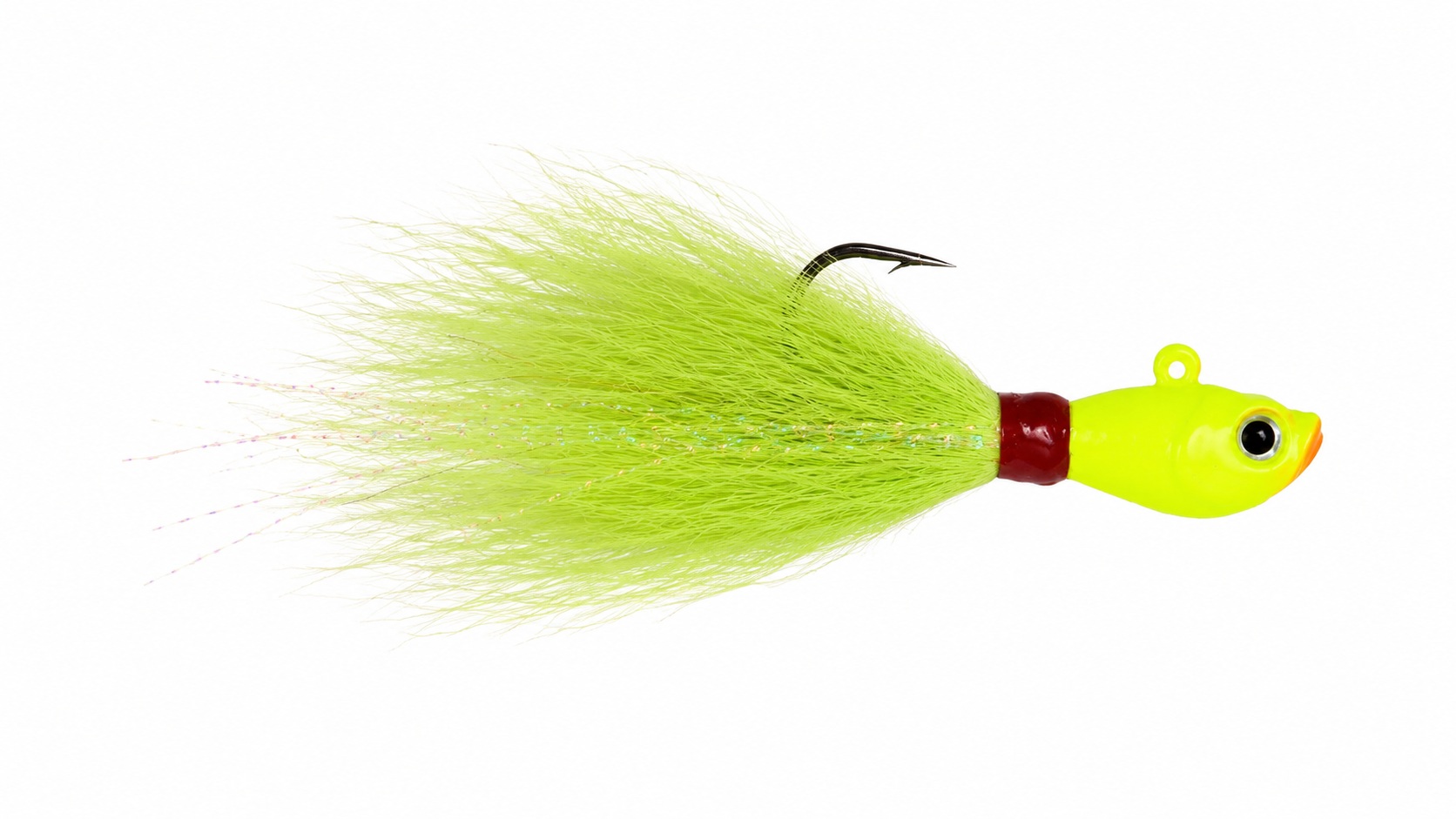
The bucktail jig is one of the oldest, simplest, and most productive saltwater lures ever made. It is nothing more than a lead jig head tied with a collar of deer-tail hair — bucktail — that flows and pulses in the water with every pause in the retrieve. That breathing action, which happens with almost no angler input, is why the bucktail has stayed relevant for decades while more complicated lures come and go.
Saltwater anglers reach for bucktails when they want a bait they can throw anywhere: into structure, along a sandy bottom, across a flat, or straight down under a boat. It sinks fast, handles current well, and draws strikes from a long list of inshore and nearshore predators. Common snook, redfish, flounder, striped bass, bluefish, cobia, and spanish mackerel all eat bucktails regularly. The lure is beginner-friendly — the presentation requires no special motion — but it rewards anglers who learn to work it precisely.
How to rig it
A bucktail jig comes pre-tied from the factory and is ready to fish out of the package. The hook is molded into the jig head; there is no separate hook to rig. That said, there are two useful additions:
Trailers: A soft plastic trailer — a curly-tail grub, a paddletail swimbait, or a soft-plastic shrimp — threaded onto the hook adds bulk, scent, and a larger profile. In clearer water, a matching-color trailer is a common upgrade. In stained water or during the mullet run when big fish are feeding aggressively, more profile can trigger faster strikes.
Assist hook: Some anglers rig a short trailing hook off a loop or assist cord through the eye of the main hook when targeting short-striking fish like flounder or when using longer trailers that put the hook away from the strike zone. This is optional but worth knowing.
No leader setup is required beyond whatever you have tied to your mainline — a 24 to 36 inch fluorocarbon leader of 20 to 30 lb is standard for inshore work, attached to braid via an FG or double uni knot.
How to fish it
The most common retrieve is a cast-and-hop presentation: cast the jig upcurrent or toward structure, let it sink to the desired depth, then lift the rod tip and let the jig fall back. The strike usually happens on the fall. Keep the line semi-taut during the drop so you feel it.
The pause matters: The deer hair on a bucktail is at its most effective when the jig is motionless or nearly motionless. A hard stop in the retrieve lets the hair flare out and pulse without any movement from you. Do not rush past this moment.
At piers and jetties: Cast uptide into the rocks and pilings, then let the current sweep the jig naturally past the structure as it sinks. This mimics a baitfish being pushed through the current — exactly what snook and striped bass are waiting for. Keep the rod tip low and follow the drift.
For flounder on sandy bottom: Drag the jig slowly along the sand near jetty bases, inlet channels, and grass edges. Keep it close to the floor and move it in short hops. Flounder ambush from below; the jig needs to pass within a few inches of their lie.
Vertical jigging: From a boat positioned over structure, drop the jig straight down, let it hit bottom, and work it in short hops with a tight line. This is effective for cobia over reefs and amberjack over wrecks, and for snook and redfish holding under docks in tidal current.
When to use it
The bucktail is a four-season bait, but a few scenarios stand out.
Moving tides near structure: Tidal flow activates inshore predators that hold near rocks, pilings, channel edges, and inlet mouths. A bucktail fished on a moving tide — incoming or outgoing — is one of the most reliable setups for snook and redfish in these locations.
The mullet run: Along Florida’s east coast and throughout the Southeast, the fall mullet migration triggers some of the best inshore action of the year. A 3/4 to 1 oz white bucktail fished through an inlet on a moving tide during the mullet run will draw strikes from snook, bluefish, jacks, and larger predators following the bait schools.
Pier tips and bridges: At pier tips where current concentrates bait, a bucktail cast upcurrent and allowed to swing past the end is a proven approach for spanish mackerel and bluefish. Use a silver or white jig and keep the retrieve faster in this scenario.
Post-frontal clear water: When cold fronts push clean water into the estuary, bucktails outperform noisier hard baits. The subtle, natural action of the hair holds fish attention better in conditions where finesse matters.
Size and color selection
Match the jig weight to the current and depth, and the color to water clarity.
| Weight | Best use |
|---|---|
| 1/4 oz | Shallow flats, calm conditions, light current |
| 3/8 – 1/2 oz | Standard inshore all-around; moderate current |
| 3/4 oz | Inlet fishing, jetties, moving tides; snook and reds in current |
| 1 oz+ | Strong tidal current, nearshore structure, vertical jigging from a boat |
| Color | When to use |
|---|---|
| White | Default choice; works in most conditions for most species |
| Chartreuse / white | Stained or off-color water; gets seen in low visibility |
| Silver / white | Clear water; mackerel, bluefish, striped bass at surface or mid-column |
| Pink / tan | Mimics shrimp; redfish and flounder in shallow grass and sand flats |
| Brown / natural | Ultra-clear conditions when fish are spooky |
Gear setup
Rod: A medium to medium-heavy 7 to 7’6” spinning rod with a fast tip works well for most bucktail applications. Enough backbone to cast heavier jigs and set the hook firmly, with a sensitive tip to feel the fall.
Reel: A mid-sized spinning reel in the 2500 to 4000 class spooled with 20 to 30 lb braided line. Braid’s low stretch transmits the tap of a strike on the drop and keeps the jig responsive at depth.
Leader: 24 to 36 inches of 20 to 30 lb fluorocarbon. For toothy species like bluefish or king mackerel, step up to a short section of 40 to 60 lb mono or use wire. For everything else, fluorocarbon is adequate.
Brands worth knowing
SPRO makes the Bucktail Jig in a full range of weights and colors, with tight hair ties that hold up to repeated use. It is one of the most widely available quality bucktails in the market.
Hookup Baits produces bucktails specifically designed for inshore fishing with balanced swim angles and high-quality hooks. They are a popular choice among Florida inshore guides.
Tsunami and Barlows offer solid value-tier options that fish well and are easy to find at coastal tackle shops.
VMC makes bucktail jig heads separately, which lets you tie or rebind your own hair if you want to customize colors or replace a worn collar — a small step up in craft that dedicated bucktail anglers often take.