A note about links: If we include links to retail sites like Amazon or Bass Pro Shops, it's because they're relevant to the topic and, as anglers ourselves, we believe they're worth checking out. As an Amazon Associate we earn from qualifying purchases.
If you have never had a jack crevalle eat a topwater popper in front of your eyes, you are missing one of the purest thrills inshore fishing has to offer. These fish travel in wolf packs, push bait schools to the surface, and attack with a violence that does not feel proportional to their size. Anglers who first hook a 15-pound jack on a medium spinning rod often cannot believe what happens next: the fish simply does not stop. It makes a searing run, comes back, makes another run, bulldogs toward the bottom, and keeps going until you have pumped it to the surface four times. On light tackle, a solid jack is a 15-to-20-minute fight against a fish that plays as hard at the end as at the start. They are common along much of the Atlantic and Gulf coasts, they eat almost anything you throw at them, and they are one of the most accessible hard-fighting fish any angler can target from shore, kayak, or boat.
How to identify one
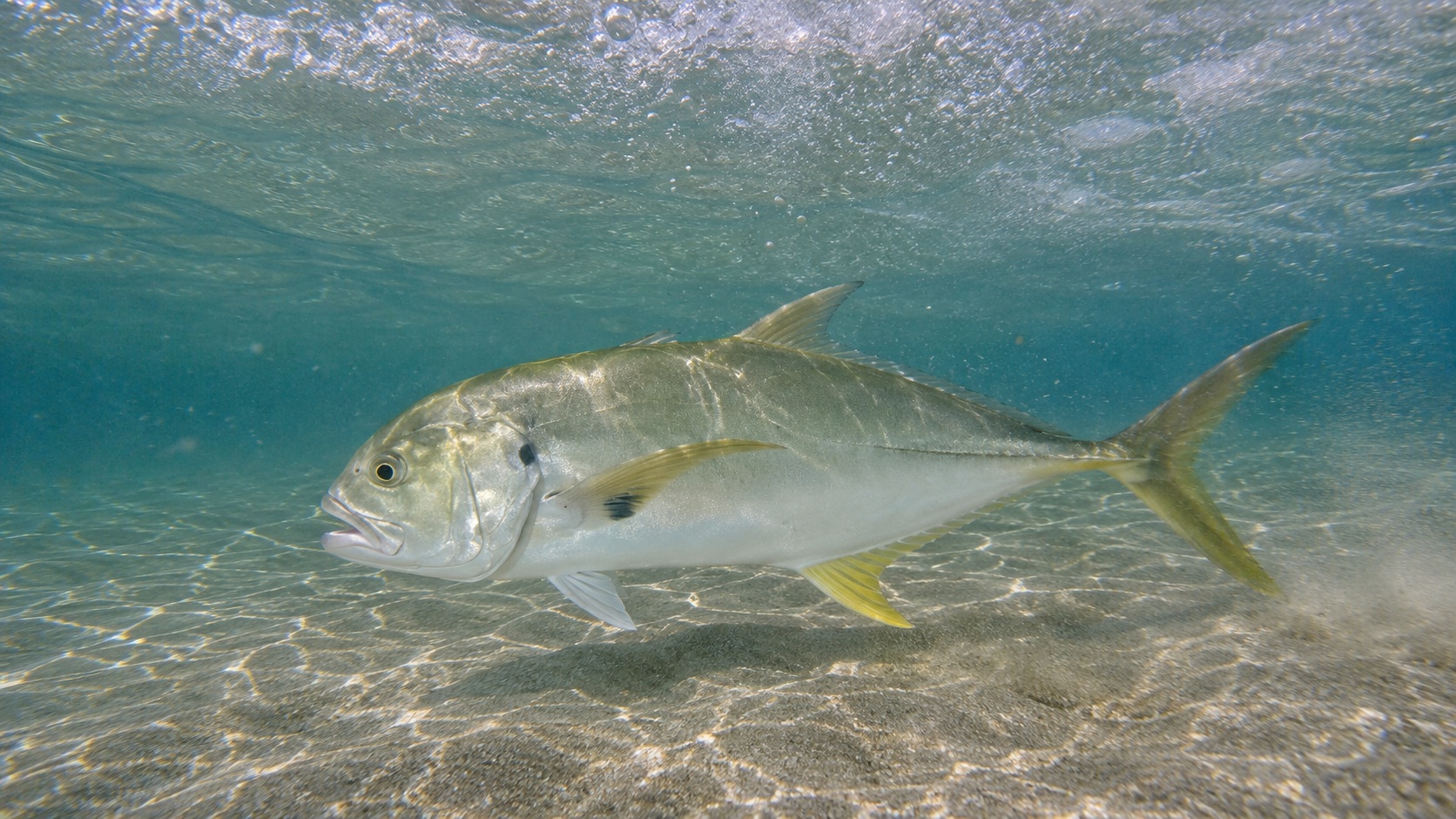
Jack crevalle are built like a compressed wedge. The head is blunt and rounded, the body is deep and laterally flattened, and everything tapers sharply toward a narrow caudal peduncle that connects to a powerful, deeply forked tail. That tail is the engine: it generates the powerful thrusts that make jacks so exhausting to fight.
The most reliable field ID mark is the solid dark spot at the base of the pectoral fin. Every jack crevalle has it. There is also a dark spot on the upper edge of the gill cover. The back runs from bluish-green to greenish-gold, and the belly is silver to yellowish. The chest patch between the pelvic fins and the pectoral fins is scaleless, which is unusual and a useful confirmation if you have the fish in hand.
Juveniles (6 to 12 inches) carry five dark vertical bars on the sides that fade as they mature. These smaller fish are extremely common in estuary and backcountry environments and are fantastic on ultralight gear.
The species most likely to cause confusion is the horse-eye jack (Caranx latus), which has a similar body shape. Look at the eye: horse-eye jacks have noticeably larger eyes relative to the head and lack the distinctive blunt-nosed profile.
Where to find them
Jack crevalle thrive wherever baitfish concentrate. Schools of adults work surf troughs and jetties, crashing through mullet schools and blitzing in a way you can often see from the beach. Around inlets and passes, jacks stack up in the current near rocks and jetties, particularly during mullet runs in late summer and fall. In estuaries and lagoons, they roam grass flat edges, work the channels between spoil islands, and push bait against shoreline structure.
Along the Atlantic coast, jacks are common from the Carolinas through the Florida Keys and can show up as far north as New England during warm summer months. The Chesapeake Bay and its tributaries see schools of jacks in summer and early fall. In the Gulf of Mexico, the species is abundant from Florida through Texas, with the bays and estuaries of Louisiana, Mississippi, Alabama, and the Texas Gulf Coast all hosting good numbers in the warmer months. Corpus Christi Bay and the Laguna Madre region in Texas are well-known jack crevalle fisheries. On the Pacific coast, the closely related Pacific crevalle jack (Caranx caninus) ranges from Baja California into California waters during warm years.
Structure is a consistent attractor regardless of region. Dock pilings, bridge abutments, channel markers, inlet jetties, and any submerged debris will hold jacks at some point during the day. They are not homebodies, though; a school can move a quarter mile in minutes when chasing bait. The most reliable way to find them is visually: look for sudden surface explosions, nervous baitfish jumping clear of the water, or diving terns and pelicans working a moving school. Birds on a moving bait ball almost always have jacks underneath.
In backcountry and estuary flats throughout their range, juvenile jacks from 6 to 12 inches are a constant presence around grass edges and mangrove shorelines.
When to go
Jack crevalle are a warm-water species, and water temperature is the most reliable guide to when they are active. Schools become most aggressive once water temperatures climb above 70°F, with peak surface-feeding behavior typically occurring between 72°F and 85°F. Below 65°F, schools shrink, fish move offshore or to deeper structure, and surface blitzes become rare.
Because of this temperature dependence, timing shifts significantly by latitude. In the Gulf Coast and South Florida, jacks can be caught year-round with only a brief winter slowdown. From the Carolinas and the mid-Atlantic coast, the season runs roughly May through October, with the best action concentrated in summer and early fall. In the northernmost reaches of their range — waters around New York and New England — jacks are a warm-season visitor from June into September.
The fall bait migration is the single most reliable trigger for blitz conditions throughout their range. As mullet and other forage species make their annual southward runs along both coasts, jack crevalle are among the most aggressive predators pushing them to the surface. This window — which arrives earlier in northern states and later in southern ones — is peak time for topwater action from shore or boat.
The heat of summer midday often pushes active schools deeper or into shadier structure; early morning and late afternoon are consistently more productive.
What to throw
Jack crevalle are opportunistic and fast, and the single most important thing you can do is match the speed and chaos of what they are doing. A slow presentation to an active school will often be ignored entirely.
Topwater poppers are the most exciting option and legitimately one of the best. A 3/4 to 1 oz popper worked with hard, rhythmic pops and short pauses gets destroyed when jacks are working the surface. The retrieve does not need to be subtle. Loud, splashy, and fast is the right call. When you see a school pushing bait, lead them by 10 to 15 feet and start popping immediately.
Metal spoons and fast-retrieved jigs account for a huge number of jacks. A 3/4 oz silver spoon burned back to the boat through a bait school is almost irresistible. The same logic applies to a 1/2 oz bucktail jig or a paddle-tail swimbait on a 3/8 oz jighead: keep the retrieve fast, keep the bait near the top of the water column when fish are surface-feeding.
Live bait produces the biggest fish, especially around inlets and passes. A live finger mullet, pinfish, or menhaden fished under a popping cork or free-lined near structure will get eaten.
Flies are spectacular when jacks are in range. A large, flashy baitfish pattern stripped fast through the edge of a feeding school produces crushing strikes. Jacks are a popular fly target in estuary and lagoon systems precisely because they are aggressive, often visible, and give fly anglers their money’s worth.
Regulations
Jack crevalle regulations vary by state. In some states the species is unregulated, meaning no minimum size limit or bag limit applies. In others, general saltwater fish rules or specific jack regulations may apply. Always check current rules with your state’s fish and wildlife agency before fishing. In Florida, jack crevalle are currently unregulated by FWC, with a default 100-pound-per-person-per-day recreational limit. Because jack crevalle range across multiple Gulf and Atlantic states, regulations can differ significantly depending on where you are fishing — confirm local rules before you go.
Handling and release
Most jacks are released, and they handle well if you keep the fight reasonably short and avoid dropping them. Grip the fish firmly across the body just ahead of the tail and support the belly for a quick photo. Revive the fish headfirst into the current until it kicks free strongly. A jack that fought hard for 15 minutes may need 20 to 30 seconds of revival before it swims off with authority.
If you want to eat one, smoking is the recommended preparation. The meat is dark, oily, and strongly flavored, which puts off most anglers who try it pan-fried. Brined and slow-smoked, the strong flavor becomes an asset.
On the Table
Jack crevalle are primarily a catch-and-release fish for most anglers, and that reputation is earned — but not entirely deserved. With careful handling and the right preparation, smaller fish can be genuinely good eating. Larger specimens are usually released or used as bait, and for good reason.
Taste and texture: The flesh is dark pink to reddish-brown, dense, and coarse-grained — more reminiscent of red meat than typical flaky white fish. Flavor is bold, rich, and distinctly “fishy” if mishandled; properly bled and trimmed fish has a deep, savory flavor that some compare to beef or tuna. A prominent bloodline running through each fillet is the main source of strong off-flavors and must be removed entirely before cooking.
Best preparation methods: Jack crevalle rewards high-heat, bold-flavored approaches rather than delicate techniques.
- Blackening or pan-searing: The firm, dense flesh holds up well to a hot cast-iron skillet. Heavy spice rubs with paprika, cayenne, garlic, and herbs mask any remaining gaminess and produce a great crust.
- Grilling over high heat: Cube the trimmed fillets for kabobs or grill whole butterflied fillets. Cook to medium — some pink remaining in the center — because jack dries out and toughens quickly past that point.
- Citrus marinade then grill or broil: A lime-juice, garlic, and cumin marinade for 30-60 minutes before cooking tenderizes the flesh and balances the bold flavor profile.
- Smoking: The oily, meaty texture takes smoke well. Works best for smaller fish where the bloodline has been fully removed.
Handling for table quality: Handling is everything with jack crevalle. Bleed the fish immediately after landing — cut behind the gills or nick the tail and let the heart do the work — ideally within two minutes of the catch. Blood left in the flesh is nearly impossible to cook around. Place fish on ice immediately after bleeding. When filleting, remove the entire dark bloodline that runs laterally through each fillet; use a flexible knife and cut generously around it. Some anglers soak trimmed fillets in milk or buttermilk for 12-24 hours, which draws out remaining blood compounds and further mellows the flavor. Keep fillets smaller (from fish in the 2-4 pound range) for the mildest results.
Eating caveats:
- Size strongly affects quality: Jacks over roughly 5 pounds develop more pronounced bloodlines, stronger flavor, and coarser texture. Most experienced anglers keep only fish under 24 inches for the table.
- Moderate mercury: Jack crevalle accumulate moderate mercury as they grow. Larger, older fish should be eaten infrequently; pregnant women, nursing mothers, and young children should avoid large fish and limit smaller ones to one serving per month.
- Low-to-moderate ciguatera risk: Jacks caught near reef structures in tropical and subtropical waters carry some ciguatera risk, though it is lower than for dedicated reef predators like large grouper or barracuda. Open-water and Gulf Coast fish carry minimal risk. Ciguatoxins are not destroyed by cooking.