A note about links: If we include links to retail sites like Amazon or Bass Pro Shops, it's because they're relevant to the topic and, as anglers ourselves, we believe they're worth checking out. As an Amazon Associate we earn from qualifying purchases.
What it is
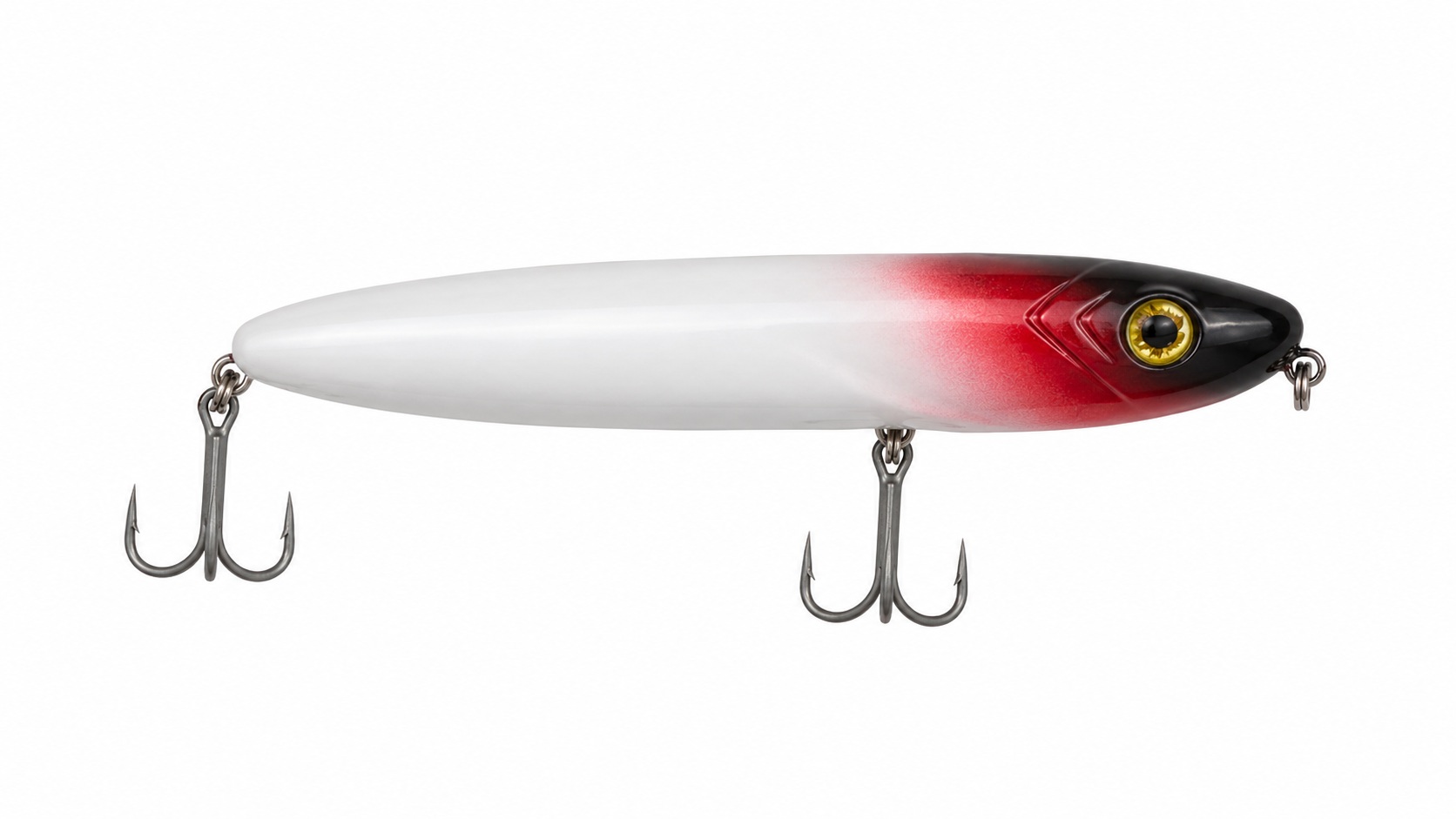
The topwater walker is a hard plastic, cigar-shaped surface lure that produces a rhythmic side-to-side “walk-the-dog” action when worked on slack-line twitches. It carries no built-in lip or rattle chamber designed to pull the bait down — the design keeps it on the surface, where the angler’s rod work drives all of the movement. The result is a lure that zigzags across the water with minimal forward momentum, covering a small patch of water for a long time and giving predatory fish multiple looks.
Few presentations are more visual. When a largemouth erupts on a walker in shallow water, or a redfish blows up on one over a grass flat at first light, it is the kind of strike that keeps anglers coming back. The topwater walker works across fresh and salt water, covering bass in lakes, striped bass in rivers, redfish and spotted-seatrout over inshore grass flats, and open-water bluefish and jack-crevalle anywhere bait is being pushed to the surface.
It is beginner-accessible. The technique takes a few casts to feel right, but it does not require tuning or specialized tackle beyond what most anglers already own.
How it’s rigged
Topwater walkers come equipped with two or three sets of treble hooks from the factory. No additional rigging is needed in most cases. What matters is the connection to your line.
A loop knot — a Non-Slip Mono Loop or Rapala knot — is the preferred connection. A loop allows the lure to pivot freely at the line tie, which amplifies the walking action. A tight clinch knot or improved clinch knot restricts that pivot point and deadens the action noticeably, especially on smaller lures.
Avoid heavy snap swivels. A small, high-quality coastlock snap is acceptable and makes lure changes faster, but a thick swivel adds weight to the nose and pushes the bait out of balance.
In saltwater, replace factory trebles with corrosion-resistant hooks (VMC, Owner, or Gamakatsu stainless or coated) before your first trip. Standard freshwater hooks rust quickly in salt and brackish water.
How to fish it
The retrieve is the technique. Point your rod tip down toward the water — close to parallel with the surface — and use short, sharp, rhythmic wrist twitches to make the lure dart left and then right. Each twitch pushes slack line into the bait, which allows the nose to kick to one side. The rod tip comes back to neutral between each twitch before the next one fires. Let the line go slack between beats; if you’re maintaining constant tension, the bait will track straight and the action disappears.
The cadence is the variable you control to match fish activity. A slow, deliberate walk with a full one-count pause between twitches is the right starting point during cold fronts, in cold water, and anytime fish are reluctant to commit. A faster, more aggressive cadence with shorter pauses suits active fish in warm water — redfish over shallow grass at first light, bass pushing baitfish against a bank, or bluefish working a blitz.
Work it along dock shadows, over submerged points, parallel to grass edges, or across open pockets in shallow cover. In the lagoon or inshore flats, redfish and gator trout respond well to a slow walk over grass at low light. Cast past the target structure and retrieve the bait along it — walking the lure so it spends time in the strike zone, not just passing through it.
When to use it
The topwater walker is a warm-weather bait. It works best when water temperatures are above 60°F and fish are actively feeding at or near the surface. Spring, summer, and early fall are the primary windows.
Early morning is the most productive time of day. The combination of low light, calm surface conditions, and actively feeding predators makes first light the top window for both freshwater and saltwater applications. Overcast days extend that window — fish stay on top longer when the sun is not driving them into the shade. On bright, sunny days, focus walker fishing on the first and last hour of light.
Post-front conditions shut down topwater fishing quickly. Cold fronts push water temperatures down and calm the surface in ways that make fish reluctant to commit to a fast surface bait. After a front, drop down to a soft plastic on a texas rig, a drop shot, or a subsurface bait until conditions stabilize.
In salt water, the topwater walker is a go-to during mullet and glass minnow runs when inshore predators are pushing bait to the surface. Redfish, common snook, and spotted-seatrout stack up in predictable areas — grass flat edges, oyster bar drop-offs, the mouths of tidal creeks — and walkers are one of the fastest ways to locate and trigger fish.
Color selection
Color choice for topwater walkers is driven primarily by light conditions and water clarity.
| Condition | Color to start with |
|---|---|
| Dawn / dusk / overcast | Dark back (black, black/silver, bone) |
| Bright sun, clear water | Chrome, white, natural baitfish patterns |
| Stained or tannic water | Chartreuse, chartreuse/black back |
| Saltwater mullet match | Mullet, silver/grey, bone |
| Saltwater glass minnow match | Bone, white/silver, clear belly |
Dark-backed patterns produce a clean silhouette against a low-light sky when viewed from below. Bone is a versatile transition color that works at dawn, dusk, and on overcast days. Bright chrome and white patterns reflect natural sky color and look like a struggling baitfish on sunny, clear days.
Gear setup
The topwater walker is a casting-distance bait as much as a technique bait — getting it out to feeding fish or across a wide flat requires decent casting ability, which is why balanced gear matters.
- Rod: Medium or medium-heavy power, moderate-fast to fast action; 6’10” to 7’6” is the common range. A moderate-fast tip loads on the cast and gives the rhythmic flex needed to walk the bait. Too-stiff rods tire the angler quickly and reduce action quality.
- Reel: Spinning or baitcasting both work. Spinning is easier for beginners and for lighter lures. Baitcasters offer better distance and control with larger, heavier walkers.
- Line: 10–17 lb monofilament or 10–20 lb fluorocarbon for freshwater. Monofilament has slight stretch that dampens aggressive hooksets on treble-hook fish, which helps with thrown hooks. In salt water, 20–30 lb braided main line with a 20–30 lb fluorocarbon leader (3–4 feet) is the standard setup for larger, harder-pulling fish.
Avoid heavy braid direct-to-lure in freshwater topwater fishing — the no-stretch characteristic of braid causes fish to throw hooks more frequently on topwater lures.
Brands worth knowing
Heddon Zara Spook is the benchmark walker. It has been in production since 1939 and remains the most imitated topwater lure ever made. Available in multiple sizes — the standard Spook (5 inches, 7/8 oz) for freshwater and larger bass, the Spook Jr. (4 inches, 1/2 oz) for smaller presentations and finesse situations. The Spook’s balanced weight distribution and body profile walk with minimal effort.
MirrOlure Top Dog is the saltwater-focused equivalent. It has a slightly larger profile than the Spook and comes in color patterns built around inshore baitfish. Stainless hardware from the factory makes it ready for brackish and full-salt use. The Top Dog Plus adds a rattle.
Lucky Craft Sammy walks with a tighter, faster action than the Spook and excels in clear-water situations where a subtle, high-frequency zigzag draws line-shy fish better than the wider Spook swing.
Rapala Skitter Walk is a solid entry-level option with wide availability. Its action is slightly more forgiving of inconsistent rod work, which makes it a good starting point for anglers learning the retrieve.
Yo-Zuri 3DB Pencil bridges freshwater and saltwater use with a durable polycarbonate body and UV-reactive finishes. It holds up to repeated strikes from bluefish and jack-crevalle better than thinner-walled options.