A note about links: If we include links to retail sites like Amazon or Bass Pro Shops, it's because they're relevant to the topic and, as anglers ourselves, we believe they're worth checking out. As an Amazon Associate we earn from qualifying purchases.
What it is
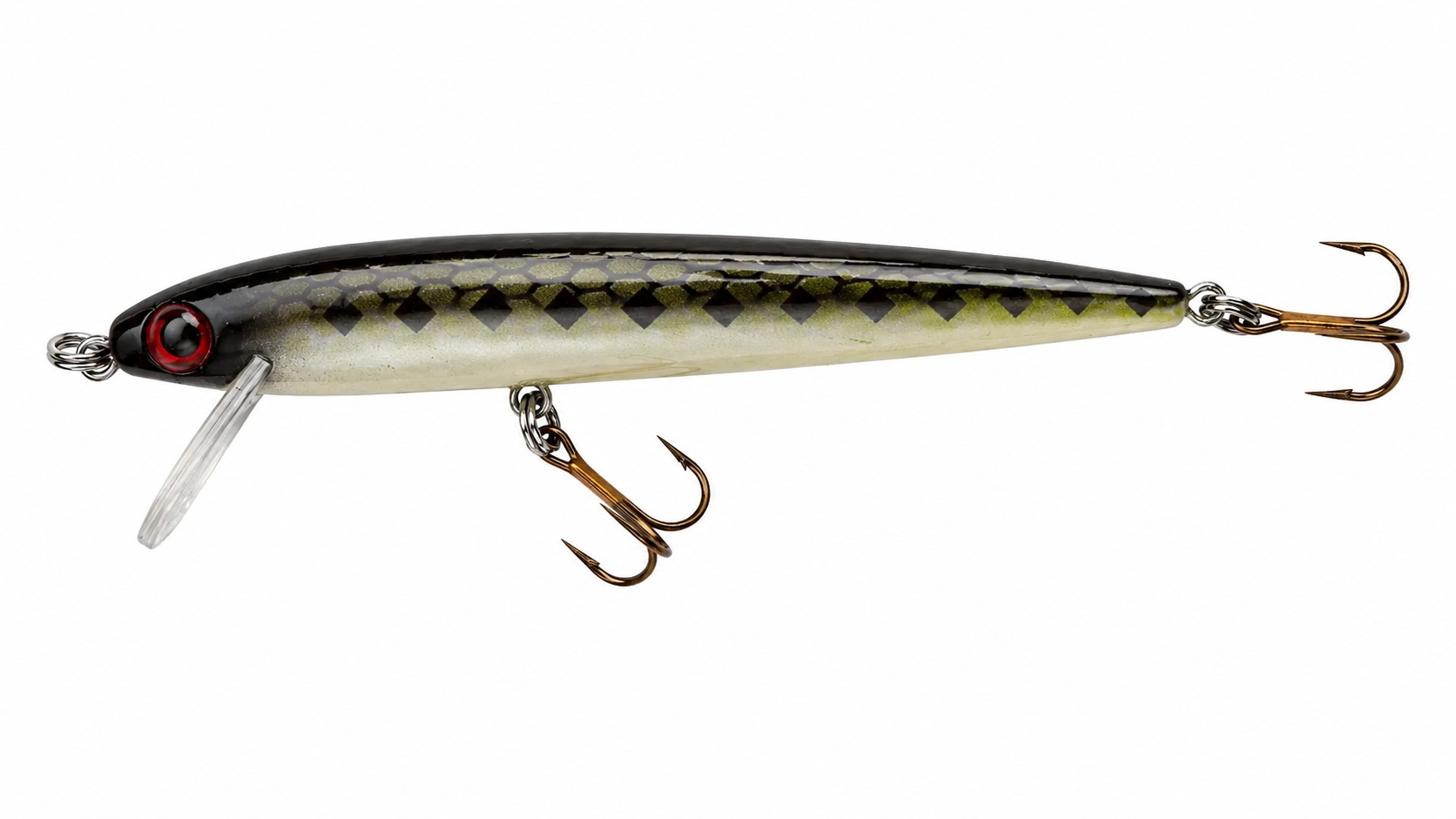
The hard jerkbait is a slender, hard plastic lure shaped to imitate a baitfish — typically a shad, herring, or juvenile minnow — that hangs nearly motionless in the water column after each twitch. Unlike a crankbait that does most of the work on a steady retrieve, a jerkbait is an angler-controlled presentation: the rod imparts all the action, and the pause is where the magic happens.
Most jerkbaits fall into one of three buoyancy categories. Floating models rise on the pause and are best for shallow fish. Sinking models drop slowly and cover the water column on a controlled fall. Suspending models are the most popular — they hang in place after a twitch, giving a neutral or negative fish time to make up its mind. A true suspending bait stays put at depth when the angler stops, which is what makes this presentation so effective in cold water and tough conditions.
Jerkbaits consistently produce largemouth bass, smallmouth bass, walleye, striped bass, spotted seatrout, and even muskellunge. Any species that feeds on baitfish will eat a properly worked jerkbait.
How it’s rigged
Jerkbaits come factory-rigged with two or three treble hooks. Most are ready to fish out of the package. A few adjustments are worth knowing:
Tuning for suspension: Water temperature affects buoyancy. A bait that suspends perfectly at 65°F may float slightly in warmer water or sink slightly in very cold water. Suspend Dots or small Storm SuspenStrips (adhesive weight strips) can be placed on the belly or hook shanks to dial in neutral buoyancy in any temperature. Check your bait’s balance in the water before fishing — if it floats or sinks aggressively, adjust accordingly.
Hook upgrades: Factory trebles on budget jerkbaits are often soft. Swapping to Gamakatsu or VMC round-bend trebles improves hook-up ratios, especially on light-biting fish.
Snap or split ring: Most experienced jerkbait anglers tie directly to the split ring at the nose or use a small snap. Avoid a heavy snap or steel leader — it kills the action. A loop knot (non-slip mono loop) also gives the bait maximum freedom of movement.
How to fish it
The standard retrieve for a suspending jerkbait is twitch-twitch-pause, but the pause length is the variable you control to match fish mood.
On aggressive fish — actively feeding, or in water above 55°F — a two- to three-second pause is often enough to draw the strike. In cold water (below 50°F) or after a cold front, extend the pause dramatically. Pauses of 10, 15, even 20 seconds are not overkill in winter conditions. Fish in cold water metabolize slowly and may track a bait from several feet away before committing. If you’re not pausing long enough, you’re moving the bait out of the strike zone before the fish decides to eat.
Rod technique: Use a medium-power rod held at roughly the 10 o’clock position. Sharp downward twitches with the rod tip drive the bait into its darting side-to-side walk. The amount of slack on the line when you twitch controls how violently the bait darts — more slack equals more erratic movement. After twitching, drop the rod tip and let the bait settle completely before moving it again.
Vary cadence: Twitch-twitch-pause is the baseline, but experiment. Single twitches with long pauses, three rapid twitches followed by a 10-second pause, a slow steady pull to reposition — fish will tell you what they want on a given day.
Setting the hook: Strikes on the pause often feel like a slight weight or a soft “tick” on the line. Keep the rod tip down, reel down to take up slack, and sweep the rod sideways rather than straight up. Ripping the rod on a treble-hook bait pulls it right out of the fish’s mouth.
When to use it
The jerkbait’s strongest window is cold water — late fall, winter, and early spring. When water temperatures drop below 55°F and other high-action baits lose effectiveness, the jerkbait’s slow-falling, suspended presentation is one of the few that consistently draws strikes from lethargic fish.
Post-cold-front conditions are the other signature situation. After a weather system passes and barometric pressure spikes, bass go inactive and move tight to cover. Slowing a jerkbait to a near-dead-stop near visible structure — dock edges, submerged points, rock piles — is one of the most reliable patterns for shut-down fish.
Spring is also productive as water warms back into the 45–60°F range and bass begin moving shallow to feed before the spawn. Run jerkbaits along points, channel edges, and rocky banks where fish stage.
In saltwater, jerkbaits shine for spotted seatrout in cooler months and for striped bass around baitfish schools.
Color selection
Match color to water clarity and light conditions.
| Condition | Color choice |
|---|---|
| Clear water, bright sun | Natural shad, ghost minnow, pearl |
| Clear water, overcast | Natural shad, ayu (brown/gold), bone |
| Stained water, overcast | Solid white, bone, chartreuse shad |
| Stained water, any light | Chart/white, firetiger |
| Night or very dark water | Solid black, dark blue/black |
Overcast skies combined with stained water are the clearest call for solid white or bone — high visibility without the flash that clear-water fish will reject. In clear water under overcast skies, natural shad patterns are hard to beat. Avoid anything too flashy in ultra-clear conditions; subtle, translucent patterns are more convincing.
Gear setup
Rod: Medium power, fast or extra-fast action, 6’6” to 7’. A longer rod helps with distance on casts and gives you the sweep angle you need to take up slack on the hookset. Moderate-fast action works for beginners — it offers a bit more forgiveness.
Reel: A 6.3:1 to 7.1:1 gear ratio baitcaster works well for power applications. For finesse jerkbaits on spinning tackle, a 2500–3000 size spinning reel with a smooth drag is the better choice.
Line: Fluorocarbon is the standard for jerkbaits because it sinks — keeping the bait at depth rather than floating it up — and its low visibility matters in clear water. For finesse applications on spinning gear, 6–8 lb fluorocarbon is ideal. On a baitcaster with larger jerkbaits or in heavier cover, 10–15 lb fluorocarbon handles the presentation and any cover contact.
Avoid braid as a mainline for jerkbaits. Zero-stretch braid makes it easy to over-twitch the bait and can tear treble hooks out of fish. If you prefer braid, use a 6–8 foot fluorocarbon leader.
Brands worth knowing
Rapala X-Rap is one of the most proven jerkbaits in freshwater fishing. The internal rattle, textured body, and sharp tail create a distinctive darting action. Available in a wide size range. The X-Rap Magnum extends the system to larger saltwater and striped bass applications.
Strike King KVD Jerkbait (KVD 100 and 110 series) suspends reliably across a wide temperature range with minimal tuning. Built to tournament spec with sharp Owner hooks stock.
Lucky Craft Pointer (100 and 128) is a Japanese-built premium option that suspends with precision and has a uniquely subtle, tight wobble that produces on heavily pressured fish. The 128 is a proven big-bass and walleye bait.
Megabass Vision 110 is one of the most copied jerkbaits in the world. Its internal weight transfer system improves casting distance and its unique darting action is hard to replicate. Premium price, but it performs.
Smithwick Suspending Rogue is the old-school American option — a longer, slender minnow with a loose wobble that has produced walleye and bass for decades. If fish are keyed on a larger, slower-falling profile, the Rogue is worth tying on.