A note about links: If we include links to retail sites like Amazon or Bass Pro Shops, it's because they're relevant to the topic and, as anglers ourselves, we believe they're worth checking out. As an Amazon Associate we earn from qualifying purchases.
Few freshwater fish inspire the kind of devotion that walleye do. In the Midwest and Great Lakes region, generations of anglers have measured their seasons by walleye catches: the first open-water trip of spring, twilight drifts over rocky reefs, the weight of a keeper swinging into the net just as the last light dies over the water. The walleye earns its status as North America’s most popular table fish on the plate as much as it earns it on the rod, with white, firm, mild flesh that needs little more than a cast-iron skillet and butter. Targeting them teaches you to read water, think in low light, and slow down.
How to identify one
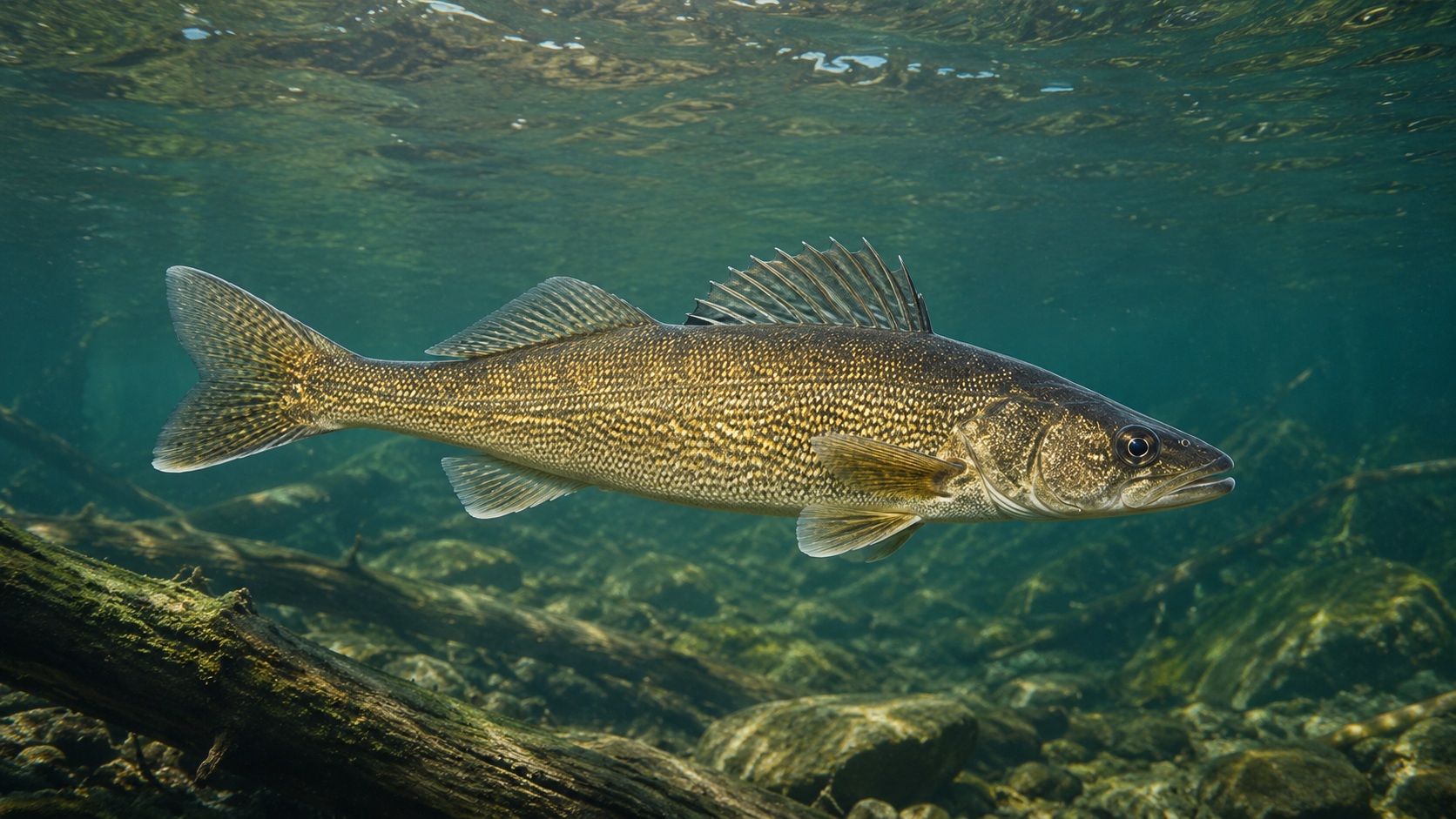
Walleye are hard to mistake once you have seen a set of those eyes. The defining field mark is the large, milky, opalescent eye, the result of a reflective layer called the tapetum lucidum that bounces light back through the retina and makes walleye function like night-vision predators. The body is olive-gold to brassy-brown on the back, fading to cream on the belly, with faint brindled markings along the sides. Look for a distinct black splotch at the rear base of the spiny first dorsal fin and a crisp white patch at the lower tip of the tail. Those two marks together close the ID. Sauger are the most common lookalike: they share the same shape and glowing eye but are smaller, spottier, and lack the white tail tip. Walleye-sauger hybrids, called saugeye, split the difference and can cause confusion in waters where both species coexist.
Where to find them
Walleye are native to the Great Lakes and the Mississippi River drainage, stretching from Tennessee north through the Canadian interior to Hudson Bay. Widespread stocking has extended their range into the Northeast, the plains states, and parts of the Pacific Northwest. The epicenter of walleye culture is Lake Erie, which supports one of the most productive walleye fisheries in the world, with the western basin around Sandusky Bay and the islands off Port Clinton drawing boats from across the country every spring. Lake Ontario, the Minnesota boundary waters, Mille Lacs Lake, Lake of the Woods, and the Missouri and Ohio River systems all hold strong populations. North of the border, Manitoba’s Lake Winnipeg and the Winnipeg River system, Ontario’s Lake Simcoe and the Kawartha Lakes, and Saskatchewan’s shield lakes round out the range of waters that define walleye culture for serious anglers — including many who cross the border specifically for the fishery. Walleye favor cooler, cleaner lakes and reservoirs with rocky or gravel bottoms, submerged reefs, points, and creek channel edges. They use turbid, wind-churned water to their advantage, pushing into shallows that are too bright on a calm day. In rivers, look for them below dams, along current breaks, and in the slack water behind mid-channel boulders.
When to go
Spring is the prime season. Walleye spawn on gravel reefs and rocky shoals when water temperatures climb through the low 40s Fahrenheit, typically March through May depending on latitude. Post-spawn fish are hungry and concentrated, making them easier to locate and more willing to commit to a bait. In Lake Erie’s western basin, late April through June is peak time for the big runs. Fall is the second prime window. As water cools below 60 degrees in September and October, walleye feed aggressively to put on weight before winter, and the largest fish of the year are frequently caught during mid-fall through early November. Summer fishing is productive at night when walleye move from daytime depth into the shallows to feed under cover of darkness. Overcast days and wind-whipped “walleye chop” extend feeding windows into daylight hours by cutting surface light penetration.
What to throw
Jigs are the foundational walleye tool. A 1/8-ounce jig in clear, shallow water or a 3/8 to 5/8-ounce jig for deeper structure covers most situations. Tip them with a live minnow nose-hooked through the lips, a leech, or a 3-to-4-inch soft-plastic paddle tail or minnow body. Color selection follows the light: chartreuse and white on overcast or stained-water days, natural shad and smoke patterns in clear conditions. The most common mistake with jigs is fishing them too fast. Lift the rod tip slowly, let the jig fall on semi-slack line, and expect the bite on the drop.
Lindy Rigs (also called live-bait walking sinker rigs) are the patience play and often the big-fish play. Thread a walking sinker on your main line, tie a barrel swivel, run a 4-to-6-foot fluorocarbon leader, and hook a leech, nightcrawler, or minnow through the back. Drag it slowly along the bottom behind the boat at 0.5 to 1.0 mph, feeling for the subtle tick of a pick-up. When a walleye takes, give it two to three seconds before setting the hook.
Crankbaits and stick baits excel for trolling open water or covering large flats quickly. Shad Raps, Flicker Shads, and Bandits in fire tiger, gold-black, and perch patterns are proven producers on Erie and the Minnesota lakes. Troll at 1.5 to 2.5 mph and vary depth until you find the zone. Spinner rigs, a bead-and-blade harness ahead of a nightcrawler or leech on a bottom bouncer, work throughout the open-water season and are especially effective in summer when walleye sulk deep.
Blade baits and jigging spoons like the Swedish Pimple or Rapala Jigging Rap shine for ice fishing and cold-water vertical jigging in late fall and winter.
Regulations
Walleye regulations vary significantly by state, lake, and season. Always verify current rules with the managing state agency before fishing.
Ohio (Lake Erie): The Ohio Department of Natural Resources sets Lake Erie walleye limits annually based on total allowable catch assessments. For the 2026 season, the daily bag limit is 6 walleye (walleye, sauger, and saugeye combined), with a 15-inch minimum length. Limits for the March-April period may differ from the May-forward season. Verify current limits at ohiodnr.gov before heading out.
Minnesota: The statewide daily and possession limit is currently 6 walleye, with a proposed reduction to 4 fish (with only one over 20 inches) pending rulemaking for a March 2027 implementation. Special regulations apply to Mille Lacs Lake and other specific waters. Verify current rules at dnr.state.mn.us.
Wisconsin: Statewide daily bag limit is 5 walleye; special rules apply in the Ceded Territory and specific waters such as Florence County (15-inch minimum, 3-fish bag). Verify at dnr.wisconsin.gov.
Iowa: Daily bag limit of 5 walleye with a 15-inch minimum size. Verify at iowadnr.gov.
Because regulations on walleye are among the most actively managed and frequently revised in freshwater fishing, check the specific agency website for the state and water body you intend to fish before every trip.
Handling and release
Walleye have a well-deserved reputation as table fish and are widely kept within legal limits. The flesh is firm, white, and fine-grained, with a mild flavor that holds up to frying, baking, and chowder. Lip-grip the fish or support the body horizontally to prevent jaw injury if releasing. Walleye are relatively hardy compared to some cold-water species, but avoid prolonged air exposure in warm weather. If releasing a large fish, hold it upright in the water until it kicks free under its own power. For those keeping fish: clean walleye promptly, keep them on ice, and fillet within a day for best quality.
On the Table
Walleye is one of the most prized freshwater table fish in North America, and anglers keep them eagerly — the firm, white, mild flesh is the reason many people target walleye in the first place.
Taste and texture: Walleye has a clean, mild, slightly sweet flavor with almost no fishiness. The flesh is bright white, fine-grained, and flaky without being mushy. It is lean and delicate enough to absorb seasonings well without the fat content masking anything. Many anglers rank it alongside crappie and yellow perch as the best-tasting freshwater fish available.
Best preparation methods:
- Pan-frying: The classic approach, and for good reason. Walleye fillets dredged in seasoned flour or a light cornmeal coating and fried in butter develop a golden crust that complements the delicate flesh without overpowering it. The lean meat stays moist because the cook time is short.
- Beer batter frying: A thicker batter adds body and crunch that holds up well to the mild flavor. This is the standard preparation at fish fries across the Midwest and Great Lakes region.
- Baking or broiling: Because walleye flesh is firm enough to hold shape, it bakes cleanly with simple seasoning — lemon, butter, fresh herbs. Broiling adds color without drying the fillet out if watched carefully.
- Shore lunch skillet: Walleye is the quintessential shore lunch fish. Cleaned streamside, dusted in a simple mix, and cooked in a cast iron skillet over an open fire, it is hard to beat for freshness and flavor.
Handling for table quality: Walleye quality drops fast in warm water. Keep fish alive in a livewell or on a stringer in cool water, and transfer them to an ice-filled cooler as soon as possible after the catch. Bleeding the fish immediately after landing helps keep the flesh clean and white. Walleye skin has a mild flavor and is edible, but most anglers skin the fillets for a cleaner presentation. The lateral line contains a strip of darker, stronger-tasting meat; trimming this out before cooking improves the flavor, especially on larger fish.
Eating caveats: Walleye in many waters are managed under slot limits or size restrictions that define which fish are legal to keep. Check local regulations before retaining any fish. In some Great Lakes and river systems, older advisories exist for contaminants such as PCBs in larger, older walleye; consulting your state or provincial fish consumption advisory for the specific body of water is good practice, particularly for fish over 18-20 inches.