A note about links: If we include links to retail sites like Amazon or Bass Pro Shops, it's because they're relevant to the topic and, as anglers ourselves, we believe they're worth checking out. As an Amazon Associate we earn from qualifying purchases.
What it is
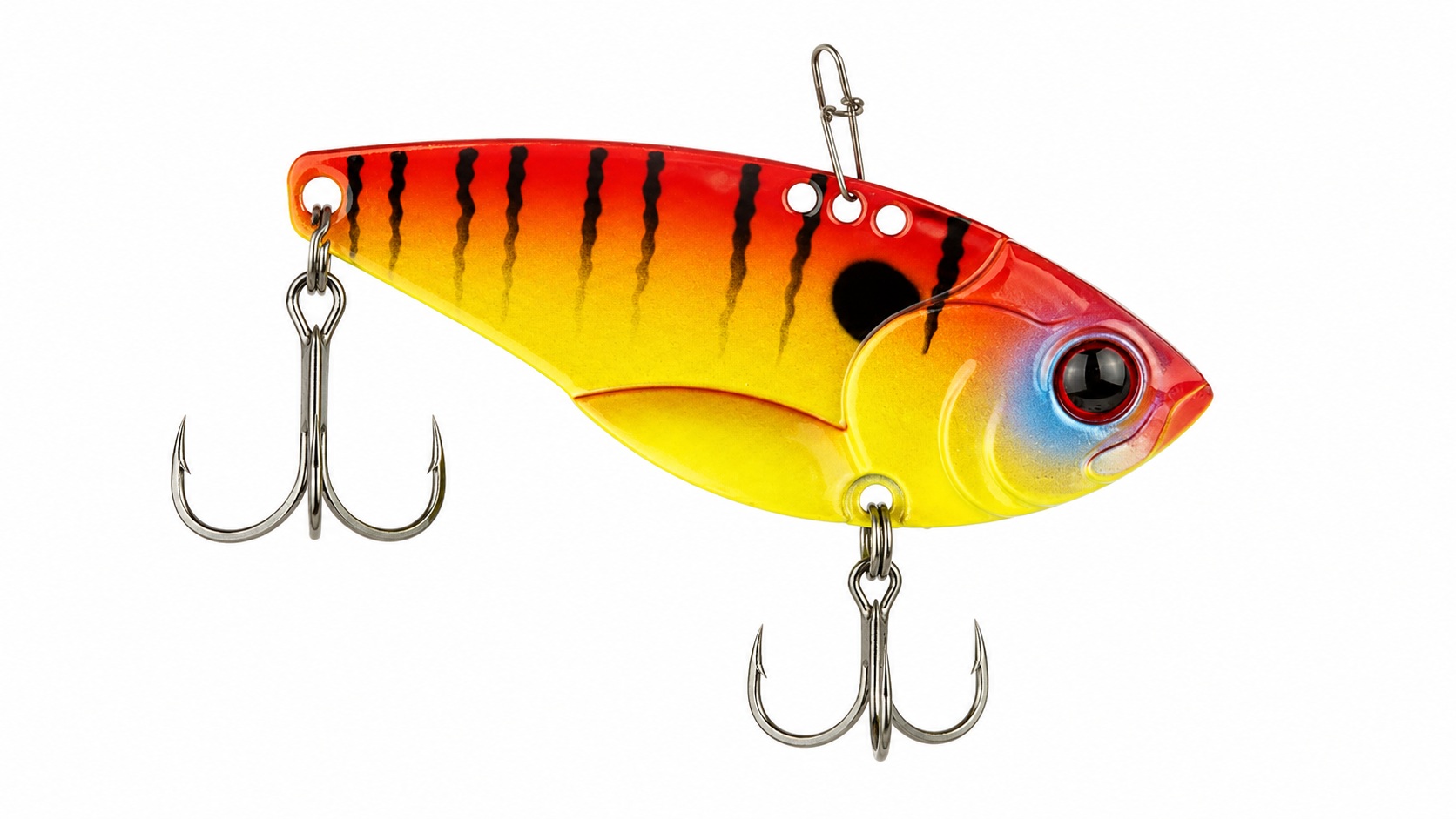
A blade bait is a thick, stamped metal slab — flat on two sides, dense enough to sink fast, and shaped to vibrate wildly when you move it through the water. When you lift the rod and let the bait fall on a semi-slack line, it wobbles and flutters on the way down in a way that is nearly impossible to replicate with any other lure. That combination of tight vibration on the lift and erratic flutter on the fall is what triggers walleye, smallmouth bass, and striped bass in cold, deep water when other presentations simply do not connect.
The defining feature is a row of two or three line-tie holes along the top spine. Moving the line tie forward produces a more aggressive, wider vibration. Moving it back tightens the action and makes the bait run flatter. Most anglers start in the middle hole and adjust from there based on how the fish respond on a given day.
The Silver Buddy is the benchmark freshwater blade bait in the United States — the one most anglers picture when they hear the name. The Swedish Pimple, imported from Scandinavia and originally designed for ice fishing, occupies the same category and is equally effective, particularly for walleye and yellow perch in northern lakes.
The setup
Blade bait rigging is minimal. The lure comes ready to fish — just attach your line to one of the line-tie holes using a small split ring and a snap, or tie directly with a loop knot. The loop knot and snap options both allow the bait to swing freely, which preserves the vibration. A direct knot to the hole without a snap will kill some of the action.
Line-tie position guide:
- Forward hole: Wider vibration angle, more aggressive thump — good when fish are active
- Middle hole: Balanced action — the best starting point in most conditions
- Rear hole: Tighter, more subtle action — better when fish are finicky or heavily pressured
Sizes: 1/4 oz covers water in the 10–20 ft range and is a good perch and finesse walleye option. 3/8–1/2 oz is the everyday workhorse for walleye in 15–30 ft. 3/4 oz handles deeper water, faster-sinking requirements, and larger striped bass.
How to fish it
Vertical jigging
This is what the blade bait was built for. The technique is simple in principle and takes a few trips to dial in.
- Locate fish on your sonar — suspended walleye, bass stacked on a hump, or a school of perch at a specific depth. The lure’s strength is precision depth delivery.
- Drop the blade straight down to that depth. Let it hit bottom if needed, then count up to the marked depth.
- Lift the rod tip smoothly and steadily — about 12 to 18 inches. You will feel the lure vibrate on the way up.
- Drop the rod tip back down quickly and allow the bait to fall on a semi-slack line. The slack is critical; a tight line kills the flutter.
- Repeat. Most strikes come on the fall or at the pause just as the bait reaches the bottom of the drop.
The cadence varies by species. Walleye often respond to a slow, deliberate lift with a long pause. Smallmouth bass typically prefer a more aggressive, quick lift-drop rhythm. Start slow and speed up until the fish tell you what they want.
Casting and counting down
When fish are scattered over a flat or relating to a specific depth along a break, cast the blade out and count it down to the target zone as it sinks. Then work the lure back with a lift-drop retrieve — raise the rod tip, let the bait fall on semi-slack line, reel up the slack, and repeat. The bait swings forward and upward on the lift, then flutters down in a semi-circular arc on the drop. This is different from a steady retrieve; you are always giving the lure a moment to freefall.
When to use it
The blade bait earns its keep from late fall through winter, when cold water pushes baitfish — primarily shad and shiners — into the lower third of the water column and concentrates gamefish over predictable structure. Main-lake humps, rocky points, submerged creek channel edges, and deep ledges are the primary targets.
Key triggers for reaching for a blade bait:
- Water temperature below 55°F: Walleye and bass slow down and respond better to a lure they can intercept vertically with minimal effort
- Fish visible on sonar at specific depths: The blade bait drops to an exact depth faster and more accurately than almost any other lure
- Post-cold-front conditions in fall: When a sharp front pushes fish tight to bottom structure, a slow vertical presentation with plenty of pause time can be the only thing that works
- Ice-out: Early spring on northern lakes, before water temperatures climb, blade baits can be exceptional for walleye and yellow perch
The blade bait is not a warm-weather tool. In summer, a lipless crankbait covers water faster and is easier to keep at a consistent depth on the cast-and-retrieve. The blade bait’s vertical precision is most valuable when fish are deep, lethargic, and holding in a tight zone.
Size and color guide
| Size | Best Use |
|---|---|
| 1/4 oz | Clear-water perch, finesse walleye, 10–20 ft |
| 3/8 oz | Walleye and smallmouth bass, 15–25 ft |
| 1/2 oz | All-around workhorse, 20–35 ft |
| 3/4 oz | Deep water, striped bass, fast sink needed |
For color, chrome and silver are the defaults and cover most situations — blade baits mimic shad, and silver matches shad. Gold works well in stained water and on overcast days. Some blade baits come with painted finishes (chartreuse, firetiger) that can trigger neutral fish when natural colors fail.
Gear setup
Rod: Medium to medium-heavy, 6’6”–7’, with a moderate-fast to fast action. You need enough sensitivity to feel the vibration on the lift and detect subtle strikes on the fall, but enough backbone to drive the hook. A soft rod absorbs too much of the hookset energy at depth.
Line: 8–12 lb fluorocarbon or monofilament. This is one case where braid is actively counterproductive — braided line has zero stretch, and the blade bait’s action depends on a slight amount of give in the line to allow it to fall freely and flutter correctly. Fluorocarbon is the preferred choice: low visibility, slight stretch, and it sinks alongside the lure rather than floating above it.
Reel: A smooth, mid-range spinning reel in the 2500–3500 size covers most vertical situations. A baitcasting reel works for casting applications where heavier sizes are needed.
Brands worth knowing
Silver Buddy (made in Alabama by Bill Lewis) is the original and most recognized American blade bait. Available in 1/4, 3/8, and 1/2 oz with a range of finishes. It is the lure most tournament walleye anglers mean when they say “blade bait.”
Bay de Noc produces the Swedish Pimple, which runs slimmer and longer than the Silver Buddy and is a staple on Great Lakes and northern lake systems.
Heddon Sonar is one of the older blade baits still in production and remains a reliable option, particularly for casting applications.
Custom Jig & Spin and Reef Runner offer regional alternatives that are well regarded among Great Lakes walleye fishermen.