A note about links: If we include links to retail sites like Amazon or Bass Pro Shops, it's because they're relevant to the topic and, as anglers ourselves, we believe they're worth checking out. As an Amazon Associate we earn from qualifying purchases.
What It Is
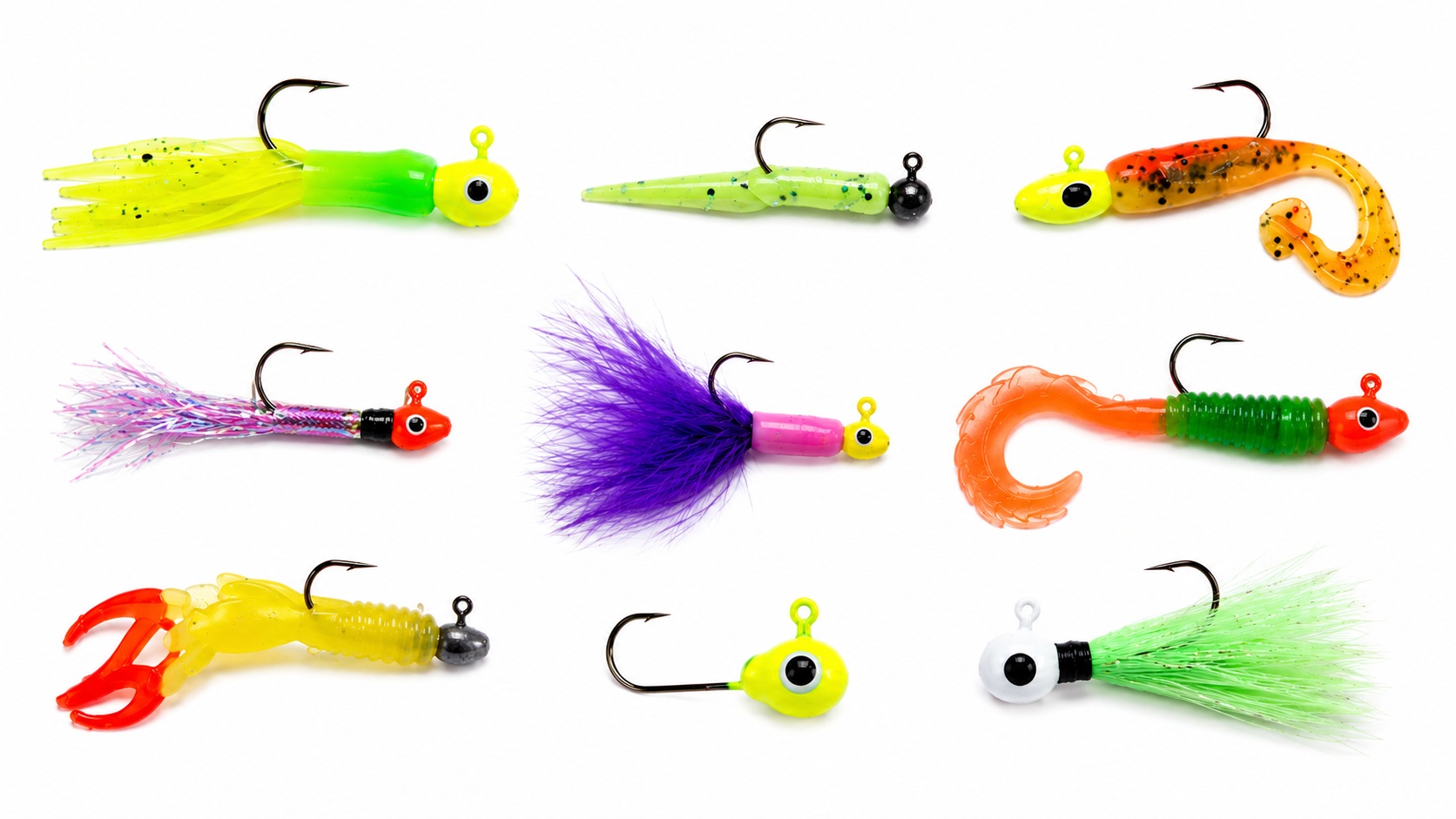
The crappie jig is the single most proven lure in freshwater panfishing. At its core it is nothing more than a small lead or tungsten jig head threaded with a soft plastic body, tube, or dressed with hair or feathers — but that simplicity is exactly what makes it deadly. Crappie are visual predators with small mouths, and this lure hits both constraints perfectly: it looks like a minnow or invertebrate, it falls naturally, and it fits.
Most crappie jigs run between 1 to 2.5 inches in total length. The head shape affects sink rate and hook orientation; round heads are the standard, but keeper-style and banana heads also see regular use. The dressing — whether a Bobby Garland Baby Shad, a Southern Pro tube, or a marabou hair jig — provides action on the fall and during any pause, which is often when the bite happens.
The Setup
Weight selection drives everything else. Use 1/32 oz for winter fishing when crappie are lethargic and need a slow-falling presentation, and for shallow applications directly under a float at 2 to 4 feet. The 1/16 oz is the all-around workhorse — enough weight to cast on light spinning gear while still falling slowly enough to trigger neutral fish. Step up to 1/8 oz when you need to reach water deeper than 12 feet, when there is current, or when you need casting distance to cover water.
Hook the soft plastic body straight onto the jig head so the lure hangs level. A twisted or angled body will kill the presentation — it spins unnaturally and crappie will refuse it. Tubes should be threaded so the collar of the tube sits flush against the jig head collar with no gap.
The Road Runner is a variation worth knowing. It adds a small spinner blade mounted on a wire collar just behind the jig head. The blade rotates on the retrieve and produces flash and low-frequency vibration that carries further in stained or slightly off-color water. It is particularly effective around dock pilings and in rivers where crappie hold in current eddies.
How to Fish It
Under a Float
Setting a crappie jig beneath a slip float or fixed bobber is one of the most effective and readable presentations available. Dial your depth so the jig hangs 3 to 6 feet off the bottom, which is where crappie typically suspend in brush piles, timber, and along channel ledges. Cast past the structure and work the float toward it. A subtle twitch every few seconds imparts action; long pauses let the jig hang and swing naturally. Watch the float — crappie often inhale small jigs with almost no movement at the surface.
Vertical Presentation
When you are sitting directly over brush, timber, or dock pilings, vertical jigging is more precise than casting. Lower the jig straight down to the depth where your electronics or experience tell you fish are holding. Lift and drop with 2 to 4 inch strokes, letting the jig fall back on semi-slack line. Crappie often hit on the drop. This presentation keeps the lure in the strike zone indefinitely and is especially effective in cold water when the fish are tight to wood and unwilling to chase.
Spring Spawn Casting
During the spring spawn, crappie move to shallow water — often just 2 to 4 feet deep — near gravel, sand, or clay banks with sparse brush or dock edges. Cast small 1/32 or 1/16 oz jigs parallel to the bank and retrieve slowly with occasional pauses. Work the lure along the contour of the bank rather than straight toward the boat. Fan-cast to cover the area and let the lure fall along any visible structure. This is the time of year when crappie are most aggressive and concentrated, and casting small jigs on light line is one of the most productive methods there is.
Color and Size Guide
| Condition | Weight | Color |
|---|---|---|
| Clear water, bright sun | 1/32 — 1/16 oz | Pink/white, light chartreuse |
| Standard stained water | 1/16 oz | Chartreuse/white, yellow/white |
| Low light, overcast | 1/16 — 1/8 oz | Purple/black, blue/black |
| Dingy or muddy water | 1/16 — 1/8 oz | Bright chartreuse, solid white, orange |
| Winter, slow bite | 1/32 oz | Natural shad, light pink, white |
| Deep water, current | 1/8 oz | Match to light conditions above |
Chartreuse and white covers most situations. When in doubt, start there. Switch to purple and black in low-light conditions or when the water has a heavy stain — these dark profiles create a stronger silhouette that crappie can locate.
Gear Setup
Light gear is not optional here — it is part of what makes the presentation work. A 7-foot light-action spinning rod paired with a 2500-size reel spooled with 6 lb monofilament or 6 lb fluorocarbon covers nearly every crappie situation. Fluorocarbon is less visible underwater and sinks faster, which can help with deeper vertical presentations. If you are casting 1/32 oz jigs at distance, drop to 4 lb mono for added castability.
Many crappie anglers spool with 10 to 15 lb braid and add a 6 to 8 foot fluorocarbon leader. Braid has near-zero stretch and telegraphs subtle bites clearly — useful when you are fishing deep timber and need to detect a fish that barely moved the jig.
Brands worth knowing
Bobby Garland is the reference standard. The Baby Shad in 1.5 and 2 inch sizes accounts for more crappie than nearly any other soft plastic.
Southern Pro tube jigs are a close second and are widely available in the South.
Road Runner makes the definitive spinning-blade jig for stained water and river applications.
Strike King and Berkley both produce quality crappie jig heads and bodies at accessible price points.
Leland makes excellent hair jigs for anglers who prefer a natural-fiber dressing over soft plastic.
Start with a 1/16 oz round-head jig, a pack of Bobby Garland Baby Shads in chartreuse/white and purple/black, and a simple slip float. That combination will produce crappie in nearly any lake or pond in the country.