A note about links: If we include links to retail sites like Amazon or Bass Pro Shops, it's because they're relevant to the topic and, as anglers ourselves, we believe they're worth checking out. As an Amazon Associate we earn from qualifying purchases.
Ask any angler who grew up fishing for the table what their target fish is on a cold January morning, and the answer varies by region — but in much of the country it is the crappie. Black crappie are found in nearly every state east of the Rockies and have been introduced well beyond their native range. They stack in accessible cover, bite eagerly in cold water when other species have shut down, and produce some of the finest table fare in freshwater fishing. A dock, a small jig, and a couple of hours can produce a skillet full of fillets almost anywhere in their range. That is the crappie proposition, and it is a good one.
How to identify one
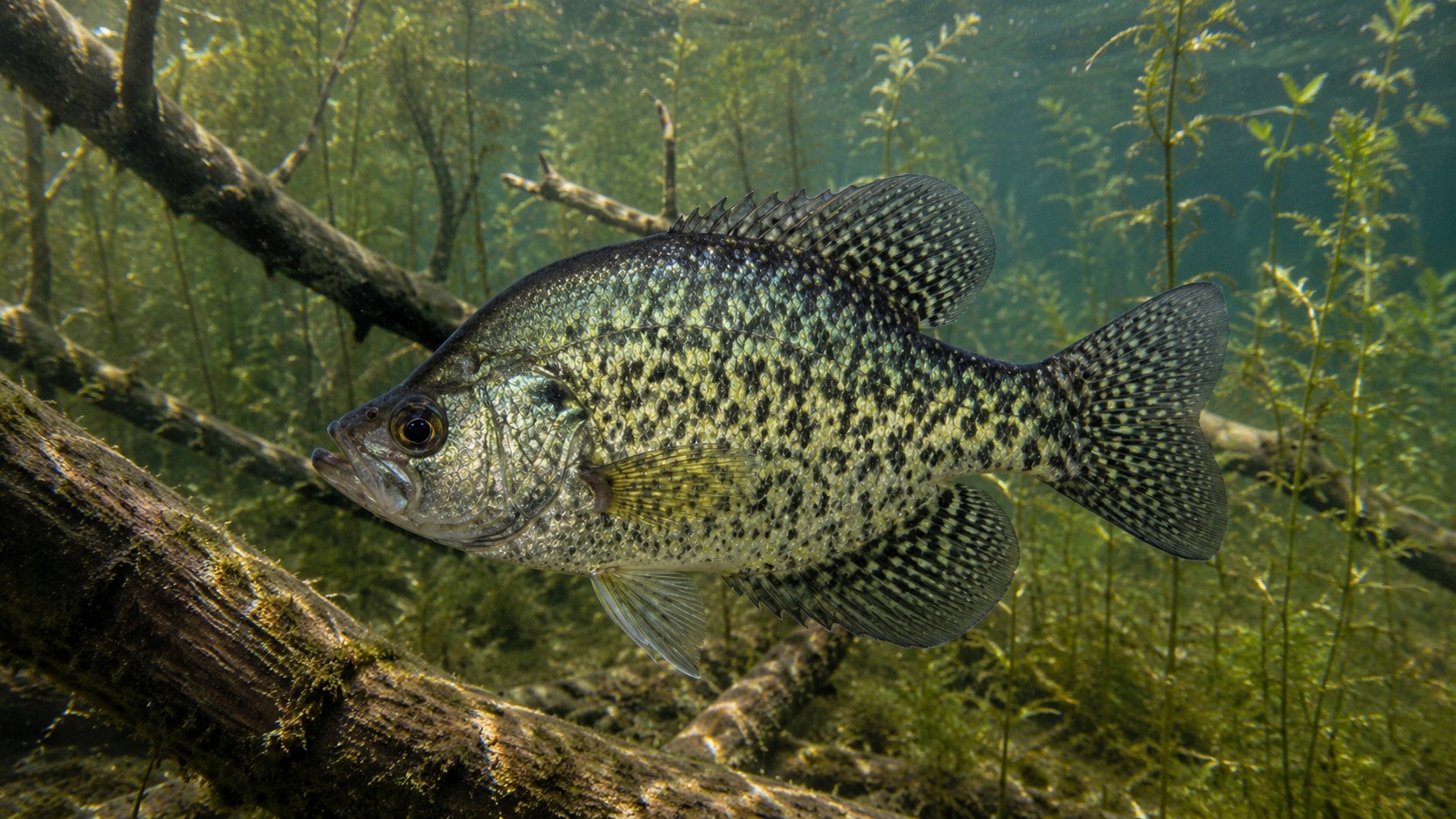
Black crappie have a deeply compressed, nearly round body profile. The most striking feature is the heavy, irregular speckling across their silver-green body: a scattered black-on-silver pattern with no vertical bars. That absence of bars is the key field mark when comparing them to their close relative, the white crappie. White crappie show distinct vertical bars along the sides; black crappie look more randomly speckled, like someone flicked a paintbrush at them.
Count the dorsal spines if you want a definitive ID. Black crappie carry 7 to 8 dorsal spines; white crappie have only 5 to 6. The mouth is notably large for a panfish, papery and thin-lipped, which is why old-timers call them “papermouths.” That thin membrane tears easily around a hook, so a gentle hand during the fight matters. Coloration darkens significantly in spawning males, sometimes appearing nearly black on the back and face. Fish from heavily vegetated, tannin-stained waters will run darker overall than fish from clear, sandy-bottomed lakes.
Where to find them
Black crappie prefer clear to moderately clear water with aquatic vegetation and soft, muddy or sandy bottoms. They are found in reservoirs, natural lakes, river backwaters, and larger ponds throughout their range — from the Great Lakes south through the Mississippi and Ohio valleys, across the Tennessee and Cumberland river systems, and into Gulf Coast drainages. Well-known crappie waters include Kentucky Lake and Lake Barkley on the Tennessee-Kentucky border, Grenada Lake in Mississippi, Lake Erie’s western basin, the St. Johns River system in Florida, and countless smaller impoundments in between.
Structure is everything. Crappie are cover-oriented fish that suspend at a consistent depth and rarely stray far from wood, vegetation, or shade. Dock pilings are the most accessible target: find a dock over water deeper than six feet, and crappie are almost certainly somewhere along those pilings. Submerged timber, bridge supports, and laydowns in six to fifteen feet of water are all prime real estate. Hydrilla and pondweed edges hold fish during warmer months in southern lakes; milfoil and cabbage weed serve the same function in northern fisheries. In rivers, look for slower backwater cuts, boat ramps with old pilings, and any flooded timber or brush that collects current debris.
When to go
The two most productive windows are the pre-spawn and post-spawn periods flanking the spring spawn, and the winter period when crappie school tightly around deep structure.
Spawn timing varies significantly by latitude. In the Deep South and Gulf Coast states, crappie begin moving shallow when water temperatures reach the low 60s Fahrenheit — this can happen as early as February in Florida and Louisiana. In the mid-South (Tennessee, Arkansas, Kentucky), the spawn typically runs March into early May. In the Great Lakes region and upper Midwest, crappie don’t spawn until late May or June when surface temperatures finally climb above 60°F. Wherever you fish, the trigger is water temperature, not calendar date. Use a thermometer, not a date.
Spawning crappie move into two to four feet of water, fan out nests near vegetation and hard bottom, and become aggressive and highly catchable. This is the most visually exciting window across the range. Pre-spawn staging fish — in the four to ten foot zone, about to move shallow — are often the most catchable of all.
Winter fishing is productive across the range but looks different north to south. In southern states, crappie feed actively all winter and school in deeper water around structure. In the northern half of the range, crappie are famously targeted through the ice. Hard-water crappie fishing on lakes in Minnesota, Wisconsin, Michigan, and Ontario is a tradition in its own right: fish suspend at very consistent depths in open-basin water, and once you drill down to them, the bite can be exceptional.
Summer crappie fishing is slower in most regions as fish retreat to deeper, cooler water. Early morning and late evening are the productive windows.
What to throw
The standard setup is a 1/32 to 1/16 ounce jig head dressed with a small soft plastic body, a marabou tail, or a tube body in chartreuse, white, pink, or combinations of all three. The small weight allows a slow, fluttering fall that crappie cannot resist. Match the jig size to the depth and current: use 1/32 ounce for water under ten feet with no current, step up to 1/16 or even 1/8 ounce for faster drops or current-affected water.
For dock fishing, the presentation is simple. Lower the jig straight down alongside a piling, count it down in one-second increments, and pause at each depth for three to five seconds. When the line twitches or goes slack unexpectedly, lift gently: that is a crappie. Once you find the holding depth, stay there and repeat. A small float set at the correct depth makes this even more efficient and is a great setup for anyone learning the technique.
Live minnows suspended under a small float are the top live bait option and will often out-fish artificials by a significant margin on tough days. Use 1.5 to 2 inch minnows on a small wire hook, hooked lightly through the back behind the dorsal fin. Set the float depth to match where fish are holding.
Spider rigging is a technique popular on larger southern reservoirs. Anglers run a boat slowly across main-lake structure with four to eight long rods extended forward in rod holders, each rigged with a jig at a slightly different depth. This fans out a wide search pattern, allows efficient coverage of open-water schools, and quickly identifies the holding depth when one of the rods gets hammered.
Ultra-light spinning gear in the 4 to 6 pound test range is ideal. The thin diameter helps small jigs sink naturally and transmit the subtle bites crappie are known for.
Regulations
Bag limits and size minimums for black crappie vary by state and, in some cases, by individual water body. Most states allow generous bag limits in the 15 to 30 fish range with no minimum size requirement, reflecting healthy populations and the species’ productive spawning cycle. Some reservoirs with special management carry stricter rules. Always check current regulations from your state fish and wildlife agency before keeping fish — rules change seasonally and by location.
Handling and release
Crappie have a thin, soft mouth that tears easily, so avoid twisting or yanking hooks free. Wet your hands before handling fish you plan to release, grip the fish gently around the body, and back the hook out with a small pair of forceps or needle-nose pliers. If you are keeping fish for the table, a cooler with ice maintains quality far better than a stringer in warm water. The fillets are thin but delicious, and any fish over 10 inches will yield a respectable double-sided fillet worth the effort.
On the table
Black crappie is one of the most prized panfish in freshwater fishing, widely kept for the table because of its mild, sweet flavor and firm white flesh — qualities that make it a genuine treat even for people who don’t usually eat freshwater fish.
Taste and texture: The flesh is white, fine-grained, and mildly sweet with very little of the “fishy” flavor that puts some anglers off freshwater species. Texture is delicate but holds together well during cooking, flaking cleanly once done. Fat content is low, which keeps the flavor clean and neutral enough to complement a wide range of seasonings.
Best preparation methods:
- Pan-frying (breaded or floured): The classic approach for a reason. Crappie fillets are thin and cook quickly in a cast-iron skillet with a light cornmeal or seasoned flour coating. The delicate flesh stays moist inside while the crust crisps up fast — overcooking is the main risk, so high heat and short cook times are key.
- Deep-frying (battered): A buttermilk-and-cornmeal batter seals in moisture and produces the traditional fish-fry result. Works especially well for smaller fish where the fillet-to-crust ratio stays high.
- Baking or broiling: For a lighter preparation, fillets seasoned simply with lemon, butter, and herbs bake well at moderate heat (375 F). Best for larger, thicker fillets where the flesh can handle dry heat without drying out.
- Fish tacos or sandwiches: The mild flavor and clean white flake make crappie a natural for light taco preparations with citrus slaw, or pan-fried and served on a soft roll.
Handling for table quality: Crappie are fragile once out of the water and their flesh quality degrades quickly in warm conditions. Keep fish alive on a stringer or in a livewell until you’re ready to clean them, or place them immediately on ice. Fillet promptly after the trip and rinse fillets in cold water. Thin fillets should be cooked or frozen within a day or two for best results. A paper towel pat-dry before cooking improves browning significantly.
Eating caveats: No significant mercury or parasite concerns for black crappie in most fisheries. Check local consumption advisories for specific lakes or reservoirs, particularly in areas near agricultural runoff or industrial contamination. Bag limits vary widely by state — most regions allow generous limits, but confirm local regulations before keeping a full cooler.