A note about links: If we include links to retail sites like Amazon or Bass Pro Shops, it's because they're relevant to the topic and, as anglers ourselves, we believe they're worth checking out. As an Amazon Associate we earn from qualifying purchases.
What it is
If you have ever caught a fish, there is a very good chance a worm was on the hook. The nightcrawler — and its smaller cousins, the red wiggler and the garden earthworm — is the bait almost every angler started with, and it is still one of the most effective baits in all of freshwater fishing. There is no mystery to it and no skill to master. A worm wiggles, it smells alive, and nearly everything that swims wants to eat it.
That is the humble truth worth saying plainly: a worm under a bobber is the single best way to put a beginner or a kid on fish. It works on bluegill and redear sunfish off a dock, on crappie and yellow perch around brush, on rainbow and brown trout in a stream, on largemouth and smallmouth bass, on channel catfish on the bottom, and on walleye dragged slowly across a flat. You do not need to match a hatch or read a feeding mood. You put a worm in the water where fish live, and fish find it.
How to rig and fish it
Start with the hook. A baitholder hook — a long-shank hook with a couple of small barbs on the shank to keep bait from sliding off — is the classic choice. Match the size to your quarry: a #8 or #6 for panfish, a #4 or #2 for bass, trout, and catfish.
How you put the worm on the hook depends on what you are after. The why matters here:
- For panfish (bluegill, redear, perch, crappie): Use only a small piece of worm and thread it fully onto the hook so the point is nearly covered. Panfish are expert bait-stealers; a long tail just feeds them for free. A short, well-threaded piece means the fish has to take the hook to take the worm.
- For bass, trout, and walleye: Hook a whole worm once, near the collar (the thick band), and let the rest dangle and wiggle. That natural, swimming motion is exactly what a bigger, hungrier fish keys on. Threading the worm tames the wiggle; hooking it once sets it free.
Once it is on the hook, you have several proven ways to fish it:
- Worm-and-bobber (float): The original and still the best teaching setup. Clip a bobber or slip float above the hook, add a split shot or two for casting weight, and set the depth so the worm hangs near the fish. When the bobber goes under, you have a bite. This is classic float and cork fishing and it is hard to beat for putting a beginner on bluegill and crappie.
- Split-shot or bottom rig: Pinch a small split shot a foot or two above the hook and let the worm rest on or just off the bottom. This bottom fishing approach shines for channel catfish, perch, and trout in current.
- Carolina rig: A sliding sinker, a bead, a swivel, and a leader to the hook lets a worm float freely above the bottom while you cover water — a deadly way to fish a nightcrawler for bass and walleye.
- Drop-shot rig: Tie the hook above a weight to suspend a worm at a precise depth over fish you have spotted — finesse presentation for pressured bass and perch.
All of these are simply live bait fishing: a real, wriggling animal doing the work for you.
When to use it
The honest answer is almost always. Worms catch fish in every season — spring, summer, fall, and even through the ice in winter, where a piece of worm on a small jig tempts panfish and perch. But a few moments stand out.
Reach for a worm when the bite is tough and artificial lures are going ignored — natural scent and live movement can turn a slow day around. Reach for one in cold or muddy water, where fish hunt by smell more than sight. And reach for one any time the goal is simply to catch fish, fast, with the least fuss: a new angler, a young kid, a quick evening at the pond. When you want a fish on the line and a smile on a face, a worm is the answer.
Forms and keeping it
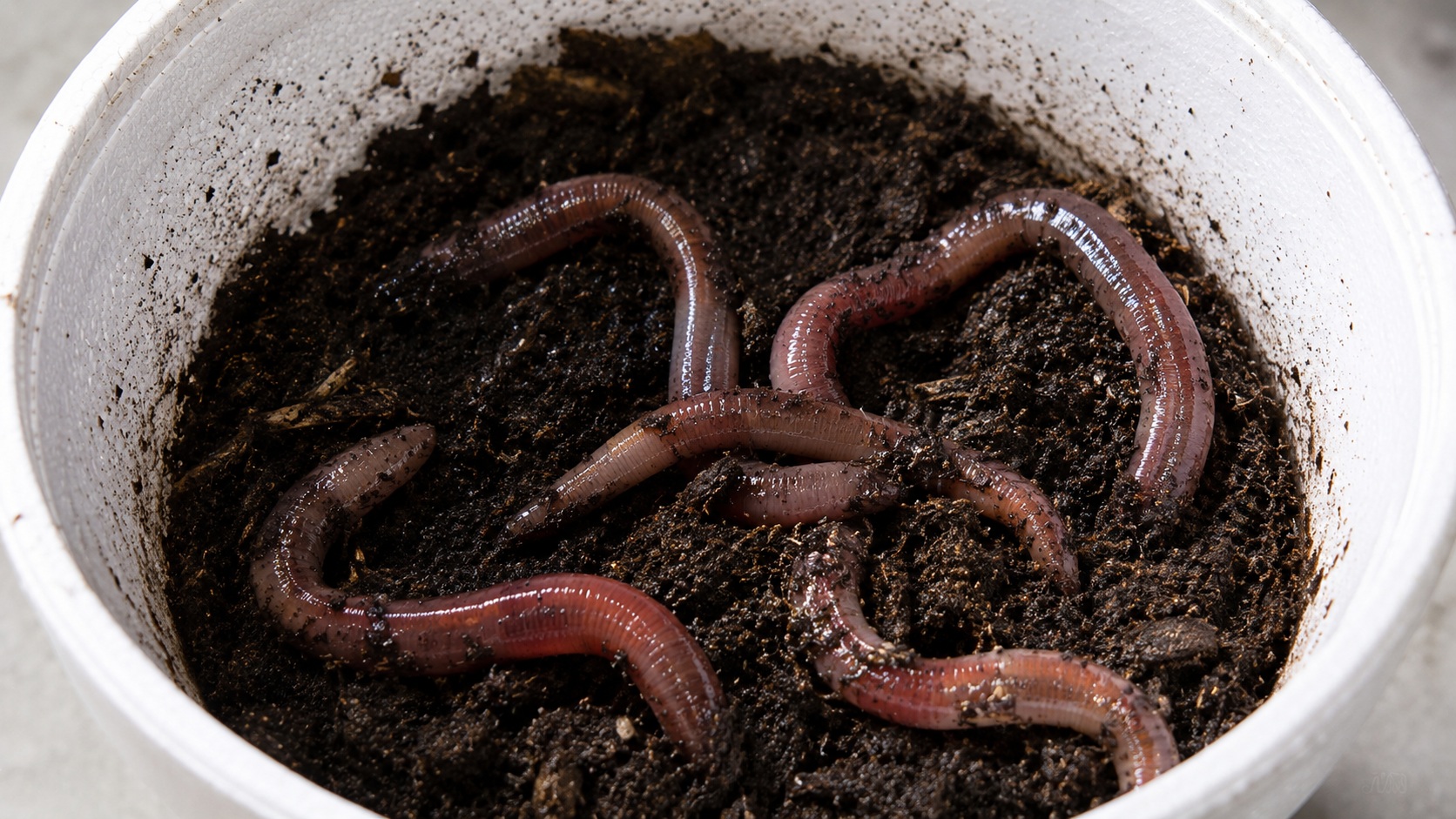
Bait shops sell two main forms. Nightcrawlers are the big ones — four to eight inches, thick-bodied, and lively — the go-to for bass, walleye, catfish, and trout. Red wigglers are smaller and tougher, and they stay frisky on the hook longer; they are perfect for panfish and ideal cut into pieces. Common garden earthworms work fine too, dug from your own yard after a rain.
The single most important thing about live worms is to keep them cool and moist. Worms die fast in heat. Store them in their tub of bedding (the dark, damp soil-like material they come in) in a refrigerator or a cooler with an ice pack — never in direct sun or a hot car. Kept cool in good bedding, a tub of crawlers lasts for weeks. As Outdoor Life notes, a cheap styrofoam cooler traps the essential moisture and keeps them cool so they live longer.
If the mess of live worms is not for you, there is an excellent synthetic alternative. Berkley Gulp and PowerBait make scented artificial worms and “wax worms” that look, feel, and smell like the real thing — no dirt, no wiggling tub in your fridge, and a long shelf life. They are a genuinely effective stand-in, especially for trout and panfish, and they let you keep a pack in the tackle box for any trip.
Gear and sourcing
You need very little to fish a worm well — that is part of the beauty of it.
- Baitholder hooks — the barbed-shank hooks that keep worms in place; an assortment of #8 through #2 covers everything from bluegill to catfish.
- Slip bobbers — adjustable floats that let you fish a worm at any depth and still cast easily; far more versatile than a fixed clip-on bobber.
- Split shot weights — a few pinched on the line add casting weight and sink the worm to the fish.
- Worm blower — a small tool that injects a puff of air into a nightcrawler so it floats up off the bottom, right into a fish’s view.
- Berkley Gulp & PowerBait worms — the no-mess synthetic alternative when you would rather not keep live bait.
A note on sourcing: buy worms from a bait shop, dig them from your yard, or use the synthetic versions — but never collect or fish with protected or non-native live animals where doing so is restricted. When in doubt, the bait-shop tub is the easy, legal, and reliable choice.