A note about links: If we include links to retail sites like Amazon or Bass Pro Shops, it's because they're relevant to the topic and, as anglers ourselves, we believe they're worth checking out. As an Amazon Associate we earn from qualifying purchases.
The fish that humbles anglers. Brown trout have a reputation for outsmarting the room, and that reputation is earned. They refuse flies tied to a thread’s difference, spook at shadows, feed in windows measured in minutes, and grow to sizes that make the hands shake. Landing a big, wild brown on your terms, in clear water, on a well-placed cast, is one of freshwater fishing’s most complete achievements. Introduced from Europe in the 1880s, they took to North American tailwaters and spring creeks as if the continent had been waiting for them. If you want a fish that will make you a better angler by sheer necessity, this is it.
How to identify one
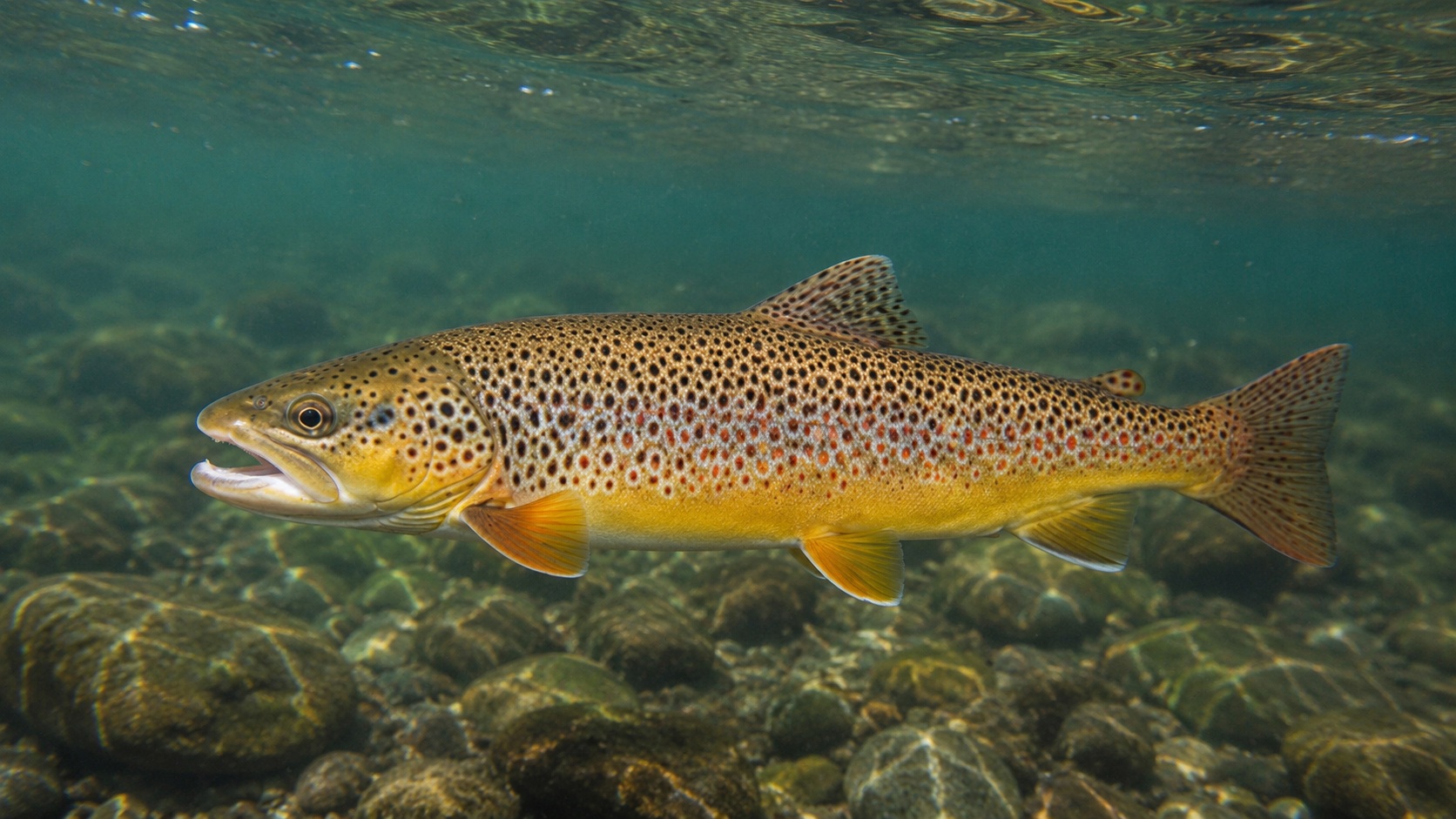
Brown trout wear an olive-green to golden-brown back that lightens toward a cream or yellowish belly. The most reliable field mark is the spotting pattern: dark black spots scattered across the back and flanks, many with pale halos, and a secondary scattering of red or orange spots along the midsection. This combination of dark black spots plus reddish spots with pale rings is unique to brown trout among the common North American species.
To separate browns from the other trout you are likely to encounter: rainbow trout carry a bold pink or reddish lateral stripe and heavy black spotting across the tail; brown trout tails are lightly spotted to nearly clear. Brook trout have wormy marbled patterns on the back, vivid red spots in blue halos, and white-edged lower fins; brown trout have none of these. The jaw on large males hooks forward and turns into a pronounced kype during fall spawning season, a useful clue when fishing autumn tailwaters.
Where to find them
Brown trout need cold, clear, well-oxygenated water, but they tolerate warmth better than other salmonids and can persist where water temperatures approach 75 degrees Fahrenheit. This tolerance makes them the dominant trout in many tailwater fisheries below large dams, where cold reservoir water releases year-round.
In the eastern United States, the Delaware River system in New York and Pennsylvania holds superb wild brown trout populations, with fish rising predictably to evening hatches. Pennsylvania’s limestone spring creeks, including Penns Creek and Spring Creek in Centre County, are legendary for selective browns feeding on prolific insect hatches. In the South, the White River tailwater system below Bull Shoals Dam in Arkansas is arguably the finest big-brown fishery in the country, having produced fish over 35 pounds and holding documented densities near 188 brown trout per mile exceeding five pounds.
In the Appalachians, the Watauga, South Holston, Clinch, and Hiwassee tailwaters in Tennessee are year-round options with both stocked and holdover fish. Moving west, the Bighorn River below Yellowtail Dam in Montana stays between 40 and 55 degrees year-round and supports 3,000 to 5,000 trout per mile in the first 13 miles. The Madison River in Montana and the Yellowstone River offer wild browns alongside cutthroat and rainbow trout. Colorado’s Gunnison River and the Dream Stream section of the South Platte below Spinney Mountain Reservoir are well-known trophy brown trout destinations.
Brown trout are not a Florida freshwater target. Florida does not stock or manage coldwater trout species. Anglers in Florida seeking “trout” fishing pursue spotted seatrout, an unrelated saltwater species.
When to go
Two windows stand above all others. Spring, from late March through May, finds brown trout actively feeding after the energetic demands of fall spawning. Water is often high and cold, streamers produce well, and rising fish appear during hatches of blue-winged olives and early caddis on warmer afternoons.
Fall, from September through November, triggers pre-spawn aggression. Browns that have been selective and difficult all summer begin chasing larger prey items. They move into shallower riffle water to stage for spawning, feed more boldly during low-light periods, and respond to streamers even when they have ignored smaller presentations. This is the window for a fish of a lifetime on a streamer.
Summer fishing is productive on spring creeks and tailwaters that maintain cold temperatures, but expect the most selectivity of the year. Dawn and dusk are the productive windows; midday fishing in summer requires small flies, light tippet, and slow, deliberate presentations. Large browns feed heavily at night during summer, and mousing after dark along undercut banks and log jams is a legitimate strategy for fish that will not show themselves during daylight.
Winter fishing is underrated on tailwaters, where consistent flows and stable temperatures keep fish feeding. Small midge patterns and blue-winged olive nymphs in sizes 20 to 24 account for fish when nothing else will.
What to throw
Dry flies are the heart of brown trout fishing on spring creeks and technical rivers. The Blue-Winged Olive in sizes 18 to 24 is the single most important pattern across most of the brown trout’s North American range, effective from fall through spring during overcast days and cold afternoon hatches. Elk Hair Caddis in sizes 12 to 16 covers evening rises from May through September. Parachute Adams patterns in sizes 14 to 18 serve as a searching dry when no specific hatch is occurring. In summer, hopper patterns such as the Dave’s Hopper or Chernobyl Ant in sizes 8 to 12 pulled along grassy banks trigger aggressive takes.
Nymphs account for most of the trout caught on any given day. Pheasant Tail Nymphs in sizes 16 to 22, with or without a bead, are the foundational pattern. A Hare’s Ear Nymph in sizes 12 to 16 covers a broader silhouette and works through riffles and broken water. Set your indicator at 1.5 to 2 times the water depth, fish 2 to 3 feet-per-second current seams, and trust occasional bottom contact as confirmation of proper depth.
Streamers are the tool for big browns. Woolly Buggers in sizes 4 to 8, black or olive, cover the basic sculpin-leech silhouette that large browns key on. Articulated patterns like the Drunk and Disorderly and Circus Peanut imitate large baitfish and produce the biggest fish. On conventional gear, Countdown Rapalas and Husky Jerks in shad or perch colors fished with a slow, erratic retrieve along current seams produce trophy fish in lakes and larger rivers. Cast quartering upstream and strip slowly; brown trout, especially large ones, prefer a slower presentation than rainbow trout.
Mousing after dark deserves its own mention. Floating mouse patterns stripped along shoreline structure during the first and last hours of darkness produce violent strikes from fish that never show during daylight. A 1X leader without tippet is appropriate, as large brown trout have teeth sharp enough to cut light monofilament on a hard take.
For spinning tackle, in-line spinners such as Rooster Tails and Panther Martins in size 2 to 3 produce well in spring when fish are active, and small crankbaits in natural baitfish colors work across all seasons.
Regulations
Brown trout regulations vary significantly by state and often by individual water body. There is no single national standard, and many of the most productive fisheries have special slot limits, catch-and-release-only sections, or single-barbless-hook requirements designed to protect trophy fish.
Tennessee (TWRA): General statewide trout waters allow 4 trout per day in combination (rainbow, brown, brook) with a 7-inch minimum. Major tailwaters carry stricter rules: the Caney Fork allows 5 total trout per day but only 1 brown trout, with a 24-inch minimum length for that fish. Always verify current rules at https://www.tn.gov/twra/fishing-regs/trout-regulations.html before fishing.
Pennsylvania (PFBC): Regular season opens the first Saturday in April. Daily limit is 5 trout during the regular harvest season, 3 trout during the extended season. The 7-inch minimum applies on most waters, with many limestone streams carrying special delayed-harvest or catch-and-release designations. Verify at https://www.fishandboat.com.
Montana (FWP): Most rivers are open year-round with 5 trout daily, but many quality fisheries including the Bighorn and sections of the Madison carry special regulations with lower limits or catch-and-release requirements. Verify at https://fwp.mt.gov.
Arkansas (AGFC): White River tailwaters have zone-specific rules; some sections are catch-and-release only for brown trout, others allow harvest with size minimums. Verify current rules at https://www.agfc.com.
Regulations change annually. Always verify current rules at the managing state wildlife agency before fishing any specific water.
Handling and release
Brown trout are a cold-water species with limited tolerance for warm air temperatures, warm water, and prolonged handling. Keep fish in the water whenever possible during release. Wet your hands before touching any trout. Use a rubberized net rather than knotted nylon to protect the slime coat. For large fish, avoid vertical lifts by the jaw; support the body horizontally. Keep the fish submerged and pointed into current until it swims away under its own power.
During summer and early fall, water temperatures on many trout streams rise into stress ranges for salmonids. When stream temperatures exceed 68 degrees Fahrenheit, consider not fishing for trout at all, or fish only the coldest hours of the morning. A brown trout that swims away may still die from thermal stress if the water is too warm.
Brown trout are excellent table fare, with firm, pink to orange flesh in wild fish feeding on natural forage. Where harvest is legal and appropriate, fish from cold tailwaters in autumn have outstanding flavor. Stocked fish are milder in taste but still good eating. The decision to harvest should always account for the specific regulation status of the water and the population health of the fishery.
On the Table
Brown trout are excellent table fare, widely respected for their rich, nuanced flavor — though many anglers practice catch-and-release given their status as a prized sport fish, especially in quality wild-trout waters.
Taste and texture: Brown trout have a more pronounced, earthy flavor than rainbow trout, with a slightly richer, less mild profile that some describe as nutty or mildly gamey in a pleasant way. Wild fish feeding on insects and small baitfish develop deeper flavor than hatchery fish. The flesh ranges from off-white to a soft pink depending on diet, and the texture is moderately firm and flaky — holding together well for most cooking methods without falling apart.
Best preparation methods:
- Pan-frying: The classic approach for stream-caught browns. A simple dredge in seasoned flour and butter-fry in a cast-iron skillet preserves the delicate skin and lets the natural flavor shine. Whole small fish work especially well this way.
- Smoking: Brown trout’s slightly richer flesh takes smoke exceptionally well. A light cold or hot smoke with alder or apple wood produces a finished product similar in quality to smoked salmon, making it one of the better freshwater candidates for the smoker.
- Baking or roasting: Larger fish (over 2 lbs) benefit from roasting whole or in fillets with herbs, lemon, and olive oil. The firmer flesh of big browns holds up to heat without drying out as quickly as leaner trout species.
- Grilling: Works well for fillets from larger fish; the higher fat content compared to brook trout helps prevent sticking and keeps the flesh moist over direct heat.
Handling for table quality: Brown trout are soft-fleshed and degrade quickly in warm water. Kill the fish immediately by spiking or a sharp blow to the head, then ice it promptly — do not let it sit in a warm creel or livewell. Rinse the body cavity thoroughly after gutting and keep fish cold until cooking. Fillets can be kept skin-on to protect flesh during cooking and removed after if preferred.
Eating caveats:
- Worm parasites: Brown trout, like most freshwater fish, can carry internal parasites including roundworms. Thorough cooking to an internal temperature of 145°F eliminates all risk. Do not eat raw or undercooked trout.
- Regulations and size: Many quality wild-trout streams have catch-and-release regulations or slot limits specifically designed to protect larger, wild fish. Check local regulations before keeping any brown trout — in many designated wild-trout waters, keeping fish is either prohibited or restricted to small hatchery fish. Hatchery fish are generally considered more appropriate to keep for the table than large, wild stream fish.