A note about links: If we include links to retail sites like Amazon or Bass Pro Shops, it's because they're relevant to the topic and, as anglers ourselves, we believe they're worth checking out. As an Amazon Associate we earn from qualifying purchases.
There is a moment in small-stream brookie fishing that every angler remembers: you creep up on a pocket of cold water no bigger than a bathtub, drop a fly into the current seam, and a fish the color of a living sunset explodes on the surface before your line has time to straighten. Brook trout are the most vividly colored freshwater fish in North America, and they earn that title without argument. They are also among the most accessible wild trout a beginner can target, willing biters in the kind of intimate, wooded headwater streams that feel genuinely remote even an hour from a city. Chasing brookies is less about technical mastery and more about getting into wild places, reading cold water, and staying low.
How to identify one
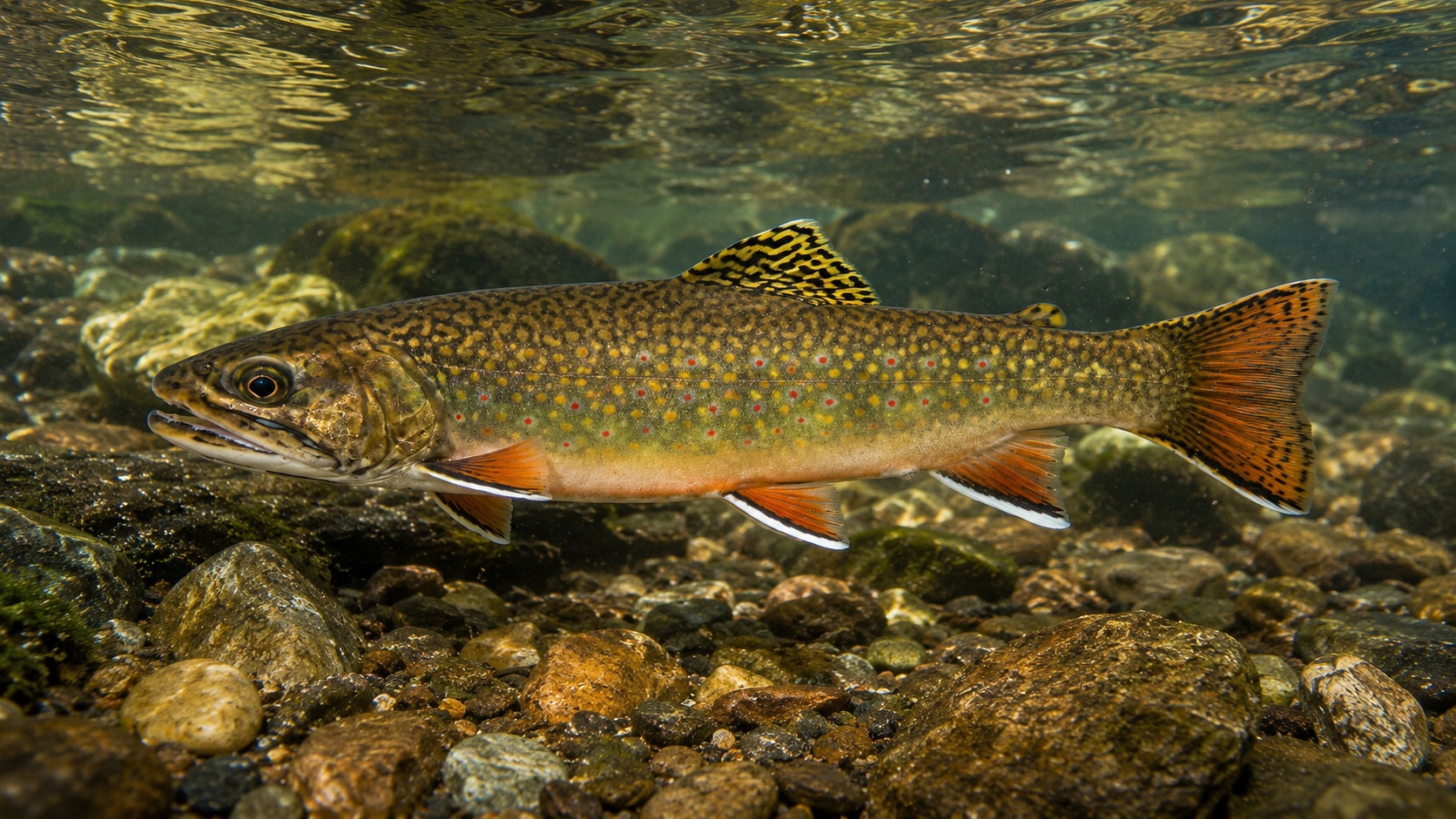
No other fish in North American freshwater looks quite like a brookie. The back runs olive to dark green with yellow worm-like markings called vermiculations. Along the flanks you will find scattered red spots each ringed in pale blue, set against a canvas that shifts from olive on top to burnt orange toward the belly. The lower fins are a vivid orange or red edged with a crisp white stripe followed by a black stripe, a field mark shared only with other chars. The tail is slightly forked but much squarer than a rainbow or brown trout, which is where the old nickname “squaretail” comes from. In fall spawning condition, males develop a bright orange-red belly that is almost impossible to misidentify. The closest lookalike is the lake trout, which shares the char family but grows much larger and lacks the red spots with blue halos. In waters where brookies have hybridized with brown trout, the resulting “tiger trout” shows a bold marbled pattern that is distinct from either parent.
Where to find them
Brook trout are a creature of cold, clear, clean water. They need temperatures below 68 degrees Fahrenheit to thrive and will abandon any stretch of stream that climbs above 70 degrees in summer. That requirement shapes where you will find them: headwater streams, spring seeps, high-elevation drainages, and cold-water lakes fed by groundwater. Sandy or gravel bottoms with riparian cover and moderate current are ideal. In streams, look for them holding in pools just downstream of fast water, tucked under undercut banks, or stacked in the slack water behind boulders.
The strongest wild brook trout fishing in the eastern United States runs through a band from Maine to Georgia along the Appalachian spine. In Maine, the Rangeley Lakes region and the Rapid River are classics. New York’s Adirondacks hold some of the most productive brook trout pond fishing on the continent, with the St. Regis Canoe Area, Pharaoh Lake Wilderness, and West Canada Lake Wilderness all holding strong populations. In the mid-Atlantic, Pennsylvania’s limestone spring creeks and mountain drainages hold healthy numbers, and Virginia’s Blue Ridge streams are worth seeking out.
The upper Midwest holds its own brook trout heritage. Minnesota’s Lake Superior North Shore tributaries — the Baptism River, Temperance River, and Cascade River — support wild and stocked brook trout in cold, rocky runs that drain into the biggest freshwater lake on the continent. Wisconsin’s Driftless Area in the southwest corner of the state maintains viable brookie habitat in spring-fed coulee streams that stayed unglaciated and cold. These populations offer a different experience from the Appalachian fishery: more open terrain, shorter seasons, and the occasional tributary that runs clear and cold all the way down to big water.
The Southern Appalachians deserve special mention. Great Smoky Mountains National Park protects some of the only remaining wild brook trout populations in the South. The upper reaches of Lynn Camp Prong, Raven Fork, and Kanati Fork all hold native fish above 3,000 feet elevation. Chasteen Creek and the upper drainage of Deep Creek are also worth hiking to reach. These southern brookies are smaller on average than their northern relatives, rarely topping 8 inches, but they are genetically distinct, entirely wild, and fishing for them in old-growth cove forest is an experience that stands apart from anything else in American freshwater fishing.
When to go
Spring and fall are the bookends of prime brook trout time. In the Northeast and upper Midwest, the general season opens in April once water temperatures climb out of the low 40s and insect hatches begin. Brook trout feed aggressively through May and June as caddisflies, mayflies, and stoneflies come off the water. Summer fishing is possible but requires moving to higher elevations or north-facing drainages where water stays cold. By August, many lower-elevation streams are simply too warm and the fish become sluggish and stressed. September and October bring the best of both worlds: cooling water, hungry pre-spawn fish, and fall foliage that makes any day on the water memorable. Brook trout spawn in October and November, and in many states regulations tighten or close during that window to protect redds. Early morning and evening are the most productive windows during warmer months. On overcast days, feeding continues throughout the day.
What to throw
Dry flies are the most satisfying way to catch brook trout and, in clear water conditions, often the most effective. Adams (size 14-16), Elk Hair Caddis (size 14-16, tan or olive), and Royal Wulff (size 12-16) are the three flies to start with on any brookie stream. Brookies are aggressive and rarely fussy, so pattern matters less than placement. Drop the fly into the seam line at the head of a pool and let it drift naturally. Nymphs like a Pheasant Tail or Hare’s Ear (size 14-18) in a dead drift along the bottom produce well when fish are not rising, especially in early spring when water is still cold. For larger fish in deeper pools, streamers like a Woolly Bugger or Muddler Minnow stripped through the pool on a tight line will draw strikes. A 3-weight fly rod, 7.5-foot leader tapered to 5X, and a floating line covers nearly all brook trout stream situations.
On spinning gear, inline spinners are hard to beat. A Mepps Aglia size 0 or 1 in gold or a Rooster Tail 1/16 oz in yellow or brown will produce on virtually any brook trout water. Cast 45 degrees upstream and reel just fast enough to keep the blade spinning, letting the current do the work. Small spoons like a 1/8 oz Acme Kastmaster in gold are excellent in deeper pools and lake margins. Small jigs tipped with a white curly tail grub (1/16 to 1/8 oz) fish well along the bottom in slower pools. Use 4 to 6 lb monofilament and a light action rod. Brook trout have sharp eyesight and lighter line gets significantly more strikes in pressured or clear-water situations.
For bait fishing where allowed, nightcrawlers or worm pieces on a size 8 or 10 hook with a split shot fished under a small float or drifted along the bottom remain the most effective technique for new anglers. Small minnows and crickets also produce well. Note that many trophy streams and national park waters prohibit live bait entirely.
Regulations
Brook trout regulations vary more dramatically by state and water body than almost any other freshwater species. Some general patterns hold: most northeastern states set a minimum size of 6 to 8 inches and daily bag limits of 5 brook trout, though specific waters often have stricter rules. Pennsylvania’s general inland trout regulations set a 7-inch minimum and a 5-fish daily limit during the regular season. New York’s general season runs April 1 through October 15 with a 3-fish daily limit and a 6-inch minimum on most waters. Maine allows a 5-fish daily limit with a 6-inch minimum on general law waters, though many remote ponds have catch-and-release designations.
In Great Smoky Mountains National Park, regulations are uniform across Tennessee and North Carolina: a 7-inch minimum, a combined 5-fish daily limit for brook, rainbow, and brown trout together, and artificial lures or flies with single hooks only. No bait of any kind is permitted in the park.
New Jersey maintains a Brook Trout Conservation Zone across its northwest region where all brook trout must be immediately released unharmed. Many states designate special wild trout streams with catch-and-release or artificial-only requirements specifically to protect remaining native brook trout populations.
Because regulations change by water body and season, always verify current rules directly with your state fish and wildlife agency before fishing. Key resources:
- Pennsylvania Fish and Boat Commission: pfbc.pa.gov
- New York DEC Freshwater Fishing: dec.ny.gov
- Maine Department of Inland Fisheries and Wildlife: maine.gov/ifw
- Vermont Fish and Wildlife: vtfishandwildlife.com
- Virginia Department of Wildlife Resources: dwr.virginia.gov
- National Park Service (Great Smoky Mountains): nps.gov/grsm/planyourvisit/fishing.htm
Handling and release
Brook trout are more cold-adapted and less heat-tolerant than rainbow or brown trout, which makes proper handling especially important in summer. When water temperatures exceed 67 degrees, stress during catch-and-release increases mortality risk significantly. If your thermometer reads above 68 degrees, consider targeting a different species that day or moving to a higher, colder drainage.
Wet your hands before touching any trout. The slime coat is the fish’s primary defense against infection and disease, and dry hands strip it away. Avoid touching the gills entirely. Support the fish horizontally, gripping gently just behind the dorsal fin and in front of the tail. Keep the fish in the water as much as possible and limit air exposure to under five seconds for photos. Face the fish into the current in shallow water and wait until it swims away on its own before releasing your hold.
Brook trout are excellent table fish, with firm, pink to orange flesh and a mild, clean flavor that improves with cold water habitat. In states with liberal limits on stocked or high-density waters, keeping a legal limit for the table is a perfectly reasonable choice. Where native wild populations are present, especially in Southern Appalachian streams or designated wild trout waters, voluntary catch-and-release helps preserve fish that took decades of restoration effort to recover.
On the Table
Brook trout are widely regarded as one of the finest-eating freshwater fish in North America — clean, sweet, and delicate — and anglers who keep a legal limit are rewarded with some of the best table fare cold-water streams and mountain lakes have to offer.
Taste and texture: Brook trout flesh ranges from white to pale pink or orange depending on diet, with wild fish feeding on crustaceans and insects often showing a richer, more orange-hued flesh. The flavor is mild and subtly sweet with none of the muddy or gamey quality sometimes found in warm-water species. The texture is tender and finely flaked — delicate enough to fall apart if overcooked, so timing matters.
Best preparation methods:
- Pan-frying whole: The classic preparation for small brookies (under 12 inches). A light dredge in seasoned flour or cornmeal, then fried in butter over medium-high heat, produces crispy skin and moist flesh. The skin crisps beautifully and is worth eating. Whole-fish preparation also keeps the meat moist during cooking.
- Streamside grilling or foil-pack: For larger fish, grilling over hardwood coals or wrapping in foil with butter, lemon, and fresh herbs (thyme, dill) suits the delicate flesh. Direct high heat sears the outside before the interior dries out.
- Butter-basting (meuniere style): A simple brown butter and lemon sauce complements the sweet flavor without masking it. This method works especially well for fillets from fish 14 inches and up.
- Smoking: Brook trout take smoke exceptionally well. A low, cool smoke over apple or cherry wood produces rich, firm flesh ideal for eating cold or flaking into dips and spreads.
Handling for table quality: Brook trout are fragile and deteriorate quickly in warm water. Kill the fish immediately with a firm rap to the head, then bleed it by cutting the gills or the throat latch. Place it directly on ice or in an ice slurry — not just a dry cooler. Field dressing (gutting) on the spot is worthwhile for fish you won’t cook within a couple of hours. The flesh bruises easily, so avoid squeezing or stacking fish. Skin-on fillets or whole fish retain moisture better than skinless fillets during cooking.
Eating caveats: In some high-elevation or remote waters, brook trout may be subject to tight bag limits or special regulations aimed at protecting wild populations. Check local regulations before keeping fish, as many native brook trout streams in the Appalachians and Northeast carry single-digit daily limits or special-harvest rules. No ciguatera risk, no significant mercury concerns, and no notable parasite issues under normal cooking temperatures.