A note about links: If we include links to retail sites like Amazon or Bass Pro Shops, it's because they're relevant to the topic and, as anglers ourselves, we believe they're worth checking out. As an Amazon Associate we earn from qualifying purchases.
What it is
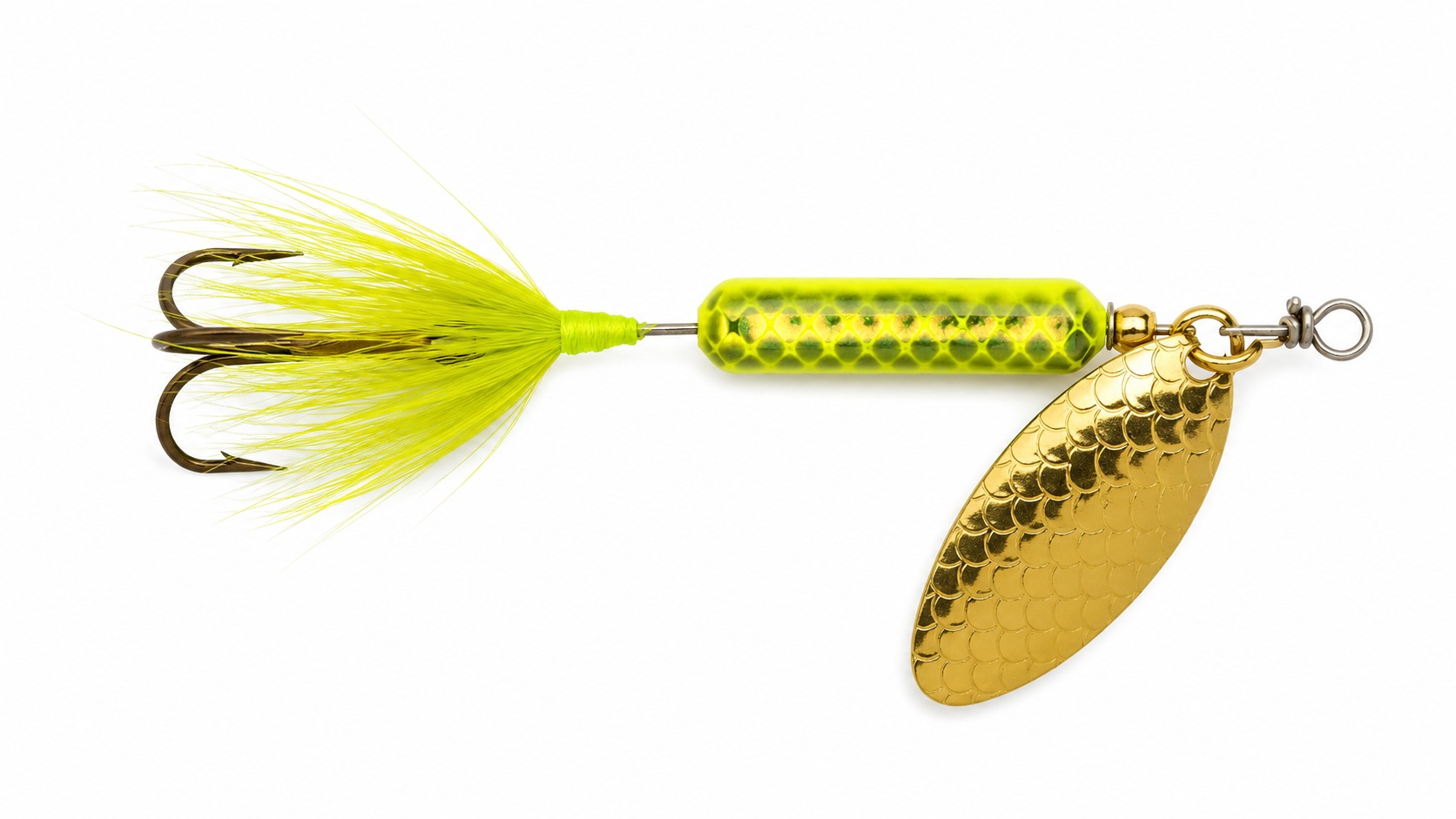
The inline spinner is as simple as a lure gets. A metal blade is mounted on a straight wire shaft so that it rotates freely around the shaft as the lure moves through the water. That spinning blade creates flash and vibration on every cast, and it does it without any rod action on your part. You cast it out and reel it back — that is the whole technique.
There is no complicated retrieve, no subtle twitch, no pause-and-shake to master. That makes the inline spinner the single most approachable lure for a new angler, and it does not stop being effective as you get better. The Mepps Aglia has been catching wild trout on rivers around the world for over seventy years. The Worden’s Rooster Tail is a staple in trout streams across North America. These are not training-wheel lures — they catch serious fish in serious water.
The blade style determines the lure’s personality. Colorado blades are round and wide; they rotate at a steep angle, create a lot of thump and vibration, and work best in murky water or cold water when fish are relying more on their lateral line than their eyes. Willow leaf blades are long and narrow; they spin faster, produce more flash with less resistance, and shine in clear water and faster current. French and Indiana blades (the classic Mepps shape) sit between the two — a moderate oval that balances vibration and flash well in most conditions. Most beginners start here and stay here.
The setup
Inline spinners come pre-rigged from the factory with a treble hook at the rear. There is nothing to assemble — you attach it to your line and fish.
The one modification that matters is a snap swivel. Thread a small snap swivel onto your main line and snap the lure’s wire loop directly to it. The swivel does two things: it lets you change lures in seconds, and more importantly, it prevents line twist. A spinning blade imparts torque on every retrieve. Without a swivel, your line will kink and coil after a dozen casts. A snap swivel rated for 6–10 lb is adequate for most freshwater inline spinners.
Tie the snap swivel to your main line with an improved clinch knot or a Palomar knot. That is the entire rig.
How to fish it
In rivers: Cast upstream and across the current, then reel downstream slightly faster than the current speed — just fast enough to keep the blade spinning. This is the standard trout approach. The spinner works against the current, holds at the correct depth, and drops directly in front of trout holding behind rocks and seams. In faster runs, a heavier spinner holds bottom better; in slow pools, a lighter lure stays at the right depth without snagging.
In lakes and ponds: Cast along the bank, parallel to fallen trees, over rocky shoals, and near points where the bottom drops off. A steady medium-speed retrieve is all you need. Vary the depth by counting down before you start reeling — count to three for shallow, count to eight for mid-depth. When you find fish, repeat that count on every cast.
Cold water: When water temperatures are below 50°F, slow everything down. Use a heavier spinner than you normally would and reel slower. The blade still spins, the vibration is still there, but the lure spends more time in front of cold, lethargic fish.
Reaction bite: Inline spinners trigger fish that are not actively feeding. The sudden flash of a blade crossing a smallmouth bass or a northern pike in clear water often produces a strike that has nothing to do with hunger. It is a reaction, and it happens fast.
When to use it
Spring and early summer are the peak seasons. Trout in rivers are actively feeding as water warms from winter. Perch and bass move shallow. The inline spinner matches this period perfectly because it covers water fast and the flash reads well in slightly off-color snowmelt runoff.
Moving water of any kind: Rivers, tailraces, dam outflows — anywhere current is present, the inline spinner is at home. The current does part of the work for you, keeping the blade turning even at a slow retrieve speed.
Clear ponds after a cold front: When a front has shut down the bite and fish are neutral, a silver-bladed spinner retrieved fast through shallow water often breaks through the lockjaw. The reaction element is stronger than the feeding cue.
Trout stocking situations: Freshly stocked rainbow trout are conditioned to competing for food. A bright inline spinner dropped near recently stocked fish almost always produces.
Size and color guide
| Weight | Best for |
|---|---|
| 1/16 – 1/8 oz | Stream trout, bluegill, yellow perch |
| 1/4 – 3/8 oz | River trout, bass, walleye |
| 1/2 oz | Largemouth bass, smallmouth bass, walleye |
| 3/4 – 1 oz | Northern pike, muskie |
| Blade color | When to use |
|---|---|
| Gold | Stained or tannin water; overcast days |
| Silver | Clear water; bright sunny conditions |
| Chartreuse / orange | Panfish, perch; heavily stocked trout |
| White / pearl | Low light, dawn, dusk |
The Rooster Tail’s feathered tail adds a second visual cue at the hook end and gives the lure a slightly different profile on a slower retrieve. It is particularly effective for panfish and trout that track a lure before committing.
Gear setup
Rod: A light or ultralight spinning rod, 5’6” to 6’6”, in a fast or medium-fast action. You want to feel the blade’s vibration through the rod tip — that feedback tells you the blade is spinning and lets you detect when weeds have fouled the hook.
Reel: A small spinning reel (size 1000 to 2500) balances well with an ultralight rod and provides enough line capacity for long casts.
Line: 4–8 lb monofilament or fluorocarbon for trout and panfish. 8–12 lb for bass and walleye. Braid in a 6–10 lb test works well for improved sensitivity and casting distance, but add a 24-inch fluorocarbon leader before the snap swivel if using braid.
Brands worth knowing
Mepps Aglia is the benchmark. The French blade shape and quality bearings let the blade spin at very slow retrieve speeds, which matters in cold water. Size 0 and 1 are the standard trout sizes; size 3 and 4 cover bass and walleye.
Worden’s Rooster Tail adds the feathered tail body that pulses and breathes on retrieve. It is especially effective when trout are in slower pools and need a slightly different look.
Panther Martin uses a body-mounted blade directly on the shaft (rather than a clevis), which lets it start spinning at slower speeds with less resistance. It runs slightly deeper than a comparable Mepps.
Blue Fox Vibrax uses a two-part body with a brass gear that produces a distinct rattling sound along with the blade vibration — useful in murky water or when fishing pressure has made trout wary of the standard presentation.
For pike and muskie, the Mepps Giant Killer (size 4 and 5 with a trailer hook) is the tool — a 3/4 to 1 oz spinner with a large blade and stinger hook that handles fish over 30 inches cleanly.