A note about links: If we include links to retail sites like Amazon or Bass Pro Shops, it's because they're relevant to the topic and, as anglers ourselves, we believe they're worth checking out. As an Amazon Associate we earn from qualifying purchases.
Northern pike are the fish that make you second-guess every other freshwater species you have targeted. The strike comes without warning: a torpedo-shaped predator exploding out of the weeds, engulfing a lure half the size of what you thought was reasonable, and running line faster than you anticipated. These fish grow large, fight hard, and live in accessible water close to shore, which makes them one of the most thrilling targets you can pursue with a medium-heavy rod. Once you have landed a thick 36-inch pike and stared into those cold, amber eyes, the obsession becomes easy to understand.
How to identify one
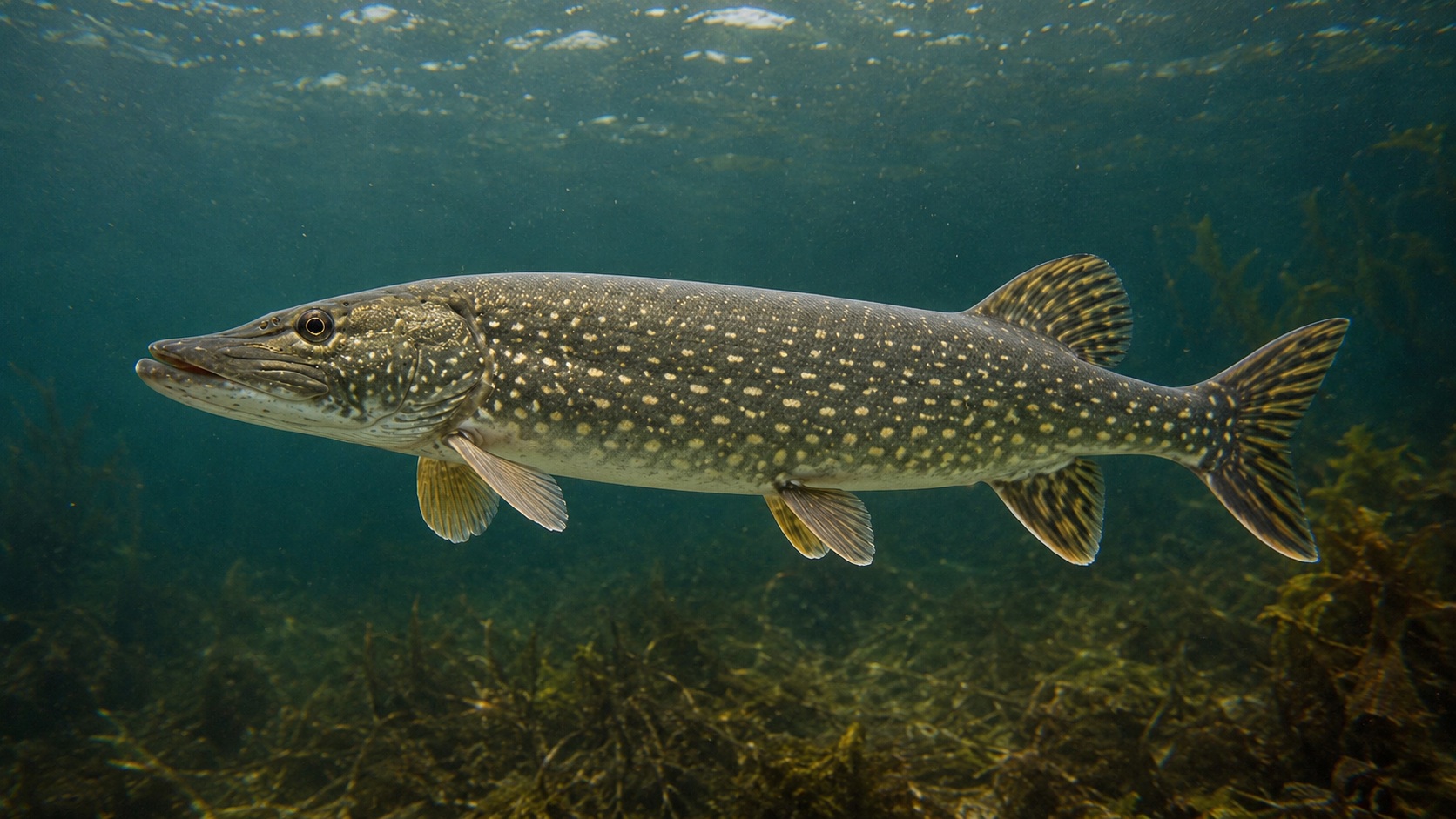
Northern pike are built for one purpose: eating things. The body is long and cylindrical, dark olive to greenish-brown along the back, fading to cream on the belly. The key field mark is the pattern of light-colored bean-shaped spots scattered across a darker body, running roughly in horizontal rows along the flanks. The snout is broad and flat, almost duck-billed, and packed with hundreds of razor-sharp teeth arranged in rows. The dorsal and anal fins sit far back on the body, close to the deeply forked tail, which gives pike their characteristic rocketlike burst of speed. Younger fish, sometimes called “hammer handles,” are slender and sometimes show vertical barring instead of spots. The closest lookalike is the muskellunge, which reverses the pattern: dark spots or markings on a lighter background. Chain pickerel share the same family but are much smaller and carry a distinct chain-link pattern. If in doubt, count the sensory pores on the underside of the jaw: pike have five or fewer on each side, muskellunge have six or more.
Where to find them
Northern pike are a cold-water species native to the northern latitudes of North America, from Alaska and northern Canada south into the Great Lakes states, through much of Wisconsin, Minnesota, Michigan, Montana, and into the upper Midwest. They are circumpolar, meaning they also span northern Europe and Asia, which explains why the all-tackle world record came from Germany.
Prime pike water is weedy, clear to lightly stained, with depths between 3 and 15 feet. Pike are edge hunters: they hold tight to the transition between open water and aquatic vegetation, using cabbage weeds, coontail, and reed lines as cover to ambush passing baitfish. In lakes, target weedy bays, rocky points draped in vegetation, sunken timber, and the outside edges of shallow shoals. In rivers, look for scoured holes behind structure, backwater sloughs, beaver-flooded shallows, and weedy eddies where current slows.
Named waters known for producing large pike include Lake of the Woods on the Minnesota-Ontario border, Mille Lacs Lake in central Minnesota, Winnebago and Green Bay in Wisconsin, the St. Lawrence River in New York, and the vast shield lakes of Ontario, Manitoba, and Saskatchewan. Northern Manitoba and Saskatchewan in particular are bucket-list destinations for pike anglers — remote fly-in lakes like Wollaston and Reindeer Lake produce fish in the 20-pound class that are genuinely rare even on the best Minnesota and Wisconsin waters. In Alaska, interior rivers and lakes from the Yukon drainage through the Kuskokwim system hold native populations.
When to go
Spring is the prime window. As ice breaks up and water temperatures climb toward the 40s and low 50s Fahrenheit, pike move into the shallowest, warmest bays to spawn, and they stay aggressive through the post-spawn period in May and early June. This is when fish of a lifetime are caught in knee-deep water. Access is easy, competition is minimal, and pike are hungry after winter.
Fall produces equally large fish as pike bulk up before freeze-up. Water temperatures dropping back through the 50s in September and October fire up feeding again, and fish push back onto the weed edges. Early morning and evening are most productive in summer; in spring and fall, pike feed throughout the day. Ice fishing through winter can be outstanding, particularly over deep weed flats in 8 to 20 feet of water. Summer fishing slows as water temperatures rise above 65 degrees Fahrenheit, pushing pike into cooler, deeper haunts where they become lethargic and harder to target.
What to throw
The single most important piece of gear for northern pike is a wire or heavy fluorocarbon leader. Pike teeth will slice through monofilament and even heavy fluorocarbon on the strike. Use a commercially tied 6-to-12-inch wire bite leader (27-pound test or heavier) or a coiled stainless steel leader between your lure and your mainline. Skip the leader and you will lose fish and lures consistently.
Spoons are the classic pike lure and still one of the most effective. The Eppinger Daredevle in red-and-white or five-diamond is a proven producer. Sizes from half-ounce to 1.5 ounces cover most conditions. Cast past the weed edge and retrieve with a steady wobble or flutter the lure on a slow lift-fall retrieve along drop-offs.
Inline spinners in sizes 3 through 6 (Mepps Aglia, Blue Fox Vibrax) draw aggressive reaction strikes. Retrieve steadily just above the weed tops. Chartreuse and white are top colors in stained water; natural perch or silver works well in clear conditions.
Topwater lures produce some of the most violent strikes in freshwater fishing. Work 4.5-to-6-inch jerkbaits and walk-the-dog style plugs (Heddon Super Spook, Sebile Stick Shadd) over shallow weed flats during calm mornings and evenings from late spring through summer. The visual of a 20-pound pike erupting through surface vegetation never gets old.
Jerkbaits and large crankbaits like the Rapala Original Floater in size 11 or 13, or a Suick Thriller, produce well worked along deep weed edges in fall. Twitch-pause-twitch retrieves trigger strikes from hesitant fish.
Soft plastics rigged on a weedless jig head (Berkley PowerBait Swim Shad in 5-to-7-inch sizes, Z-Man Swimz) let you work directly through vegetation without constant hang-ups. Big swimbaits on 1-to-1.5-ounce ball-head jigs are increasingly popular for targeting trophy fish.
Live and cut bait remains deadly, especially for ice fishing and still-fishing from docks. Suspend a 6-to-12-inch sucker, shiner, or chub 18 inches above the weeds under a large bobber. This rig accounts for a significant share of the very largest pike landed each season.
If a pike follows your lure to the boat without committing, plunge the rod tip underwater and execute a figure-eight sweep. This direction change at boatside triggers strikes from fish that have followed but refused, and it is one of the most reliable last-second techniques in pike fishing.
Regulations
Northern pike regulations vary substantially by state and even by individual water body. There is no single federal regulation for this species. Managing agencies are state-level fish and wildlife departments. A brief summary of major states:
Minnesota: The state is divided into northern pike zones. In many waters the daily limit is 3 fish with a 24-inch minimum size. Slot limits apply on designated waters (Mille Lacs Lake, for example, requires fish to be under 24 inches or over 36 inches, with one pike over 36 inches allowed). Always check the zone-specific and water-specific rules.
Wisconsin: The general statewide season runs from the first Saturday in May through March 1 of the following year, with a daily bag limit of 5 fish of any size on most inland waters. Many waters have special regulations with size minimums or reduced bag limits.
Michigan: A statewide 24-inch minimum size applies on most waters, with a daily limit of 5 fish. Designated trophy lakes carry 30-to-36-inch minimums.
Alaska and western states with introduced populations: Regulations vary widely; in some jurisdictions pike are considered invasive and there are no bag or size limits, or active eradication programs are in effect.
Always verify current rules directly with your state agency before fishing. Regulations change annually, slot limits and special waterbody rules are common, and non-compliance fines can be significant.
Authoritative regulation sources by state:
- Minnesota DNR: mndnr.gov/regulations/fishing
- Wisconsin DNR: dnr.wisconsin.gov
- Michigan DNR: michigan.gov/dnr
- Alaska ADF&G: adfg.alaska.gov
Handling and release
Northern pike are beautiful fish with serious teeth and a dense coat of protective slime that serves as their immune system. Minimize contact with that slime layer. Wet your hands before handling any pike you intend to release. For fish you plan to keep, a quick bonk and cooler works fine.
For catch-and-release, the best approach is horizontal support: cradle the fish under the belly with both hands, keeping it horizontal, and do not hold a large pike vertically by the jaw alone. The jaw hold popular with bass anglers can injure the spine of a heavy pike. A soft-mesh landing net reduces slime removal and makes handling safer for both fish and angler.
Use long needle-nose pliers or forceps to remove hooks, and consider replacing standard treble hooks with single barbless hooks or pinching barbs flat to speed release. A jaw-spreader helps when a pike has taken the lure deep. Cut the leader and leave the hook in place if a fish has swallowed a lure and removal would cause significant injury. Steel leaders rust out quickly; hooks do not, so the leader cut approach is humane and effective.
Pike are excellent table fare, particularly fish in the 18-to-26-inch range. The flesh is white and mild, but the Y-bone structure makes filleting more involved than most species. The five-cut method removes the Y-bones and yields boneless fillets from pike of any size.
On the Table
Northern pike earn a solid “good” rating at the table — genuinely tasty when handled well — but a reputation for difficulty keeps many anglers from keeping them. The culprit is a row of Y-shaped intermuscular bones that runs through each fillet; once you master the five-fillet boneless cut, pike becomes a versatile, rewarding table fish.
Taste and texture: Pike flesh is mild, clean, and slightly sweet with almost no “fishy” aftertaste. The meat is bright white, lean, and firm with large flakes. Smaller fish in the 2-5 pound range have the most delicate flavor; fish above 8-10 pounds can develop a slightly coarser texture. The skin carries a mucus coating that gives off a muddy odor — always remove the skin before cooking.
Best preparation methods:
- Beer-battered or cracker-crumb frying: Pike’s firm, lean flesh holds up perfectly to a hot-oil fry without turning mushy. Coat boneless pieces in seasoned flour, egg wash, and crushed crackers or a light beer batter, then fry at 375-380 F until golden. The mild flavor pairs well with a squeeze of lemon.
- Cedar-plank grilling: The plank insulates the lean flesh from direct flame, preventing it from drying out. A simple rub of garlic, paprika, and herbs is enough — the wood adds a subtle smokiness that complements the clean white meat.
- Hot smoking: Brine fillets for 24-48 hours, then smoke low and slow at 170-180 F over alder or apple wood for 2-3 hours. Pike’s firm texture holds the smoke beautifully without falling apart on the rack.
- Baked with aromatics: Lay skinless boneless fillets in a shallow pan with butter, lemon slices, and fresh dill and bake at 375 F until just opaque (about 15-18 minutes). This straightforward method highlights the mild sweetness without masking it.
Handling for table quality: Ice fish immediately after the catch — pike warm quickly and the flesh softens. Bleed larger fish by cutting the gill arch right after landing. When filleting, use the five-fillet technique: make the standard backbone cuts to produce two fillets, then locate the lateral-line row of Y-bones by feel and cut above and below that seam to separate three boneless top lobes from the bone strip. Always remove the skin and discard it.
Worm parasites: Pike are one of the more common freshwater hosts for tapeworm larvae and occasionally roundworms, visible as small white or clear cysts in the flesh. Fully cooking pike to an internal temperature of 145 F kills all parasites completely. If pickling pike — a traditional Scandinavian and Midwestern preparation — the FDA recommends freezing fillets at -4 F for at least seven days before pickling to ensure safety, since pickling brine alone does not reliably kill tapeworm larvae.