A note about links: If we include links to retail sites like Amazon or Bass Pro Shops, it's because they're relevant to the topic and, as anglers ourselves, we believe they're worth checking out. As an Amazon Associate we earn from qualifying purchases.
What it is
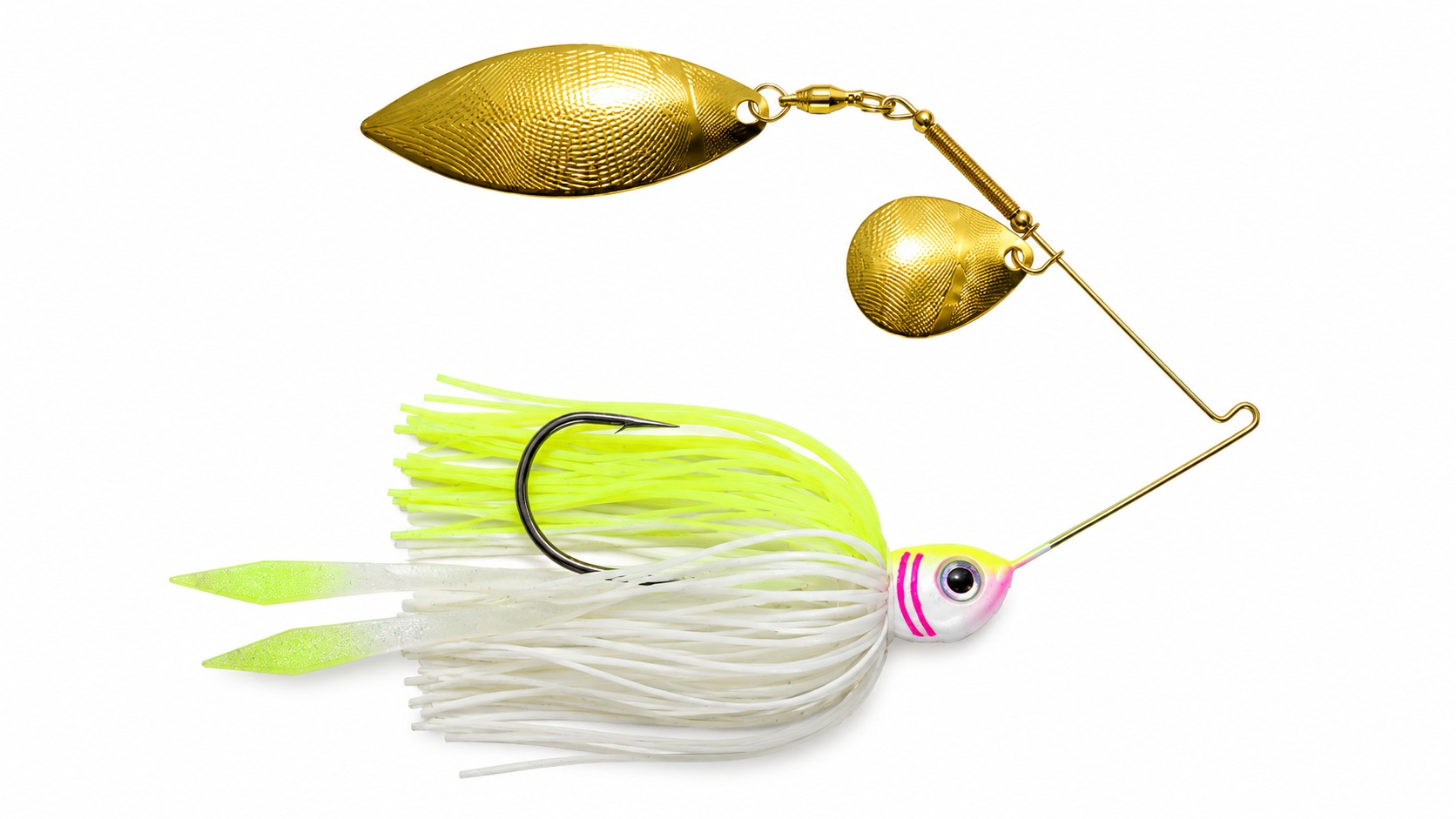
A spinnerbait is a wire-frame lure bent into a rough V or safety-pin shape. One arm holds a lead-head jig dressed with a soft plastic or silicone skirt. The other arm extends upward and carries one or two spinning metal blades. When retrieved, those blades rotate around a swivel, throwing off flash and sending pressure waves through the water that fish pick up through their lateral line.
That combination of visual and vibration triggers strikes even when fish aren’t actively feeding. It’s a reaction bait — the lure arrives fast and leaves fast, and fish respond before they have time to think. That’s what makes the spinnerbait one of the most reliable tools for covering water and locating fish, especially when conditions aren’t clear enough for finesse approaches.
Largemouth bass are the primary target, but spinnerbaits will draw strikes from smallmouth bass, northern pike, walleye, and muskellunge. Anywhere you have aggressive fish holding around cover or moving through shallow flats, the spinnerbait is worth throwing.
How it’s rigged
Spinnerbaits come pre-rigged from the factory — there’s no hook to tie on and no separate weight to thread. You tie your line directly to the wire loop at the bend of the frame using a loop knot or improved clinch knot. A loop knot (like a Rapala knot) gives the bait a bit more freedom to swing and is preferred by many anglers.
The single hook rides point-up, which helps the bait deflect off branches, stumps, and laydowns without snagging — one of the underrated advantages of the design.
The one real rigging decision is whether to add a trailer. Pinching a soft plastic grub, paddle tail, or chunk trailer onto the jig hook increases bulk, slows the fall, and adds extra action on the pause. In cold water or when fish are following without committing, a trailer often makes the difference.
How to fish it
The standard retrieve is a straight, steady wind. Keep the blades spinning just below the surface or at whatever depth you want to work. Vary your speed until you find what’s triggering strikes — sometimes a fast burn, sometimes a slow crawl.
Slow-rolling is the most productive retrieve in many situations. Drop the bait near bottom or just above the tops of submerged grass and reel just fast enough to keep the blades turning. The lure ticks along slowly, and fish that might ignore a fast bait will turn and eat it.
Helicopter the bait on the fall alongside steep cover like dock pilings, bluffs, or laydowns. Let it drop on a semi-slack line and watch for the line to jump or go slack unexpectedly — that’s a strike on the fall.
You can also burn a spinnerbait just under the surface to create a wake. This works well over shallow flats in low light, early morning, or on overcast days when fish are pushed up.
The spinnerbait excels as a search bait. Fan-cast an area, cover it methodically, and pay attention to where strikes happen. Once you locate fish, slow down and follow up with a texas rig, creature bait, or ned rig around that same piece of structure.
When to use it
Spring through fall is prime spinnerbait time. It shines in the pre-spawn period when bass are moving shallow and aggressive. It’s also one of the first baits to reach for when water clarity drops after rain.
Stained water is the spinnerbait’s home turf. Fish rely more on vibration than sight, and the blade gives them something to home in on. In muddy or heavily stained conditions, a larger blade — particularly a Colorado — produces more thump and makes the bait easier to find.
Calm, clear days with heavy fishing pressure tend to be the weakest conditions for spinnerbaits. In that scenario, switch to finesse options.
Blade and color selection
Blade shape and color selection matter more than most anglers realize.
| Blade type | Best conditions | Key quality |
|---|---|---|
| Willow leaf | Clear to lightly stained; faster current | Maximum flash, lower drag, faster sink |
| Colorado | Murky to muddy water; cold water | Maximum thump and vibration |
| Indiana | Moderate stain; all-around | Balanced flash and vibration |
| Tandem (willow + Colorado) | Stained water; open flats | Flash and vibration combined |
For skirt and blade color, a simple rule covers most situations: match the clarity of the water.
| Water clarity | Color choice |
|---|---|
| Clear | White, pearl, natural shad patterns |
| Stained | Chartreuse/white, chartreuse/blue |
| Muddy | Solid white with large Colorado blade |
| Low light / overcast | Black or dark blue/purple |
Gear setup
A medium-heavy baitcaster with a fast or extra-fast tip is the standard setup. You need enough backbone to move a fish out of cover, but a tip with enough give to let the fish load up on the bite before you set.
- Rod: 7 to 7’3” medium-heavy baitcasting rod
- Reel: Baitcaster with a 6.3:1 to 7.1:1 gear ratio; faster for covering water quickly, slower for deep slow-rolls
- Line: 15–20 lb fluorocarbon for most applications; 40–50 lb braid in heavy cover
Fluorocarbon is the standard choice because it sinks and handles well on a baitcaster. Braid is worth considering when you’re punching through thick hydrilla or lily pads.
Brands worth knowing
War Eagle spinnerbaits are a go-to for many tournament anglers and guides. The wire is durable, the blades are consistently balanced, and they come through cover well. The Hammered series is a standout.
Booyah Blade is widely available and a strong value option. The tandem-blade model covers a lot of water efficiently and holds up well to repeated use.
Terminator builds spinnerbaits with titanium wire that returns to shape after contact with cover — a real advantage when fishing around wood and rock.
Strike King and Nichols round out the reliable end of the market. Nichols in particular has a strong following among anglers who slow-roll in the Southeast.
Weights of 3/8 oz and 1/2 oz cover most freshwater situations. Go heavier (3/4 oz to 1 oz) for deeper water, strong current, or when you need to get down fast.