A note about links: If we include links to retail sites like Amazon or Bass Pro Shops, it's because they're relevant to the topic and, as anglers ourselves, we believe they're worth checking out. As an Amazon Associate we earn from qualifying purchases.
Few fishing pursuits test an angler’s patience and resolve the way muskie hunting does. The muskellunge has earned its legendary nickname honestly: blank days are the norm, not the exception, and you may log dozens of casts for every follow you see and dozens of follows for every strike you feel. But when a muskie finally commits, nothing in freshwater compares. That strike is an event. The fish is a predator built at an almost prehistoric scale, and landing one becomes a benchmark moment in an angler’s life.
How to identify one
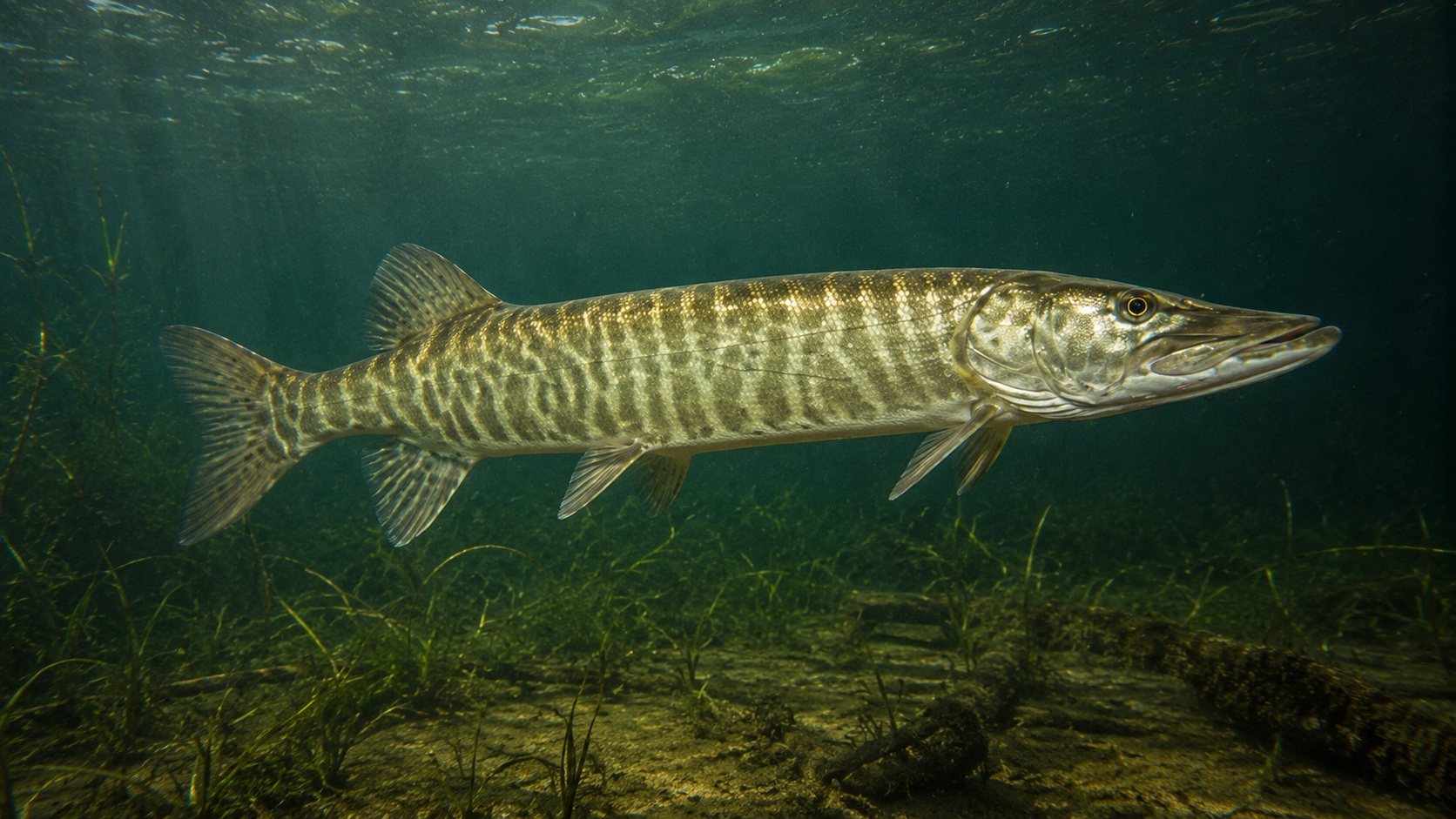
Muskellunge are elongated, torpedo-shaped fish with a broad, flat head and a mouth full of hundreds of needle-sharp teeth. The body color ranges from light silver to olive green to brown, with dark vertical bars or spots on a lighter background. This is the reverse of the northern pike, which shows light spots on a dark background, and that distinction is the most reliable field mark when separating the two species. When in doubt, count the sensory pores on the underside of the lower jaw: muskies have seven or more per side, northern pike never have more than six. The dorsal, pelvic, and anal fins sit far back toward the tail, giving the fish an arrow-like silhouette that telegraphs its function as an ambush predator. The cheeks and gill covers on a muskie are partially scaled, while a northern pike has fully scaled cheeks only. Tiger muskellunge, a hybrid of muskie and northern pike, shows a blended pattern of both parents and is also encountered in stocked waters.
Where to find them
The core muskie range runs through the Great Lakes states and provinces: Wisconsin, Minnesota, Michigan, Ontario, and New York anchor the fishery. Named trophy destinations include Hayward, Wisconsin’s Chippewa Flowage (locally called “The Big Chip”), Leech Lake and Mille Lacs Lake in Minnesota, Chautauqua Lake in western New York, Lake St. Clair on the Michigan-Ontario border, and the St. Lawrence River. Stocked populations extend into Pennsylvania’s Allegheny Reservoir, Virginia’s New River system, and portions of the Tennessee River drainage. Muskies inhabit clear to moderately stained lakes and large rivers, preferring water temperatures in the 67 to 72 degree Fahrenheit range. Within a given body of water, they orient to structure: weed edges, submerged points, rocky shoals, and the transitions between shallow flats and deeper basin water. Adult fish are solitary and highly territorial, holding in specific areas that experienced guides learn to map over years of time on the water. Baitfish concentrations are the key to finding them. Where the cisco, sucker, or shad stack up, a muskie will not be far away.
When to go
Spring and fall are the two peak windows, and for different reasons. In spring, post-spawn muskies move into shallower, warming water to feed and recover condition. Water temperatures in the 55 to 65 degree range trigger reliable activity. Summer can be productive in low-light windows, particularly early morning, late evening, and overcast days, but midday heat pushes fish deeper and makes them lethargic. Fall is widely considered the best season of all. As water cools through September and October, muskies enter a pre-winter feeding binge, putting on calories before ice-up. Fish push shallower and become more aggressive. The biggest fish of the year tend to come in October on many northern lakes. Dawn and dusk are consistently the most productive time windows regardless of season, and a light chop on the water often beats glass-calm conditions.
What to throw
Bucktail spinners are the workhorse of the muskie toolkit. Ties like the Mepps Giant Killer and Muskie Innovations Cowgirl in chartreuse, white, or black produce fish across a wide temperature range. A straight, medium-speed retrieve is the baseline, but varying the retrieve rhythm can trigger neutral fish. Glide baits like the Suick Thriller and Phantom Lures Thunder shad reward anglers who master a push-pause, side-to-side rod action. These baits sink slowly and can be worked in place or swept through turns that mimic a wounded baitfish. Swimbaits and soft plastics in the 6-to-9-inch range, such as the Muskie Innovations Bull Dawg, excel in summer and early fall when fish are feeding on large forage. Work them on a slow, pulsing retrieve along weed edges. Topwater lures produce some of the most violent strikes in freshwater fishing. Walk-the-dog style presentations and prop baits like the Whopper Plopper (jumbo sizes) are most effective from late spring through early fall, especially in low light. Jerkbaits and crankbaits in the 8-to-12-inch class cover water efficiently during trolling runs, which accounts for a large portion of all muskies caught. Troll at 4 to 7 miles per hour along weed edges and depth contours. Regardless of lure choice, always finish every retrieve with the figure-eight maneuver: as your lure nears the rod tip, plunge it a foot or two underwater and sweep a wide figure-eight pattern beside the boat. A significant percentage of muskie strikes happen right at this moment, when a following fish reacts to the sudden change in direction. Use a 12- to 18-inch wire or heavy fluorocarbon leader to protect against bite-offs, and fish with 50-to-80-pound braided main line to handle the weight and leverage demands of a big muskie.
Regulations
Muskellunge regulations vary significantly by state and waterbody, and anglers should always verify current rules before heading out. General 2026 guidelines for the primary muskie states:
Wisconsin: Season opens the Saturday before Memorial Day on most inland waters and runs through November 30. The statewide minimum size is 40 inches with a 1-fish daily bag limit. Certain trophy waters in Vilas County and other designated areas enforce a 50-inch minimum. Consult the Wisconsin DNR at dnr.wisconsin.gov before fishing any specific water.
Minnesota: The 2026 season opens June 6 and runs through December 1 on most inland waters. The statewide minimum size is 54 inches with a 1-fish daily bag limit. Consult the Minnesota DNR at dnr.state.mn.us for waterbody-specific rules.
New York: The season opens June 1 on most inland waters with a 40-inch minimum size and a 1-fish daily bag limit. On the Niagara River, Lake Ontario, Lake Erie, and the St. Lawrence River, the minimum rises to 54 inches and the season opens June 15. Consult the NYSDEC at dec.ny.gov for the full regulations guide.
Catch-and-release culture is deeply embedded in the muskie angling community. The slow growth rate of this species, its low natural population density, and its value as a trophy fishery make voluntary release the standard practice among serious muskie hunters even where harvest is technically permitted.
Handling and release
Muskellunge require careful handling to survive release in good condition. Keep the fish in the water as much as possible throughout the process. Use long-nose pliers or bolt cutters to remove hooks, and consider crimping barbs before fishing to speed up the process. If you must lift the fish for a photo, use two hands and support the body horizontally: one hand under the pectoral fins and one supporting the tail. Never hold a muskie vertically by the jaw. A muskie’s jaw is not a structural load-bearing point the way a bass jaw is, and hanging a heavy fish by its lower jaw causes serious internal damage. Large jaw spreaders can also injure the fish. Use rubber-coated nets designed for large pike family fish to minimize slime coat and scale damage. After unhooking, hold the fish upright in the water facing into any current until it powers out of your hands under its own strength. Reviving a muskie can take several minutes. Muskellunge are not considered a table fish by most anglers. The catch-and-release ethic is strong in this community for good reason: these fish grow slowly, live up to 30 years, and take exceptional effort to reach trophy size.
On the Table
Muskellunge is edible and can be genuinely good table fare from the right fish in the right water, but the vast majority of muskie anglers practice catch-and-release — a combination of conservation ethic, trophy culture, and practical concerns (mercury, bones, and size limits) makes keeping one the exception rather than the rule.
Taste and texture: Muskie flesh is white, firm, and mildly flavored, sitting in the same family as northern pike and walleye in terms of profile. Fish from cold, clear water can have a clean, slightly sweet taste with no muddy or off notes. Larger, older fish from warmer or more turbid water tend toward a coarser texture and more pronounced flavor. The flesh holds together well during cooking but dries out quickly if overcooked.
Best preparation methods: Pan-frying in butter with a light seasoned flour coat is the most forgiving method — the fat compensates for muskie’s tendency to dry, and the quick cook time keeps the flesh tender. Baking at moderate heat (around 375 F) with an olive oil or butter baste and fresh herbs works well for thicker steaks or large skin-on fillets. Smoking suits muskie because the low-and-slow process keeps moisture in and complements the mild flavor without overwhelming it. For anglers who want to sidestep the Y-bone issue entirely, grinding the meat into fish cakes or patties is a legitimate approach and produces a very clean-tasting result.
Handling for table quality: Ice the fish immediately after landing — muskellunge flesh degrades quickly in warm water or air. Bleeding at the gills right after the decision to keep is made improves flesh color and removes any residual off-flavor. The Y-bone row runs through the fillet and requires either a two-cut technique (cut above and below the bone row, then remove the strip) or steaking the fish across the body and pulling bones after cooking. A sharp fillet knife and needle-nose pliers are essential for a clean result.
Mercury concerns: Muskellunge are apex predators with long lifespans, which means mercury bioaccumulates to high levels in their flesh. Wisconsin, Minnesota, Illinois, and most other muskie states carry consumption advisories — typically one meal per month for the general population, with children and women of childbearing age advised to avoid eating muskie altogether. Smaller fish (legal slots, often in the 36-48 inch range) carry lower mercury loads than true trophy fish. Always check your state’s fish consumption advisory before keeping one.
Slot limits and size regulations: Minimum size limits in many states run 36-54 inches depending on the water, and daily bag limits are typically one fish. These regulations exist to protect the trophy fishery, not to encourage harvest, and they effectively mean most legal fish taken for the table will be younger, smaller individuals with the best eating quality anyway.