A note about links: If we include links to retail sites like Amazon or Bass Pro Shops, it's because they're relevant to the topic and, as anglers ourselves, we believe they're worth checking out. As an Amazon Associate we earn from qualifying purchases.
Punching a hole through two feet of ice over a deep basin at first light, dropping a tiny spoon to 35 feet, and watching your flasher light up with a cloud of moving marks — that is the cisco experience at its best. These silvery, torpedo-shaped fish roam suspended over open-basin depths in large, cold, clear lakes, and they will savage a well-presented jig with a ferocity that surprises anglers who expect something mild-mannered from a fish more often discussed as forage than as a target species. The cisco (also called tullibee across much of Minnesota and Canada, and lake herring in the Great Lakes region) occupies a critical ecological role as a deep-water food source for walleye, lake trout, and muskellunge — but it also supports a devoted and growing ice fishery that rewards patience, electronics skills, and light tackle finesse. When a school moves through, the action can be fast and continuous, and a limit of chunky, fat cisco bound for the smoker is one of winter fishing’s most underrated prizes.
How to identify one
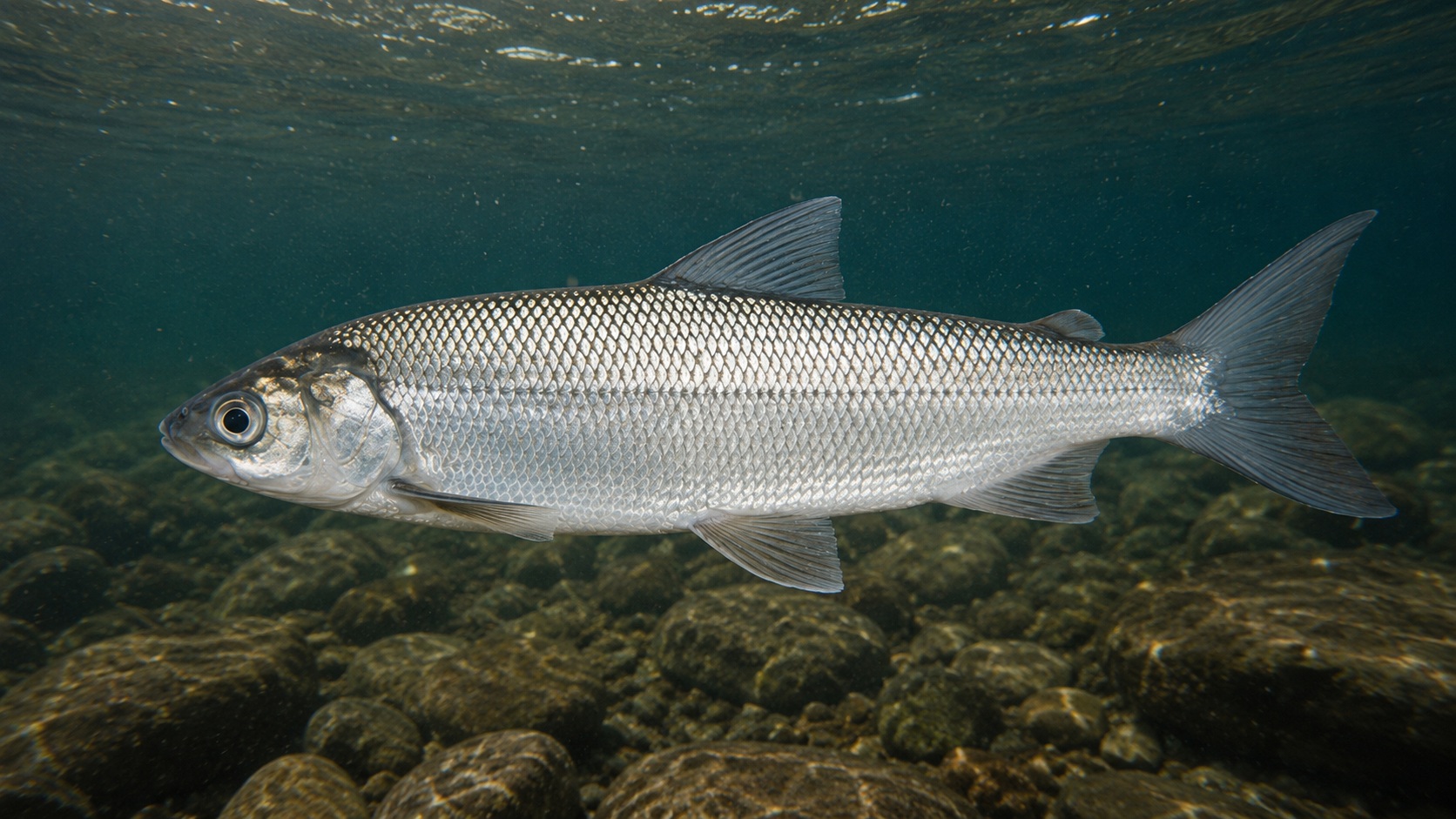
Cisco are slender, laterally compressed fish with a distinctly forked tail and a terminal mouth where the upper and lower jaws meet evenly, or the lower jaw projects only slightly. Their backs are typically blue-green to olive, fading to bright silver on the sides and white on the belly. The scales are large and reflective, giving the fish a metallic sheen that glints noticeably in underwater lighting. A key identification point is the absence of a fleshy adipose fin lobe between the dorsal fin and tail that is found on lake whitefish — cisco have this fin but it is small and unobtrusive. The body profile is more streamlined and less humpbacked than lake whitefish. Adults commonly run 10 to 16 inches and 0.5 to 1.5 pounds in most lake populations, though fish over 2 pounds are not unusual in highly productive systems. The IGFA all-tackle world record stands at 7 pounds, 6 ounces, confirming the species’ potential in exceptional conditions. Cisco can be confused with mooneye or gizzard shad at a glance, but the combination of adipose fin, forked tail, and terminal mouth separates them cleanly from non-salmonid species.
Where to find them
Cisco require cold, well-oxygenated water and are therefore restricted to deeper lakes — typically those with maximum depths exceeding 40 feet and a well-developed thermocline. Their native range centers on the Great Lakes basin, the Canadian Shield extending across Ontario and Manitoba, and the lake-dense regions of Minnesota, Wisconsin, and Michigan. In summer, cisco retreat to deep, cool water below the thermocline and are largely inaccessible to most anglers. Their importance as forage during this period is enormous: they are the primary energy source for trophy lake trout and muskellunge in many systems. Come fall, cisco stage in large schools near the surface and in shallower bays for their late-autumn spawning run, creating a brief but exciting open-water jigging window. For most of the ice season, from December through March across the northern tier of their range, cisco suspend over the deepest basins in the lake — mud flats that bottom out at 30 to 50 feet are classic holding areas. They rarely sit on the bottom; electronics almost always show them suspended somewhere in the water column, often in dense, roaming schools that can appear and vanish without warning.
When to go
Winter is the prime season for targeted cisco angling. The ice period — roughly mid-December through late February in Minnesota, Wisconsin, and Michigan — concentrates fish in predictable basin areas and coincides with a period of high fish activity in cold water. Early ice and late ice often produce the most aggressive fish, with mid-winter doldrums possible during prolonged stable cold. The late-autumn spawning period in November, when cisco move shallow and can be taken through open water on light spinning gear, is a secondary peak that many anglers overlook. Summer cisco fishing exists but is largely a deep-jigging specialty targeting suspended fish at thermocline depths, and requires downriggers or leadcore rigs to reach effectively. For most anglers, winter ice fishing from first ice through February offers the most accessible and most rewarding opportunity.
What to throw
Light tackle is the rule. Cisco have relatively small mouths and fine-wire hooks in sizes 8 to 14 are standard. The most productive ice fishing presentation is a small tungsten or lead jigging spoon in the 1/16 to 1/8 ounce range, often rigged with a small dropper jig — a Hali or Marmooska-style jig — hanging a few inches below it. The spoon generates flash and attracts fish from a distance while the small hook tipped with a single waxworm, spike, or synthetic maggot triggers the strike. Bright, flashy finishes in silver, gold, chartreuse, and glow white all produce well, and sunny days with good light penetration often fire up cisco particularly hard. Jigging style matters: start with an aggressive, high-amplitude cadence to pull fish in from a distance, then slow down and shorten your strokes once marks appear on your sonar. The classic trigger move is to reel up 3 to 5 feet when a fish levels out on your flasher — this gets the cisco chasing upward and converts lookers into biters. Electronics are not optional for serious cisco fishing; because these fish suspend over open basin and move constantly, a flasher or LX-style sonar is essential to find the strike zone and track fish position in real time. In open water during the fall spawn, small inline spinners, kastmaster-style spoons, and light jigs retrieved steadily near the surface produce well on a 4 to 6 pound test spinning setup.
Regulations
Always verify current regulations with your state fish and wildlife agency before fishing, as limits can vary by water body and change between seasons.
Minnesota: Cisco were reclassified from rough fish to game fish status in 2020, reflecting growing recognition of their sporting and ecological value. The statewide daily limit is 15 fish. Fish 7 inches and under in total length are classified as bait and are not counted toward the game fish limit. Specific waters, including Mille Lacs Lake, carry a reduced limit of 10 fish per day — always check the Minnesota DNR’s LakeFinder tool for the specific lake you plan to fish. There is no minimum size limit statewide. Consult the current Minnesota DNR Fishing Regulations at mndnr.gov for the most current rules.
Wisconsin: The statewide combined daily bag limit for whitefish and cisco is 10 fish in total. No minimum size limit applies. Special county regulations may alter season dates or limits on specific waters, so anglers should consult the current Wisconsin DNR Hook and Line Fishing Regulations guide at dnr.wisconsin.gov before each trip.
Michigan: Cisco regulations vary by water body. Consult the current Michigan DNR Fishing Guide at michigan.gov/dnr for applicable limits.
Canada: Regulations vary significantly by province. Check with the relevant provincial ministry for current rules in Ontario, Manitoba, or other Canadian Shield provinces.
Handling and release
Cisco are delicate compared to many sport fish and do not handle thermal stress well. In summer or during any period when water temperatures are elevated, keep any released fish in the water as much as possible and minimize air exposure. Wet your hands before handling and support the fish horizontally. During ice fishing, fish brought to the surface from cold, deep water require minimal recovery time, but a quick, gentle release back through the hole is still best practice for fish not being harvested. Cisco destined for the table should be chilled immediately on ice, as the meat deteriorates quickly when allowed to warm. They are among the finest eating fish in freshwater — mild, firm, and exceptionally well-suited to cold-smoking, which transforms them into a product that rivals commercially smoked salmon in flavor. Pan-frying whole cisco with butter and herbs is equally excellent. If you plan to harvest a limit, bring a cooler with ice.
On the Table
Cisco — also called lake herring or tullibee — are genuinely excellent table fish, prized by Great Lakes and northern-lake anglers who know them and often overlooked by those who don’t. Their rich omega-3 content (comparable to sockeye salmon ounce for ounce) gives the flesh a buttery, full flavor that sets them apart from most other freshwater species.
Taste and texture: The flavor is mild but noticeably richer and more buttery than lake whitefish, with a clean, fresh quality and no muddy or gamey aftertaste. The flesh is pale and soft, with a delicate, flaky texture. Because the flesh is tender and the bones are fine, cisco are often prepared whole rather than filleted.
Best preparation methods:
- Smoking is the most celebrated approach for cisco. Their high fat content holds smoke beautifully and keeps the flesh moist through long, low-temperature cooking. A simple apple-juice brine with kosher salt and brown sugar, followed by 3—4 hours at 200 deg F, produces outstanding results.
- Pan-frying whole suits smaller fish perfectly. The delicate flesh cooks quickly, and a light dusting of seasoned flour or cornmeal gives a crisp exterior without overpowering the flavor. Butter in the pan enhances the fish’s natural richness.
- Deep-frying in batter is a classic fish-fry treatment that works well for cisco, especially for groups. The mild, sweet flesh pairs cleanly with a simple egg-and-flour batter.
- Poaching or steaming preserves the clean flavor with no added fat — good for showcasing the fish’s natural taste simply with lemon and fresh herbs.
Roe note: Female cisco carry roe that is harvested commercially as freshwater caviar, prized in Scandinavian markets for its crisp texture and mild flavor. Anglers catching cisco during fall spawning runs sometimes keep roe for this purpose.
Handling for table quality: Cisco are soft-fleshed and deteriorate quickly in warm water. Ice them immediately after landing — a mesh bag in an ice slurry is ideal. Clean them the same day for best quality. Because the flesh is delicate, avoid rough handling that bruises the meat. For whole-fish preparations, snip the head, gut, and scale; the spine and ribs pull free cleanly after cooking.
Eating caveats: No significant ciguatera, mercury, or parasite concerns are associated with cisco from typical northern freshwater fisheries. Check local advisories on specific water bodies, as some Great Lakes tributaries carry advisory language for certain contaminants, but cisco are generally considered safe and healthy table fare.