A note about links: If we include links to retail sites like Amazon or Bass Pro Shops, it's because they're relevant to the topic and, as anglers ourselves, we believe they're worth checking out. As an Amazon Associate we earn from qualifying purchases.
Some fish are worth a plane ticket. Lake trout are one of them. Whether you are punching holes through two feet of ice on a January morning in Ontario, running downriggers over a 100-foot Great Lakes basin, or jigging bucktails beneath the midnight sun on Great Bear Lake, lakers pull with a cold, bulldogging authority that stays with you. They are the apex predator of the clearest, deepest, most oxygen-rich waters on the continent, and the places they live tend to be beautiful in the way that makes you want to come back every year. A 20-pound fish in the net is a realistic goal on the right water. A fish over 40 pounds is possible on the Canadian Shield. This is a species that rewards anglers who do the homework and make the trip.
How to identify one
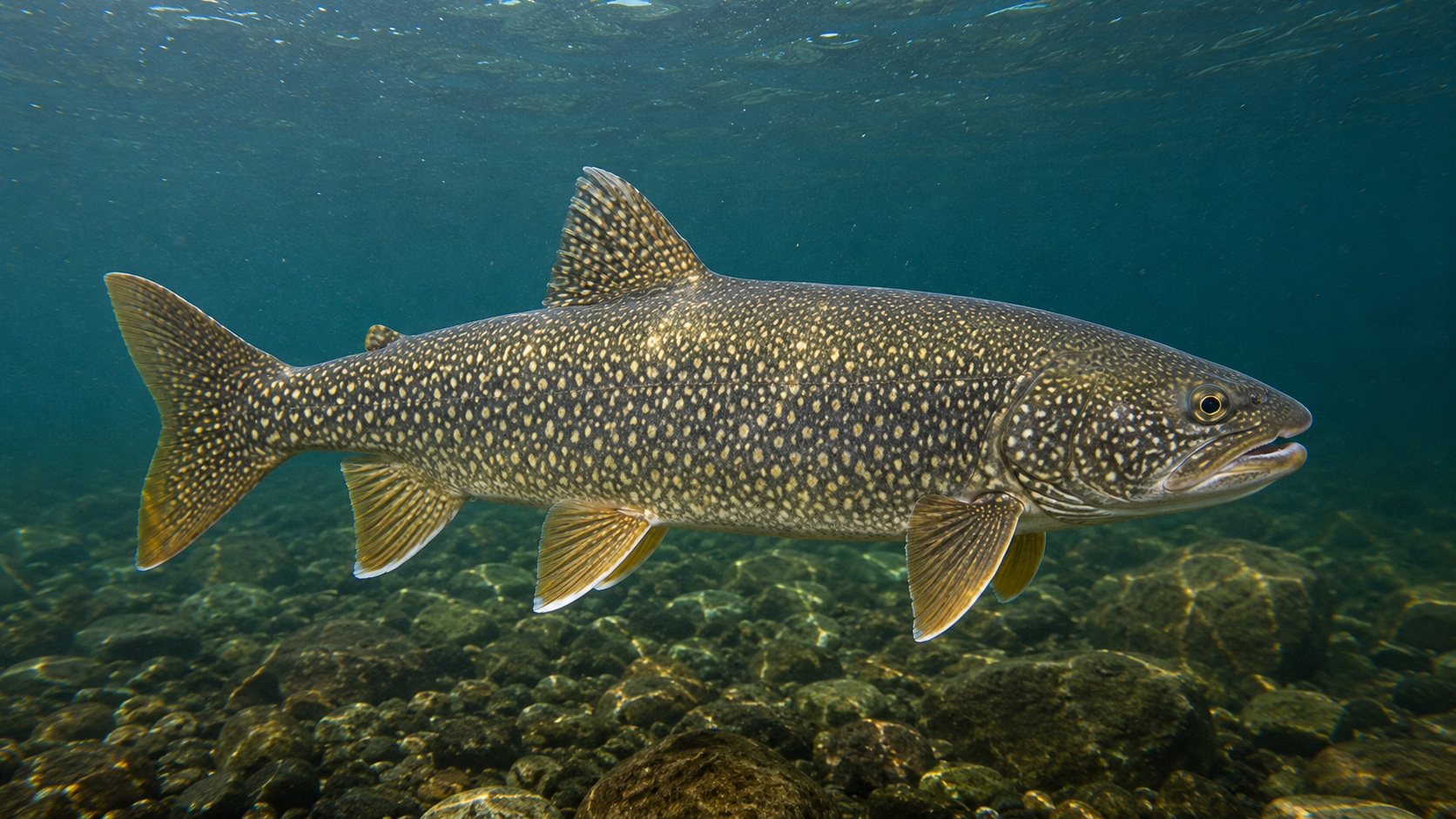
Lake trout are char, not true trout, and the difference shows. The body is grey to dark green, sometimes nearly charcoal, covered with irregular pale cream or yellow spots that run from head to tail including across the fins. Unlike brook trout, which wear vivid red and blue halos, laker spots are understated and worm-like on the back. The tail is deeply forked, more so than any other char or salmon you are likely to encounter in freshwater, and the inside of the mouth is white. Spawning males develop a lateral band of orange or copper, but outside of fall the coloration stays muted and cold. A large lake trout caught deep will often display a distended belly from the swim bladder decompressing on the way up.
Where to find them
Lake trout require cold, well-oxygenated water and spend the warm months hugging the thermocline in lakes that are deep enough to stay cold all summer. In the Great Lakes, fish are commonly found in the 80- to 120-foot range during July and August. In Canadian Shield lakes from Algonquin Park north to the Barren Lands, they roam rocky points and shoals in shallower water throughout the open-water season because surface temperatures never climb high enough to push them down. Great Bear Lake in the Northwest Territories holds some of the largest fish on earth, with trophy lakers over 40 pounds taken regularly and the all-tackle world record of 72 pounds set there in 1995. In Alaska, lake trout occupy the Brooks Range and Arctic coastal plain lakes, with good populations in Noatak, Lake Clark, and the central interior. The species is also established in mountain reservoirs in Wyoming, Montana, and Colorado, where introductions have produced trophy fisheries at depth.
When to go
Spring is the most accessible season. As ice melts and surface water warms to the low 40s Fahrenheit, lake trout come shallow to feed and are catchable from shore or a drifting boat in water as shallow as 10 feet. This window closes fast once the water stratifies in May and June. Summer fishing requires finding the thermal layer, usually through downriggers or lead-core line. Fall is another prime window as water cools and fish return to the shallows ahead of their October spawning run over clean rocky reefs. Winter is the season that defines lake trout fishing in the Great Lakes and across Canada: ice fishing for lakers is a serious pursuit on Lake Superior’s bays, Lake Simcoe, Lake Nipigon, and hundreds of Canadian Shield lakes, with fish active all winter in their cold preferred depths of 20 to 80 feet under the ice.
What to throw
Trolling is the dominant open-water method on larger lakes. Spoons are the backbone, with thinner flutter spoons like the Williams Wabler, Sutton Silver Spoon, and Bay de Noc Laker Taker producing reliably behind downriggers or with three-way swivel rigs. Troll at 2 to 2.5 mph, targeting fish in the 80- to 120-foot range in summer and shallower during spring and fall. Small lures often outperform large ones. For jigging from a boat over structure, tube jigs, bucktails, and heavy spoons in white, chartreuse, or silver all work. Under the ice, airplane jigs tipped with a smelt or sucker fillet are a classic presentation. Start on the bottom in winter, then work up through the water column while watching a flasher. When a fish appears without committing, raise the bait a foot or two to trigger the strike. Swedish Pimples and Kastmasters in half-ounce to one-ounce sizes cover water effectively when you are searching a new hole. Use tip-ups baited with dead smelt or chubs to cover additional depth while you actively jig a second hole. A fluorocarbon leader of 15 to 20 pounds reduces visibility in clear water and adds abrasion resistance against the rocky bottom these fish prefer.
Regulations
Regulations vary significantly by state, province, and specific body of water. Always check current rules for your exact water before fishing.
Minnesota: Lake Superior lake trout season runs December 1 through early October, with a daily limit of 3 fish. Inland lake trout open May 10 through September 30 for the summer season, with an additional winter season January 1 through March 31 in most waters including those within the Boundary Waters Canoe Area Wilderness. The inland daily limit is 2 fish. A Minnesota trout and salmon stamp is required in addition to an angling license when fishing Lake Superior. Fish must be transported with head and tail intact while on the water. Managing agency: Minnesota DNR.
Michigan: Great Lakes lake trout carry a 15-inch minimum size limit with a 5-fish daily limit in most zones; specific management areas like Stannard Rock on Lake Superior have more restrictive rules. Inland lakes vary. Managing agency: Michigan DNR.
Wisconsin: Regulations vary by specific water body. Use the Wisconsin DNR searchable hook-and-line fishing guide at Wisconsin DNR Fishing Regulations to look up rules for your lake.
Canada: Provincial and territorial regulations apply. In Ontario, lake trout limits and seasons vary widely by fishing management zone. Northwest Territories and Yukon waters are governed by the Department of Fisheries and Oceans Canada. Verify your zone at DFO Canada.
General note: Many quality lake trout fisheries have slot limits or reduced bag limits designed to protect large, older fish. A lake trout can live 60 to 70 years. That trophy fish is likely older than most anglers. Slot limits and voluntary catch-and-release on larger fish are increasingly common.
Handling and release
Lake trout are cold-water fish and handle stress better than trout in warm summer rivers, but they still benefit from quick, careful release. Keep the fish in the water or in a net as much as possible. Use wet hands or a wet glove before touching the fish, as dry contact strips the protective slime layer. Support the body horizontally rather than holding the fish vertically by the jaw. Never touch or compress the gill arches. If you are ice fishing and plan to release, lower the fish back through the hole gently rather than dropping it, and hold it facing the hole until it kicks away on its own. For fish caught deep on downriggers in summer, swim bladder overexpansion (barotrauma) is common; a distended belly is a sign. Venting tools or release weights can help deep-caught fish return to depth safely. Barbless hooks or crushed barbs speed up hook removal significantly and reduce handling time. Any fish that rolls or fins weakly should be held in a horizontal position in the water until it recovers fully before release.
On the Table
Lake trout are worth keeping for the table when handled well, but they require more prep work than most trout species — their high fat content and pronounced dark lateral-line meat mean shortcuts in cleaning will result in a noticeably “fishy,” off-flavored fillet.
Taste and texture: Lake trout flesh ranges from pale pink to deep orange depending on diet and geography. The flavor is richer and more pronounced than brook or rainbow trout, with a mild-to-moderate “fishy” quality that intensifies with fish size. Smaller fish (under 24 inches) are consistently milder. The texture is firm and moderately flaky, with a higher fat content than most freshwater species — comparable to a fatty salmon fillet.
Best preparation methods:
- Smoking: The high oil content makes lake trout one of the best freshwater candidates for hot-smoking. The fat carries smoke flavor deeply into the flesh, and a brine soak before smoking seasons the fish evenly and keeps it from drying out. This is arguably the single best use of a lake trout.
- Pan-searing: Skin-on fillets placed skin-side-down in a very hot dry or lightly oiled pan render their own fat as they cook, producing a crispy skin and moist interior without needing added oil. Sear 2-3 minutes skin-side, then flip for 1-2 minutes.
- Baking: Works well for whole fish or thick fillets; the fat prevents drying out even without butter-heavy preparations.
- Frying: The oiliness of the fillet means it stays moist in a hot fryer; the fish’s own fat keeps the interior succulent even through high heat.
Handling for table quality: Ice fish immediately and hard — lake trout deteriorate faster than leaner species because their fat oxidizes quickly at warm temperatures. Bleed the fish at the gill plate right after catch if you plan to keep it. When filleting, remove the skin and trim away all dark gray-brown flesh along the lateral line and under the skin before cooking. This step is non-negotiable: the dark meat concentrates off-flavors and, if left on, will taint the entire fillet. Do not soak fillets in water; pat dry with paper towel to preserve texture.
Eating caveats:
- Mercury: Lake trout are apex predators and bioaccumulate mercury. Larger fish carry higher loads. Many state health agencies — including Vermont (Lake Champlain fish over 25 inches) and Minnesota — recommend limiting consumption to one 8-ounce meal per month, and advise pregnant women, nursing mothers, and children under six to avoid them entirely. Check your state’s current fish consumption advisory for the specific water body you are fishing.
- Tapeworm parasites: Like other cold-water freshwater fish, lake trout can carry the broad fish tapeworm (Diphyllobothrium latum). Thorough cooking to an internal temperature of 145 degrees F, or freezing at or below 14 degrees F, eliminates the risk completely. Do not eat lake trout raw or undercooked.