A note about links: If we include links to retail sites like Amazon or Bass Pro Shops, it's because they're relevant to the topic and, as anglers ourselves, we believe they're worth checking out. As an Amazon Associate we earn from qualifying purchases.
Few freshwater fish hit like a rainbow trout. They explode on a dry fly, cartwheel out of the water, and run with a speed that makes a light rod feel alive. Whether you are standing knee-deep in a Montana freestone stream, drifting nymphs on Idaho’s Henry’s Fork, or fishing a stocked tailwater in the Appalachians, the rainbow delivers a level of excitement that keeps anglers coming back through every season. They are also forgiving quarry for newcomers: stocked fish take PowerBait without complaint, while wild fish in technical water will school the most experienced fly angler. That range makes the rainbow arguably the most democratic game fish in North America.
How to identify one
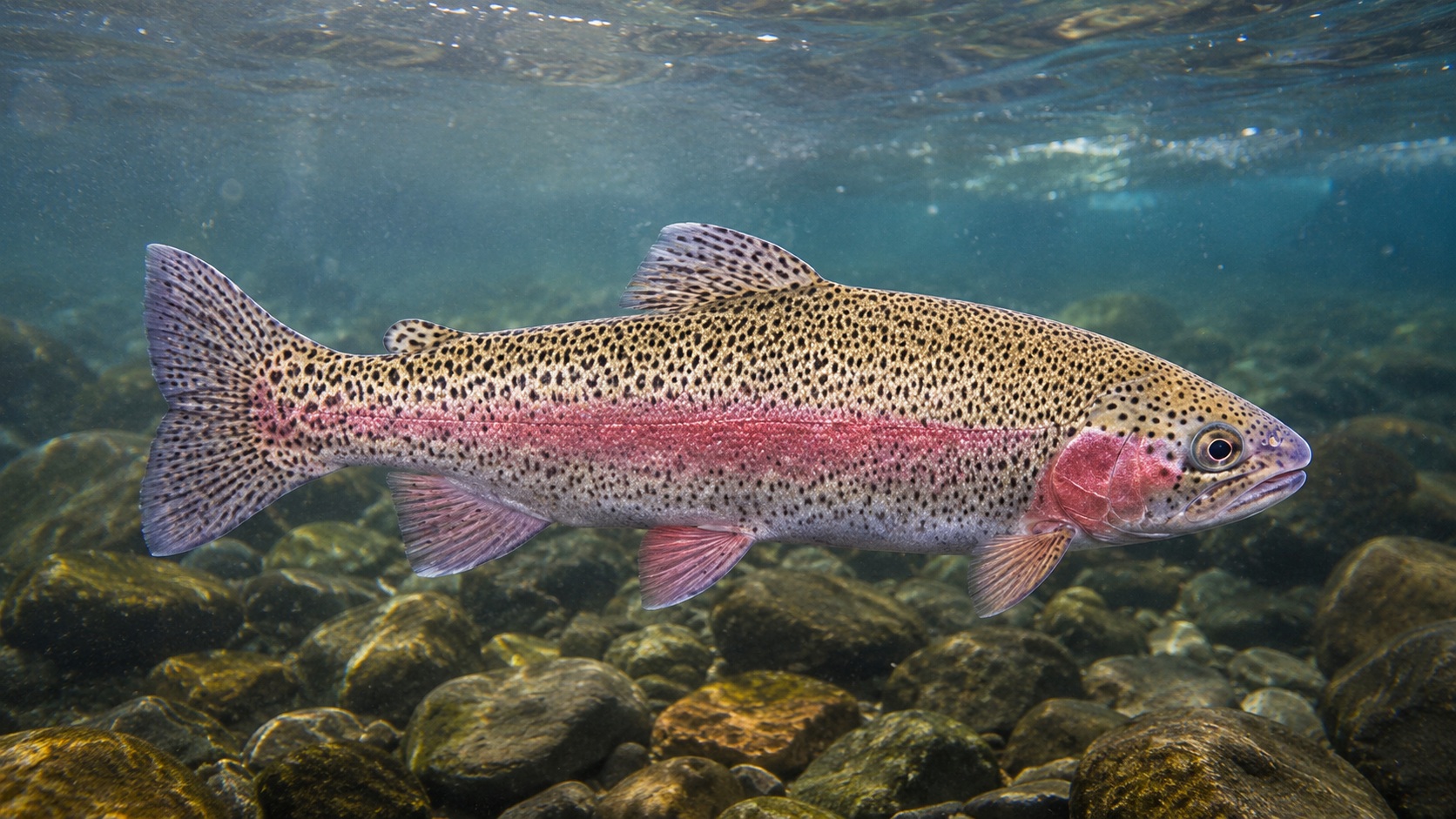
A rainbow trout is hard to confuse with anything else once you have seen one. The body is torpedo-shaped and silvery, covered in small black spots that extend across the back, dorsal fin, and tail. The defining mark is a pink-to-crimson band running along each side from the gill plate to the tail, sometimes blazing scarlet on males during spawning. The back shades from olive-green to blue-green depending on habitat. Stocked fish fresh from the hatchery may look pale and washed out, while wild fish in clear mountain streams develop vivid, saturated color. Steelhead, the sea-run or lake-run form of the same species, are far more silver overall and lose most of the pink band until they begin their spawning run. Brown trout are sometimes confused with rainbows, but browns show red spots surrounded by pale halos on their sides and lack the dense black spotting on the tail.
Where to find them
Rainbow trout are native to Pacific-draining rivers west of the Rockies, from Baja California north through British Columbia and Alaska. They have been introduced so extensively that today they swim in cold-water systems across all 48 contiguous states, much of Canada, South America, Europe, New Zealand, and beyond. Their one hard requirement is cold, well-oxygenated water. Optimal temperature sits between 50 and 65 degrees Fahrenheit. Above 70 degrees, rainbows become stressed. Above 77 degrees, they die.
In rivers, look for them in the seam between fast and slow water, at the head and tail of pools, behind boulders that break current, and in deeper runs beneath undercut banks. In lakes and reservoirs, they suspend in the thermocline, track shoreline structure at dawn and dusk, and move into shallows during low-light hours.
The names that define North American rainbow trout fishing read like a hall of fame: the Madison River and Yellowstone River in Montana, the Upper Delaware in New York, the White River in Arkansas, the Deschutes in Oregon, the Henry’s Fork in Idaho, the South Platte in Colorado, and the tailwaters of the Great Smoky Mountains. Across the Appalachians and mid-Atlantic, stocking programs extend rainbow fishing into states where natural reproduction does not sustain wild populations — Virginia’s Shenandoah Valley, the streams of western North Carolina and Tennessee, put-and-take lakes from Pennsylvania to Georgia — typically running October through April when water drops into trout range.
When to go
Spring and fall are the peak windows nationwide. As water temperatures climb from the low 40s into the 50s each spring, rainbows feed aggressively to recover from winter and build energy for spawning. Mayfly, caddis, and stonefly hatches trigger surface activity that can produce dry-fly fishing of the highest order. In tailwater fisheries fed by cold dam releases, quality fishing often extends straight through summer when nearby freestone streams go warm and low.
Fall brings another surge as water temperatures cool from summer highs and pre-winter feeding kicks in. This is the season for big fish on streamers in many Western rivers. Winter on tailwaters and stocked impoundments in the South and Appalachians offers a legitimate fishery when most other freshwater action has slowed, typically January through March.
On stocked put-and-take waters, timing your visit shortly after a stocking announcement gives the highest catch rates. Most state fisheries agencies post stocking reports online or via app. Late morning to midday in cold weather often outperforms early morning on these waters, as direct sunlight warms shallows slightly and activates recently stocked fish.
What to throw
PowerBait and scented dough baits are the top producer on stocked trout lakes and ponds. Mold a marble-sized ball onto a size 10-14 treble hook, use a 1/4-oz sliding egg sinker stopped by a barrel swivel, and leave a 12-18-inch fluorocarbon leader. The buoyant bait floats up off the bottom at eye level for cruising hatchery fish. Chartreuse, rainbow, and orange are the most reliable colors, though yellow and white produce on pressured water.
Inline spinners cover water fast and work on both stocked and wild fish. Panther Martin, Mepps Aglia, and Rooster Tail patterns in sizes 1/16 to 1/4 oz are the workhorses. Cast upstream and across at a 45-degree angle, then reel at just enough speed to keep the blade spinning. Silver and gold blades in clear water, and darker or brighter colors (black, fire-orange) in off-color water or on overcast days.
Small spoons in silver or gold (Kastmaster, Little Cleo) work well in lakes and deeper pools. Let them sink to depth, then retrieve with occasional pauses and twitches to trigger strikes from following fish.
Nightcrawlers fished under a slip float or on a split-shot rig remain one of the most reliable baits across all water types. Thread a worm section on a size 8-12 baitholder hook and drift it through runs in rivers or suspend it 2-4 feet under a float in still water. Where legal, live minnows work on the same rig for larger fish.
Salmon eggs (Pautzke or Atlas Mike’s) on a size 12-14 single egg hook, fished under a small float or allowed to roll along the bottom in current, mimic a natural food source and draw consistent strikes, especially near spawning areas in fall and winter.
Fly fishing opens up an entirely different dimension. In moving water, nymphs account for the majority of a trout’s diet year-round. A two-nymph rig with a heavy point fly (size 12-16 Hare’s Ear, Pheasant Tail, or Prince) and a smaller dropper (size 18-22 midge or soft hackle) drifted under a strike indicator covers most situations. Dry flies shine during hatches: Adams, Elk Hair Caddis, and Parachute Pale Morning Dun patterns in sizes 14-18 are staple choices. Streamers such as Woolly Buggers (size 6-8 in olive, black, or white) and Zonkers produce the largest fish, especially on overcast days and during fall when big trout move aggressively.
Soft plastic jerkbaits and grubs on light 1/16-oz jig heads are underrated on stocked lake systems, particularly when fish have seen every PowerBait color in the arsenal. A 2-inch white or chartreuse curly-tail grub retrieved slowly just above the bottom can wake up a disinterested stocked fish.
Regulations
Rainbow trout regulations vary significantly by state, water type, and whether a fishery is wild or stocked. There is no single national standard, and special regulations on hatchery versus wild fish (clipped-fin hatchery fish only rules are common on the West Coast) add additional complexity.
In Washington State (WDFW), statewide rules for most lakes and reservoirs allow a 5-fish daily limit with no minimum size. Most rivers and streams have a 2-fish daily limit with an 8-inch minimum length, though many streams have catch-and-release-only rules, single-barbless-hook requirements, or hatchery-only retention rules. Always check water-specific rules: https://wdfw.wa.gov/fishing/regulations
In Oregon (ODFW), daily limits on stocked hatchery trout are typically 5 fish per day in designated hatchery fisheries, while wild rainbow trout must be released on many river systems. Wild trout are identified by an intact adipose fin; hatchery fish have the adipose fin clipped before release.
In Colorado (Colorado Parks and Wildlife), the general statewide daily bag limit is 8 trout (all species combined) on most waters. Gold Medal waters — the Frying Pan River above Ruedi Reservoir, the Blue River below Dillon Reservoir, the Arkansas River through Brown’s Canyon — carry catch-and-release or reduced-limit rules with size minimums. Many designated Wild Trout waters have 2-fish daily limits. Verify current rules at cpw.state.co.us.
In Montana (Montana Fish, Wildlife and Parks), the statewide general limit is 5 combined trout per day, but many rivers carry special regulations by reach. The Madison, Gallatin, and Missouri rivers all have sections with lower limits or size restrictions. Verify at fwp.mt.gov before fishing any Montana water.
In Idaho (Idaho Fish and Game), general waters allow 6 trout per day, but major rivers including the Henry’s Fork and the South Fork of the Boise carry special wild fish rules with hatchery-only retention on designated reaches. Adipose fin condition — clipped for hatchery fish, intact for wild fish — is the standard way to identify legal fish on these waters. Verify at idfg.idaho.gov.
Always verify current regulations directly with the managing agency before fishing any new water:
- Washington: https://wdfw.wa.gov/fishing/regulations
- Oregon: https://myodfw.com/articles/regulation-updates
- Idaho: https://idfg.idaho.gov/fish/regs
- Montana: https://fwp.mt.gov/fish/regs
- Colorado: https://cpw.state.co.us/thingstodo/Pages/Fishing.aspx
Handling and release
Rainbow trout are sensitive fish, especially wild specimens in warm weather. Wet your hands before touching any trout, and keep the fish submerged as much as possible. A knotless rubber net reduces scale and slime coat damage compared to nylon mesh. If taking a photo, cradle the fish horizontally with one hand supporting the belly and one near the tail. Never squeeze, and never hold a trout vertically by the jaw the way you would a bass: their spines are not built for that orientation.
For table fare, rainbow trout are excellent. The flesh ranges from white to deep orange depending on diet, and the flavor is clean and mild. Hatchery fish are table-ready immediately after a clean kill on ice. Wild fish from cold, clear streams are among the best-eating freshwater fish in North America, well-suited to simple preparations: pan-fried in butter with lemon and herbs, or whole-roasted over a fire. If you plan to keep fish, check legal possession limits and ensure the water you are fishing permits harvest before your trip.
On the Table
Rainbow trout rank among the finest freshwater table fish available, and many anglers consider them a primary reason to fish trout water at all. Clean, mild, and versatile, a properly handled rainbow is genuinely delicious — a fish worth keeping when regulations and water quality allow.
Taste and texture: The flesh ranges from white to a deep pink-orange depending on diet (wild fish eating crustaceans and aquatic insects develop more color and a richer flavor than hatchery fish). The flavor is mild to moderately rich, slightly sweet, and clean without any muddy or overpowering notes. Texture is delicate and finely flaked — tender rather than firm, which rewards gentle cooking methods.
Best preparation methods:
- Pan-frying whole or butterflied: Trout’s thin fillets and delicate flesh make pan-frying in butter the classic approach. The high surface-area-to-thickness ratio means the skin crisps before the flesh overcooks, and browned butter picks up the fish’s natural sweetness.
- Smoking: Rainbow trout takes smoke beautifully. The fat content (modest but present) keeps the flesh moist through a low hot-smoke, and the result has enough structure to serve on its own or fold into dips and spreads.
- Baking or foil-roasting: Sealing a whole trout in foil with herbs, lemon, and olive oil traps moisture and produces an almost steamed interior — ideal for larger fish where pan-frying risks uneven cooking.
- Ceviche or crudo (farmed fish only): Farm-raised rainbow trout from reputable sources is commonly served raw or acid-cured. Wild fish should be cooked to eliminate parasite risk (see below).
Handling for table quality: Trout deteriorate faster than many species after death. Kill the fish immediately with a firm rap to the head, then bleed it by cutting the gills or the throat. Chill on ice right away — do not leave trout in a warm livewell or stringer in summer water. The thin skin bruises easily, so handle gently. Fillet on a clean, cold surface and remove the lateral line (darker flesh) if you prefer a milder flavor; many anglers leave it for the extra richness.
Eating caveats:
- Worm parasites: Wild rainbow trout, particularly in certain western U.S. rivers and Great Lakes tributaries, can carry anisakid nematodes or other parasites in the flesh. Thorough cooking to an internal temperature of 145 degrees F eliminates risk entirely. Do not serve wild-caught trout raw or barely acid-cured.
- Water quality: Trout in some heavily stocked hatchery-adjacent waters or near agricultural runoff can carry off-flavors. Fish from cold, clean, well-oxygenated water taste significantly better than those from warm or impaired water bodies.