A note about links: If we include links to retail sites like Amazon or Bass Pro Shops, it's because they're relevant to the topic and, as anglers ourselves, we believe they're worth checking out. As an Amazon Associate we earn from qualifying purchases.
What it is
Trolling is the simplest idea in fishing and one of the most effective: you pull one or more lures or baits behind a moving boat, letting the boat — not your arm — do the work of presenting the bait. The motor sets the speed, your rigging sets the depth, and the spread of lines behind the boat covers a wide swath of water until something eats. Where casting puts a single bait in one spot at a time, trolling drags a small fleet of baits through fresh water continuously, hour after hour.
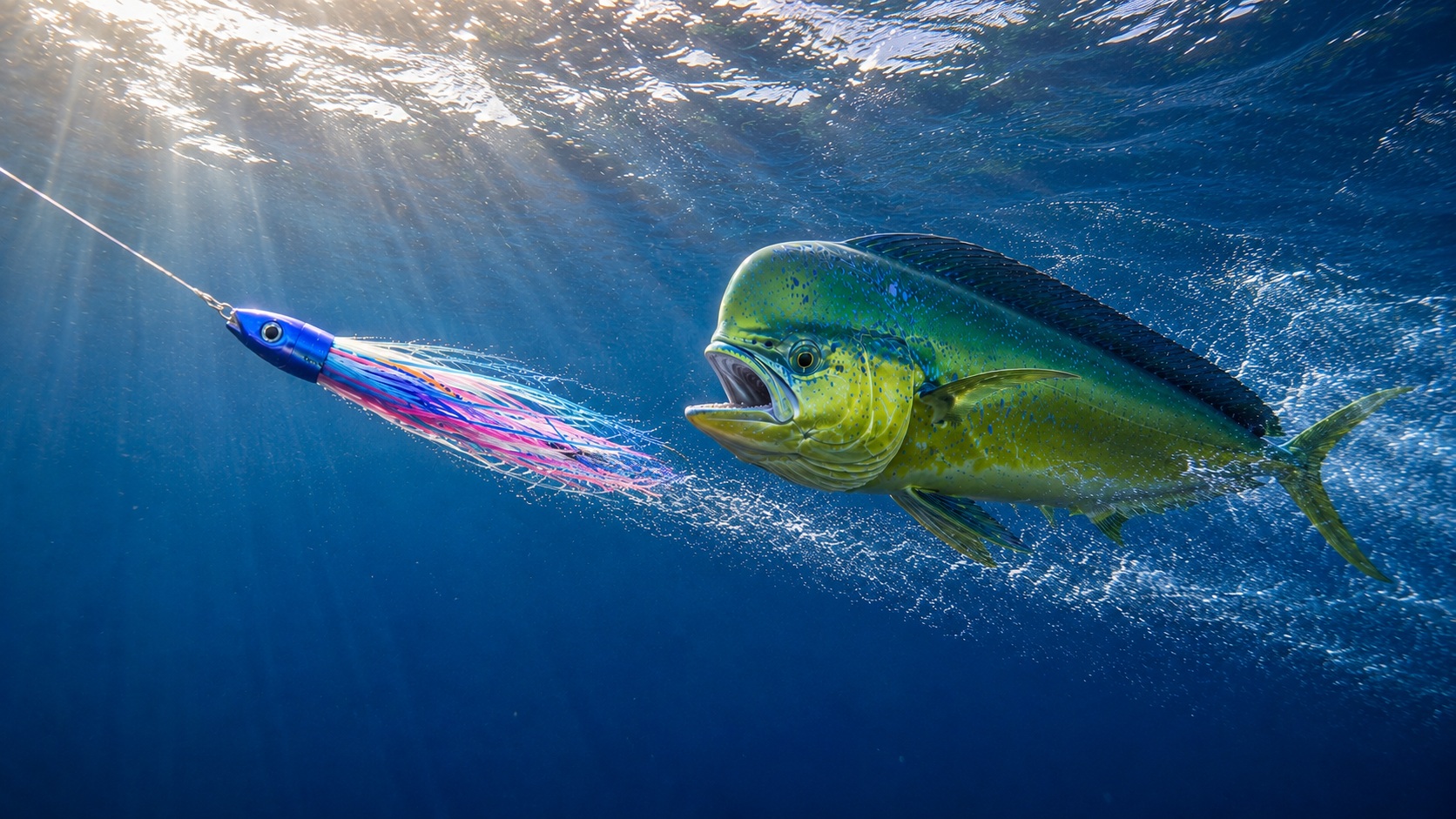
That makes trolling the dominant search tool for scattered, roaming fish over big open areas. Offshore, it is how anglers find pelagics — mahi-mahi, wahoo, king mackerel, and billfish that wander miles of blue water with no structure to pin them down. On the Great Lakes and big reservoirs, it is the standard way to catch suspended chinook and coho salmon, lake trout holding at a precise depth, and walleye spread across open basins. The common thread: when fish are spread thin over a large area and you do not know exactly where they are, trolling lets you cover ground and let the fish tell you where they are holding.
The whole game comes down to three controllable variables — speed, depth, and the layout of your spread — and learning to manage all three at once.
How to do it
Build a spread. A spread is the arrangement of multiple lines behind the boat, staggered so they do not tangle and so they fan baits across different distances, depths, and angles. Run lures at different lengths back (short, medium, and long lines), and use the boat’s wake to your advantage — many pelagics key on the prop wash and rise into a bait running just behind the boil. The more lines you can manage cleanly, the more water and depth you cover on every pass.
Control your depth. This is where the real craft lives, because fish hold at a specific depth and your bait has to get there. Several tools do the job. Deep-diving plugs dig their way down on their own, deeper the more line you let out. Downriggers clip your line to a heavy weighted ball on a cable, dropping baits to an exact, repeatable depth that you read off a counter — the standard for Great Lakes salmon and lake trout. Weighted line (lead core or wire) sinks the line itself. And planer boards pull lines out to the side of the boat, spreading the spread wider and getting baits away from the engine noise into untouched water.
Dial in your speed. Speed controls both how deep a lure runs and how it acts. Too fast and a plug blows out and skips; too slow and it goes lifeless. Salmon and trout often want a slow, steady 1.5 to 2.5 mph; walleye crawl even slower with crankbaits or worm harnesses; pelagics like wahoo and kings want a faster pull, sometimes 6 to 9 mph, to make a bait dart and flash. Confirm a lure is swimming right beside the boat before you send it back.
Space the lures. Keep lures from running on top of each other — vary how far back each line sits and how deep each one runs so every bait works clean water. When a rod loads up, note what was working, then duplicate it across the spread.
When to use it
Reach for trolling when:
- Fish are scattered over open water. Offshore blue water, big-lake basins, and broad flats with no obvious structure all favor a technique that covers ground.
- You are searching, not picking apart cover. Trolling shines when you do not yet know where the fish are and need to find them quickly across a large area.
- The fish are suspended. Salmon, trout, and open-water stripers hang in the water column far from the bottom, and trolling lets you put a bait at an exact mid-water depth and hold it there.
- You want to fish multiple presentations at once. A spread lets you test different lures, depths, and distances at the same time and let the fish vote.
The flip side: trolling is the wrong tool for tight cover, small spots, or shallow structure where you need to place a bait precisely. There, casting and retrieving or vertical jigging will out-fish a trolling pass every time.
Common mistakes
The biggest mistake is trolling at the wrong speed — most anglers run too fast and pull dead, blown-out lures past fish that never see a natural action. The second is fishing the wrong depth: if your baits are not in the same slice of water as the fish, the spread is useless, so use your electronics to mark fish and set your downriggers and divers to match. The third is letting the spread tangle from sloppy lure spacing and turns that are too tight. And the last is failing to repeat success — when a rod fires, log the exact lure, depth, distance, and speed, then put more lines in that pattern instead of guessing again.