A note about links: If we include links to retail sites like Amazon or Bass Pro Shops, it's because they're relevant to the topic and, as anglers ourselves, we believe they're worth checking out. As an Amazon Associate we earn from qualifying purchases.
The first time a mahi-mahi erupts off the surface 30 yards behind your trolling spread, your first instinct is that you’ve hooked something on fire. These fish are that vivid: bulls wear a blaze of electric blue-green and gold that fades within minutes of leaving the water, a spectacle that rewards anglers who keep a camera ready before anything else. They hit hard, run fast, and jump repeatedly, making every fish feel larger than it is. Add in the schooling behavior that lets a skilled crew turn one hookup into a box full of fish, and it becomes clear why mahi-mahi rank among the most sought-after offshore targets across the entire Atlantic seaboard, Gulf of Mexico, Hawaii, and Pacific coast.
How to identify one
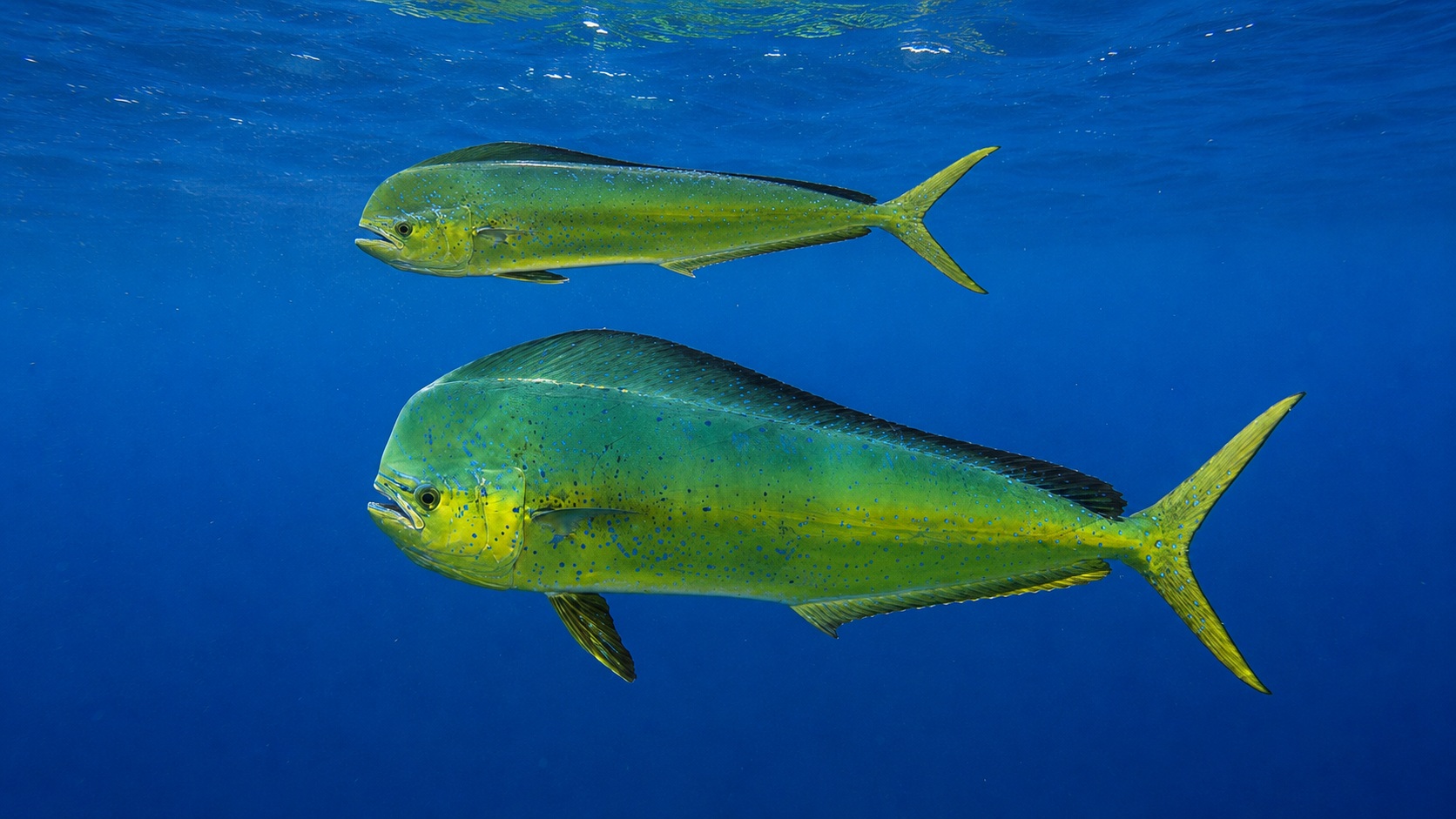
Mahi-mahi are nearly unmistakable once you have seen one. The blunt, almost vertical forehead is the key field mark: bulls (males) develop a pronounced square cranial ridge that becomes more dramatic as they grow, while cows (females) have a more rounded, tapered head. Both sexes display vivid coloration when alive, a patchwork of iridescent blue-green along the back fading to gold and yellow on the flanks, often scattered with electric blue spots. A single dorsal fin runs nearly the full length of the body. At the table or in the cooler the colors fade quickly to a dull gray-green, which is a useful reminder to take your photos while the fish is still fresh out of the water. The only realistic lookalike is the pompano dolphin (Coryphaena equiselis), a smaller, stockier species that rarely exceeds four pounds and has a more uniform shape; if you catch a small dolphinfish, check the body depth just behind the head relative to total body length to confirm the species.
Where to find them
Mahi-mahi are open-water fish that use floating structure as their organizing principle. Wherever something drifts offshore — a mat of sargassum weed, a pallet, a line of foam, a buoy, or a dead whale — mahi gather beneath it to ambush the baitfish that congregate there. Key offshore color changes, where green nearshore water meets warm blue offshore water, are productive even without visible floating debris.
On the Atlantic coast, mahi follow warm-current edges northward through spring and summer. From the Carolinas to New England, the Gulf Stream pushes close enough to shore during summer months that anglers can reach fish in a reasonable run. The waters off the Outer Banks of North Carolina are among the most productive mahi grounds on the East Coast, with the Gulf Stream regularly accessible within 20 to 40 miles. Mid-Atlantic anglers from Virginia and Maryland work canyons and warm-water rips well offshore. As summer peaks, fish push as far north as southern New England. Southern access points — from South Florida, the Florida Keys, and the Gulf Stream corridor northward — enjoy some of the longest productive seasons on the Atlantic side.
In the Gulf of Mexico, mahi appear in blue water offshore, associated with current rips and floating debris. Fish are less tied to a defined nearshore current edge compared to the Atlantic side, so locating floating structure and weedlines matters even more.
Hawaii supports a strong year-round mahi-mahi fishery. The islands’ offshore waters produce consistent fish, and mahi are one of the primary targets for charter and sportfishing fleets out of ports on all the main islands. Pacific coast anglers encounter mahi in warmer-water years when conditions push fish north from Baja California into Southern California offshore waters.
When to go
Mahi-mahi move with warm water, and water temperature is the most reliable indicator of where and when fish will be present regardless of geography. Fish become active and aggregated when surface temperatures reach the mid-70s °F and peak activity generally coincides with water in the upper 70s to low 80s °F. Timing shifts significantly by latitude: in the deep South and Gulf, fish may be accessible most of the year; in the mid-Atlantic and Northeast, the productive window compresses to summer and early fall as warm-water eddies and the Gulf Stream push fish within reach.
Spring brings large schools migrating northward along current edges on the Atlantic coast — one of the most reliable windows at southern and mid-Atlantic latitudes. Summer fishing remains strong across the range and extends the fishery into the Northeast. The fall migration reverses the pattern as cooling water pushes fish back south, often concentrating schools that can be intercepted along the way. In Hawaii, fish are available year-round with peak action in warmer months.
Time of day matters less than conditions offshore. Calm, clear mornings allow you to spot weedlines and birds at distance, which makes all the difference in locating fish on a given day.
What to throw
Rigged ballyhoo are the single most productive bait and should be your starting point for any trolling spread. Rig them on a 6/0 to 7/0 hook under a colorful skirt, trolled on 40 to 60 pound fluorocarbon leader at 6 to 9 knots. Skirted trolling lures in blue-white, pink-white, and chartreuse-orange work well as teasers and as standalone baits; chugger-style heads in 4 to 6 inch sizes are consistently productive. When fish are raised and swimming behind the boat, pitch baits close the deal: a fresh chunk of cut ballyhoo, a live sardine or similar local baitfish pitched on 20 to 30 pound fluorocarbon leader will get eaten before it sinks two feet. Soft plastic jigs in white, chartreuse, or sardine colors rigged on a 1/2 to 1 oz jig head are excellent for casting to fish holding under floating debris and let you work the school without running over it with the boat. Spoons in silver and gold provide a tight wobble that aggressive bulls find hard to ignore when they are chasing a school.
The most important technique once you find a school is to keep at least one fish in the water: mahi-mahi are schooling fish that will stay near their hooked companion, and the moment the last fish comes aboard, the school often disperses. Have your cast rods rigged and ready before you bring the first fish over the rail.
Regulations
Mahi-mahi regulations vary by state and by whether you are fishing in state or federal waters. Do not rely on any single state’s rules — check the regulations that apply to where you are actually fishing.
Federal Atlantic and Gulf of Mexico waters (NOAA/SAFMC): Mahi-mahi in federal waters off the Atlantic coast and Gulf of Mexico are managed under federal fishery management plans. Current federal rules set bag limits and size minimums that apply once you cross into federal waters; confirm current limits with NOAA Fisheries or the applicable regional fishery management council before you go. In state waters, each coastal state sets its own regulations — consult your state’s fish and wildlife or marine fisheries agency for the rules that apply to you.
Pacific and Hawaii: Mahi-mahi in Hawaii and along the Pacific coast are managed separately. Hawaii has its own regulations; check with the Hawaii Division of Aquatic Resources. Pacific coast regulations vary by state.
Because mahi-mahi regulations have changed in recent years and continue to be reviewed, always verify current rules before fishing: NOAA Fisheries at fisheries.noaa.gov, the South Atlantic Fishery Management Council at safmc.net, and your state marine fisheries or fish and wildlife agency.
Handling and release
Mahi-mahi are a warm-water, thin-skinned fish that dies quickly in a warm livewell. If you are keeping fish, bleed them immediately by cutting the gill arch and placing them on ice; the flesh bruises easily and deteriorates fast in heat. Wet your hands before handling, and avoid gripping the fish by the eyes or jaw for extended periods. If releasing a fish, especially a small cow, keep it in the water alongside the boat rather than lifting it aboard: mahi stress quickly out of the water, and a fish that swam off lethargically is not a successful release. Mahi-mahi are outstanding table fish, with firm, mild, slightly sweet white flesh that ranks among the best eating of any offshore species. Fish under 15 pounds tend to be the best eating; very large bulls can have coarser texture. A sharp knife, immediate cooling, and cooking within two days of the catch will put some of the finest offshore fillets you will ever eat on the table.
On the Table
Mahi-mahi ranks among the finest eating fish in the ocean, and most anglers who target them keep their limit without hesitation. The combination of mild, sweet flavor, firm texture, and versatile flesh makes mahi one of the most prized table fish in both home kitchens and restaurants worldwide.
Taste and texture: Mahi-mahi has a mildly sweet, slightly savory flavor with no fishiness when fresh. The flesh is pinkish-white to ivory raw, turning bright white when cooked. Texture is firm and lean with large, moist flakes — it holds together well under high heat and does not fall apart easily. Smaller fish (under 15 pounds) tend to be milder and more delicate; larger bulls can be slightly stronger in flavor but remain excellent.
Best preparation methods: Grilling is the classic approach because mahi’s firm flesh handles direct high heat without breaking apart, and it develops a light char that complements its sweetness. Blackening in a cast iron skillet with Cajun spice builds a dark crust against the sweet white flesh — a combination that works exceptionally well. Mahi is also one of the best candidates for tacos: the large, firm flakes hold up to searing or pan-frying, and the mild flavor pairs cleanly with citrus, slaw, and avocado. Ceviche is excellent with very fresh mahi — the firm texture “cooks” evenly in lime juice without turning mushy, which is a common problem with softer species.
Handling for table quality: Mahi-mahi deteriorates faster than many offshore species if not handled immediately. Bleed the fish at the gill plate right after landing, then get it on ice in a slurry (ice and seawater) as fast as possible. Avoid letting mahi sit in the sun — the flesh goes soft and takes on off-flavors quickly in heat. Fillet as soon as practical, remove the bloodline running down the center of each fillet, and keep fillets cold and dry until cooking. The bloodline is mild on fresh mahi but can turn bitter if the fish has been poorly iced, so removing it is good practice regardless.
Eating caveats: Mahi is a short-lived, fast-growing pelagic species with low mercury accumulation — it is considered a low-mercury fish by the FDA and is safe for regular consumption, including for pregnant women in moderation. No significant ciguatera risk: mahi-mahi is an open-water species and does not feed on the reef organisms that accumulate ciguatoxin. No worm or parasite concerns of note with proper icing and cooking. Bag limits vary by state and federal jurisdiction; check current regulations for where you are fishing.