A note about links: If we include links to retail sites like Amazon or Bass Pro Shops, it's because they're relevant to the topic and, as anglers ourselves, we believe they're worth checking out. As an Amazon Associate we earn from qualifying purchases.
What it is
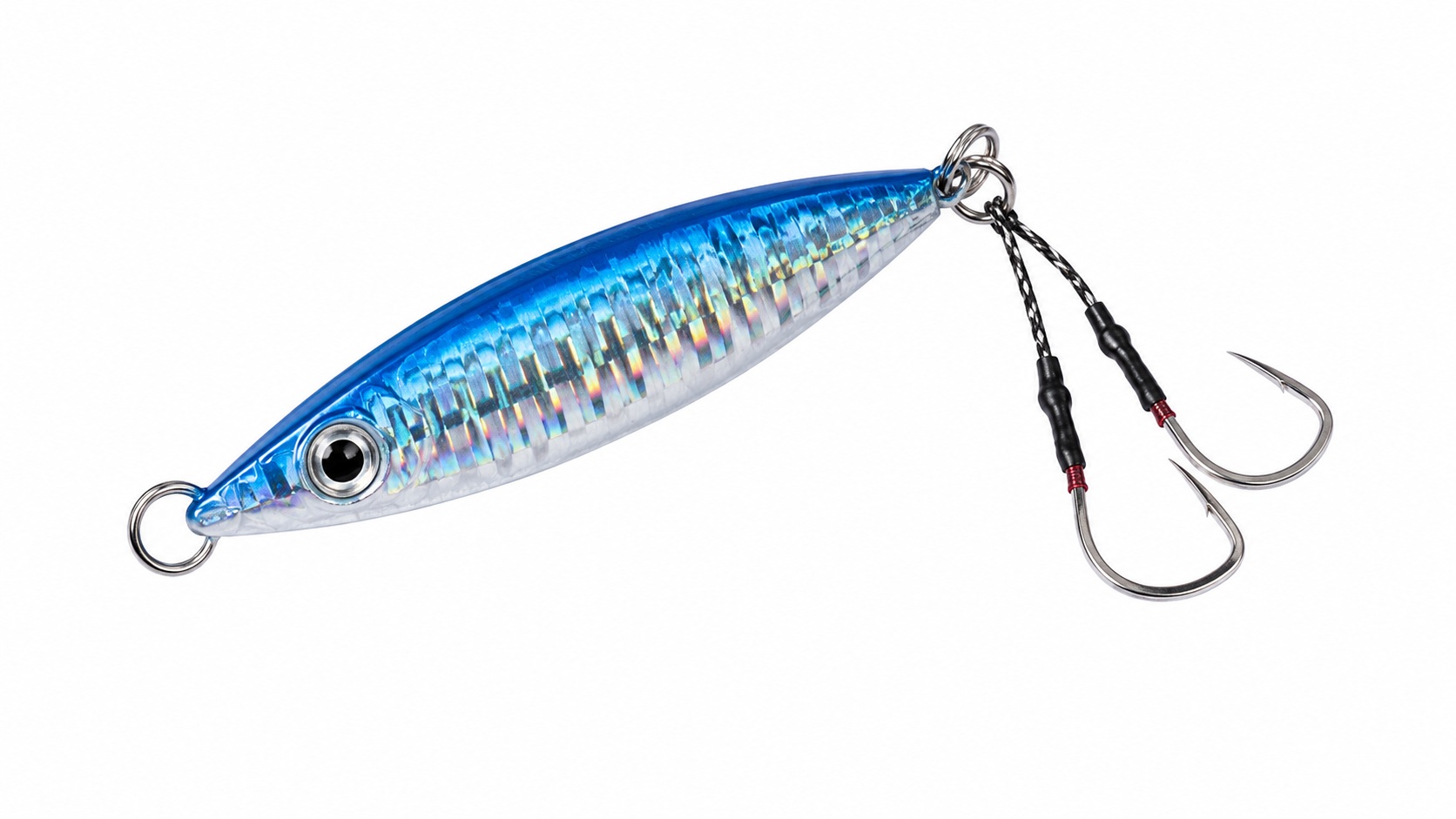
The offshore speed jig is a dense metal lure built around one purpose: getting heavy weight to depth fast and then driving it upward at a speed that triggers predatory strikes from fish that eat by instinct rather than inspection. The profile is narrow — a knife blade, an elongated teardrop, or an asymmetric flat shape — designed to cut through current and sink quickly, then shoot upward and flutter on the fall in a way that imitates a wounded baitfish fleeing then dying.
Speed jigs range from about 2 oz to 8 oz. The general rule is 1 oz of jig weight per 30 to 50 feet of water depth, adjusted upward in heavier current. Fish an amberjack ledge at 100 feet on a calm day and a 3 oz jig works fine; the same ledge with a hard Gulf Stream push may need 5 oz to stay vertical and maintain contact with the bottom.
Two broad styles exist under the speed jig umbrella. The knife jig or pilker style is symmetric front-to-back and shoots straight up fast with minimal lateral movement — this is pure speed jigging. The butterfly jig (sometimes called a slow-pitch jig, though they overlap) is flat and asymmetric, designed to glide and flutter sideways on the fall. The butterfly style produces more action during the drop and is often more effective when fish are less aggressive or sitting at mid-depth rather than tight to structure.
The setup
Speed jigging is simple to rig correctly. The hook placement matters more than anything else.
Assist hooks: The standard terminal setup is one or two assist hooks on the top (head) of the jig, attached via a short assist cord through the front split ring. Assist hooks position near the jig’s head where most strikes occur — predators typically attack baitfish from behind and below, driving their strike toward the head. Do not rig treble hooks on the belly of a speed jig; a large amberjack or wahoo running at speed will bend or break a belly treble and can injure both fish and angler during handling.
Assembly:
- Thread the front split ring of the jig onto your snap or tie direct with a loop knot (Rapala or non-slip mono loop).
- Attach your assist hook rig through the same split ring — double assist hooks (two hooks on one cord) for king mackerel and amberjack; single assist for tuna if line-shy fish are the target.
- No rear hook is needed for most speed jigging applications. A rear hook can be added for wahoo targeting.
Leader: 50 to 80 lb fluorocarbon, 4 to 6 feet. Connect to braid mainline with an FG knot or PR bobbin knot. The FG knot is standard for this application — it passes through guides cleanly during fast vertical work.
How to fish it
Drop the jig to your target depth — the bottom, a structure mark on the sounder, or the depth where fish are marking — and begin the retrieve immediately on contact.
The basic speed jigging cadence: Reel 5 to 8 fast cranks with the rod tip low, then drop the rod tip quickly and let the jig fall on a semi-slack line. Repeat continuously. The upstroke is all reel, no rod sweep — the reel drives the jig upward, not the rod. A high-speed reel (6.0:1 or higher, ideally 7:1+) is not optional here; a slow reel turns this into a different presentation entirely.
Butterfly jigging: Use a wider rod sweep — lift the rod from 9 o’clock to 12 o’clock with the reel turning simultaneously, then drop back and let the jig glide and flutter on a controlled slack fall. The fall triggers as many strikes as the upstroke, so stay alert. Strikes on the drop are often felt as a thump or sudden line movement; wind down immediately and drive the hookset.
Working the column: Do not always jig all the way to the bottom. If fish are showing at 60 feet on a 90-foot ledge, count your jig down to 60 feet and work that zone. Cover from the target depth back up through the water column on each drop.
When to use it
Amberjack on the ledges: Greater amberjack are a primary speed jig target in Florida and Gulf of Mexico waters. Ledges from 60 to 180 feet with hard bottom, rock, or reef hold fish year-round. Drop to the ledge, put the jig into the strike zone, and work it fast — amberjack respond to speed and competition instinct.
King mackerel around bait schools: When menhaden or sardines are stacked and kings are feeding through them, a silver or chartreuse speed jig worked through the school on a fast vertical cadence is highly effective. The speed matches how kings actually eat — in a running slash, not a leisurely investigation.
Cobia around structure: Cobia holding around buoys, channel markers, and offshore structure will take a speed jig worked vertically beneath the boat. Slow the cadence slightly compared to king mackerel; cobia are opportunistic but not always in a sprint-feeding mode.
Blackfin and yellowfin tuna near the shelf edge: Tuna jigging requires lighter jigs (2 to 3 oz), a slightly slower speed retrieve, and a more erratic cadence — vary the number of cranks between drops and include occasional pauses. Tuna respond to irregular movement.
Mahi and wahoo in the water column: When casting to mahi under debris or trolling spreads is not an option, a speed jig worked vertically off the transom or dropped to a mid-column mark produces strikes from both species.
Size and color
| Jig Weight | Depth Range | Best For |
|---|---|---|
| 2–3 oz | 40–80 ft | Mahi, blackfin tuna, kings, inshore edge |
| 4–5 oz | 80–150 ft | Amberjack, cobia, wahoo, mixed bottom fishing |
| 6–8 oz | 150–250 ft | Deep amberjack, deep tuna, heavy current |
Color: Silver and natural baitfish patterns (sardine, blue mackerel) cover most situations. Chartreuse and pink are strong in off-color water and for king mackerel. All-white works well for blackfin tuna. Glow finishes add visibility in deeper water and early morning conditions.
Gear setup
Rod: A dedicated jigging rod in the PE4–PE6 line rating range, 5’6” to 6’6”. Look for a solid or hollow fiberglass tip that loads smoothly through the whole rod blank (parabolic or moderate-fast bend) rather than a stiff bass-style rod that transfers all the load to your wrist and forearm. Slow-pitch rods technically differ from speed jig rods — a speed jig rod has a stiffer mid-section to drive the upstroke.
Reel: High-speed conventional or spinning reel. For conventional: 6.2:1 or higher, with strong drag and a comfortable handle knob for repetitive cranking. Penn Torque, Shimano Talica, and Daiwa Saltist are common choices. For spinning: a 5000–8000 size with 6.0:1 or higher.
Line: PE4 to PE6 braid (roughly 65–100 lb), high-visibility color preferred for reading the drop and tracking depth. 50 to 80 lb fluorocarbon leader on an FG knot.
Brands worth knowing
Shimano and Daiwa both produce purpose-built jigging series (Shimano Butterfly, Daiwa Saltiga jigs) that are widely used and available in a full range of weights and profiles.
Nomad Design makes the Streaker jig, a flat asymmetric design that has gained a strong following for pelagic species along the East Coast and Gulf.
Williamson offers excellent value in the mid-price range.
Yo-Zuri has long produced reliable metal jigs with good action and finish durability.
Mustad assist hooks (the Ultrapoint series) are among the most used for rigging both single and double assist setups on any brand of jig.
If you are starting out, buy three or four different weights of the same profile before buying across multiple brands. Understanding how a single jig style fishes at different depths and speeds teaches you more than rotating through five different shapes at once.