A note about links: If we include links to retail sites like Amazon or Bass Pro Shops, it's because they're relevant to the topic and, as anglers ourselves, we believe they're worth checking out. As an Amazon Associate we earn from qualifying purchases.
There is a moment, somewhere off a canyon edge in the Carolinas or a few miles outside a Gulf Coast inlet, when a blackfin tuna turns on a live bait and the reel simply unloads. These fish are built for speed, hitting baits with authority and running hard toward deep water before your brain has caught up to what just happened. They are the most accessible tuna species in the western Atlantic, close enough to reach on a half-day trip out of dozens of ports from the Gulf Coast to Cape Hatteras, yet fast and strong enough to make a 20-pounder feel like a fish twice its size. Whether you are new to offshore fishing or a veteran looking to add a cooler of sushi-grade fillets, blackfin tuna deliver the full offshore experience at a scale that does not require a 60-mile run or a tournament boat.
How to identify one
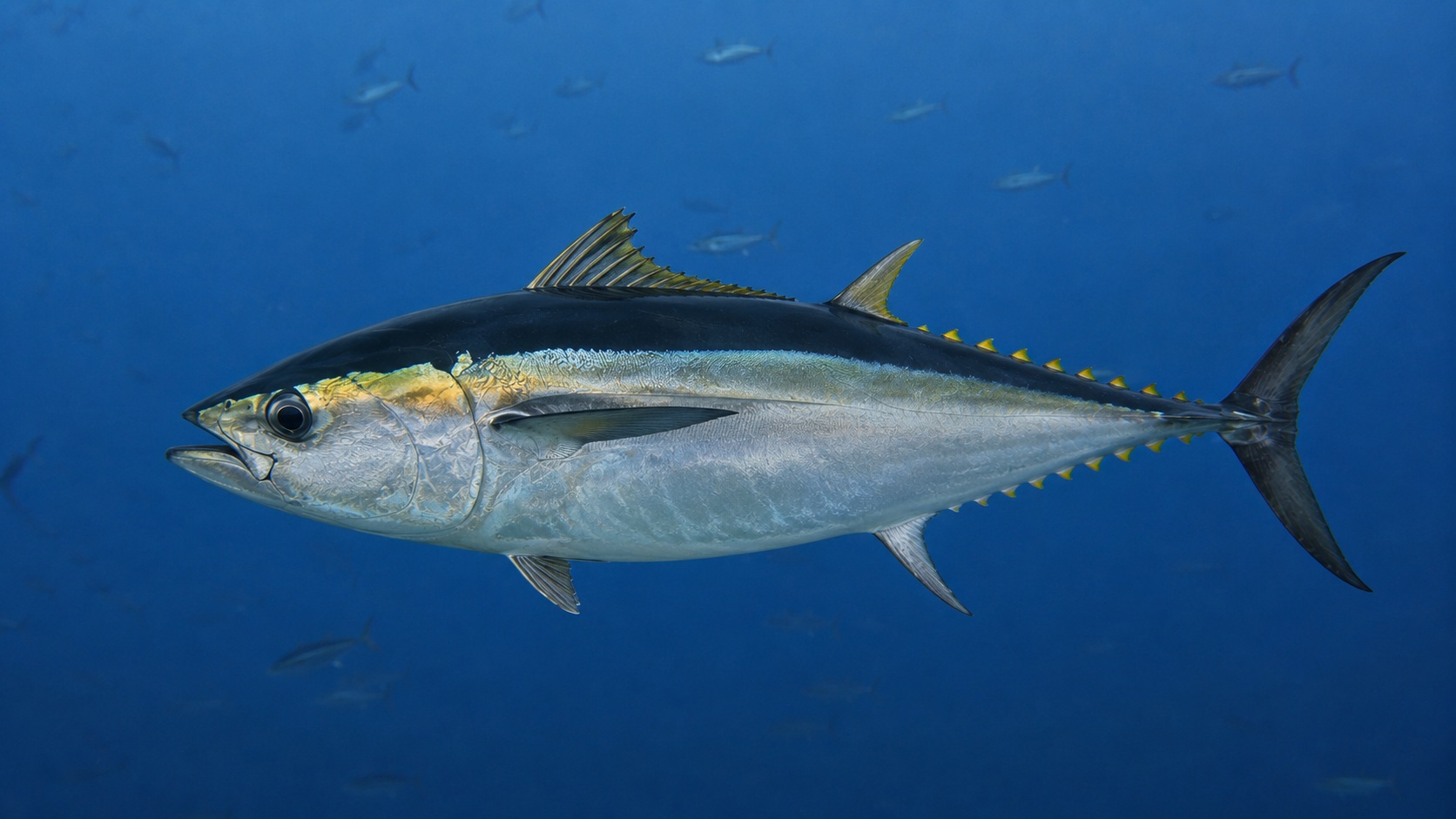
Blackfin tuna share the torpedo shape and forked tail common to all tunas, but a few field marks separate them from their relatives. The back is deep blue to black, the belly is silver-white, and a yellow-gold lateral band runs along the side from eye to tail. The most reliable ID feature is the row of small finlets between the dorsal and caudal fins: on blackfins, those finlets are bronze or dusky brown with white edges, not yellow as they appear on yellowfin tuna. The body is also more compact and oval in cross-section than a yellowfin, and blackfins top out around 39 inches, meaning any fish over 30 pounds is a genuinely large specimen. The most common confusion species throughout the range is the skipjack tuna, but skipjack have prominent dark horizontal stripes on the lower belly that blackfins lack entirely.
Where to find them
Blackfin tuna are a warm-water western Atlantic species found from Massachusetts to Brazil, with the core of their range running from the Carolinas through Florida, the Gulf of Mexico, and the Caribbean. They prefer water above 70 degrees Fahrenheit and are most often found near the continental shelf edge, along temperature breaks, and in blue oceanic water that pushes close to shore where the shelf is narrow.
Along the Atlantic coast, the Gulf Stream corridor is the highway that connects blackfin populations from south to north. Off the Outer Banks and Cape Hatteras in North Carolina, the Stream pushes warm water within range of day boats, and the area is a well-known staging ground for blackfins during warmer months. Virginia’s offshore canyons — particularly the Norfolk Canyon area — see blackfins in summer and fall mixed with other pelagic species. South Carolina and Georgia anglers access fish over nearshore ledges and the shelf break, where current edges and floating weed lines concentrate bait.
Off the Gulf Coast, blackfins gather around offshore oil and gas platforms, natural reefs, and the deep-water ledges of the continental shelf. Louisiana, Alabama, and the Florida Panhandle all have active blackfin fisheries, with structure fishing over platforms being a particularly productive approach. Fish are present in the Gulf year-round but tend to be most concentrated during cooler months when water temperatures are more stable at depth.
The Florida Keys remain one of the most renowned destinations in the species’ range, with well-known offshore humps along the 600-foot contour concentrating bait and drawing some of the largest blackfins reliably encountered anywhere. The Bahamas and Caribbean also hold excellent populations.
When to go
Timing depends heavily on latitude and water temperature. Blackfins prefer water in the 70 to 82 degree range and their movements follow those temperatures across the season.
In the Gulf of Mexico and South Florida, peak fishing typically runs from late fall through spring — roughly when nearshore and shelf waters cool into the blackfin’s preferred range. This is when fish are most concentrated on structure and temperature breaks and average size tends to be highest. Summer fishing remains productive but fish scatter more widely.
Along the Carolinas and mid-Atlantic coast, blackfins push north following warm water in summer and early fall, then retreat south as temperatures cool in October and November. Peak season for this region generally runs from late summer through early fall, when the Gulf Stream is closest to shore and water temperatures are at their peak.
Regardless of region, early morning and late afternoon are the most productive windows in any given day, with feeding activity peaking around current transitions and wherever birds are working bait.
What to throw
Live bait is the most reliable producer across all situations. Pilchards, goggle-eyes, threadfin herring, and blue runners are top choices. Thread them on a 4/0 to 6/0 circle hook tied to 30 to 40 pound fluorocarbon leader and present them free-lined or under a kite.
Kite fishing suspends live baits at the surface 50 to 150 feet behind the boat, keeping the line out of the water and the bait skipping enticingly. This method is highly effective for large blackfins and was exactly how Robert Kowalski’s 50-pound world-record fish was hooked in June 2024.
Chunking with cut bait is the workingman’s technique and it flat-out produces. Run to a temperature break or weed line, put the boat in neutral or drift, and begin tossing thumb-sized chunks of sardine, herring, or squid overboard every 20 to 30 seconds to build a slick. Hook a chunk on a 4/0 J-hook with a small split shot and let it drift back in the slick. When a school is present this method can produce steady action for hours.
Trolling locates fish when you do not know where they are holding. Run small lures at 6 to 9 knots with lines set well back from the boat, at least 50 yards, because blackfins are notoriously boat-shy. Cedar plugs, small feather rigs, and Rapala CD Mag 14s in blue/white or green/yellow are consistent producers. Once you locate the school on the troll, many anglers switch to chunking or casting to maximize numbers.
Vertical jigging is underrated for blackfins. Drop a butterfly jig or diamond jig in the 4 to 8 ounce range down to 60 to 100 feet and work it with fast, aggressive lifts. This technique is highly productive over structure — oil platforms in the Gulf, the hard-bottom humps along the shelf, and canyon edges along the mid-Atlantic all respond well to this approach.
Topwater casting works when fish are crashing bait on the surface. Blackfins are more willing to eat surface lures than most other tunas. A popper or stickbait on 40 to 65 pound braid thrown into a feeding frenzy is one of the most exciting ways to catch them.
Regulations
Blackfin tuna are managed under the federal Highly Migratory Species (HMS) program administered by NOAA Fisheries. Under federal rules, blackfin tuna are unique among tunas in having no minimum size limit and no bag limit in federal Atlantic and Gulf of Mexico waters. An HMS Angling permit is also not required to target blackfin tuna, unlike other tuna species covered under federal HMS rules. All tunas retained must be landed with the tail and at least one pectoral fin still attached. If you catch and release a blackfin on hook and line, cut the line near the hook or use a dehooking device without removing the fish from the water.
Individual states may layer their own rules on top of the federal baseline. Always verify the current regulations for your state’s fish and wildlife agency in addition to the federal HMS rules before heading out. Federal regulations are available directly from NOAA Fisheries at fisheries.noaa.gov or by calling the HMS Information Line at 1-888-872-8862.
Handling and release
Blackfin tuna are exceptional table fare and one of the best-eating fish in the western Atlantic. The dark red meat is firm, mild, and well-suited for searing, sushi, and poke. To preserve quality, bleed fish immediately by cutting the gill arches and placing them in an ice slurry. Do not let them sit on a hot deck. For fish you plan to eat, get them on ice within minutes of landing.
If you are practicing catch and release, keep the fish in the water as much as possible. Blackfins are sensitive to air exposure and can go into rapid oxygen debt after a fight. Cut the leader at the hook bend if the hook is deeply set, keep the fish horizontal and in the water while removing a barbless hook, and point it into any current or wave action to push water over the gills before release. A revived fish will kick out of your hands on its own. For released fish, avoid removing them from the water entirely and never hold them vertically by the jaw as you would a largemouth bass.
On the Table
Blackfin tuna are excellent table fare and one of the more prized catches for anglers fishing the western Atlantic and Gulf of Mexico — provided the fish is handled correctly from the moment it hits the deck. Improperly bled or unkept blackfin deteriorates fast, but a well-handled fish rivals yellowfin for quality.
Taste and texture: The flesh is deep pink to red, firm, and moderately dense with a clean, mildly rich flavor. Blackfin has less fat than bluefin and a slightly more pronounced “tuna” character than yellowfin, but it is not gamey when fresh. The texture holds up well to high heat and slices cleanly for raw preparations. Trim the dark lateral bloodline before cooking; it is edible but carries a stronger, more metallic taste.
Best preparation methods:
- Sashimi and poke: Blackfin is a popular raw fish throughout its range, with firm, smooth flesh that slices cleanly against the grain and carries enough fat to hold up without sauce. Use only fish bled and iced immediately after catch.
- Seared rare: Cast iron or screaming-hot grill, 2 minutes per side. The goal is a thin crust with a cool, translucent center. This is the most forgiving method for showcasing the mild, clean flavor without drying out the lean flesh.
- Blackened: Cajun-spiced with butter in a carbon-steel pan. Blackening suits blackfin because the bold spice complements the fish’s moderate flavor without overwhelming it, and the high-heat crust seals in moisture.
- Ceviche: The firm flesh acid-sets without turning mushy, making it well-suited for a citrus marinade. Use smaller, freshly caught fish for raw applications.
Handling for table quality: Bleed the fish immediately at the gills as soon as it is landed — this is non-negotiable with any tuna and the single biggest factor in final eating quality. After bleeding, put the fish in a slurry of ice and seawater (not dry ice, which freezes the flesh). Keep the fish cold, whole, and in the brine for at least two to three hours before filleting. Avoid letting the fish sit in the sun or flop on a hot deck. When filleting, remove the skin, dark bloodline, and any bruised flesh.
Mercury note: Blackfin tuna carry relatively elevated mercury for their size — higher on average than yellowfin. Studies report mean mercury concentrations around 1.0 ppm, above the 0.5 ppm threshold used by several health agencies. Occasional consumption poses low risk for healthy adults, but pregnant women, nursing mothers, and young children should limit or avoid blackfin tuna per standard FDA/EPA guidance on high-mercury fish.