A note about links: If we include links to retail sites like Amazon or Bass Pro Shops, it's because they're relevant to the topic and, as anglers ourselves, we believe they're worth checking out. As an Amazon Associate we earn from qualifying purchases.
What it is
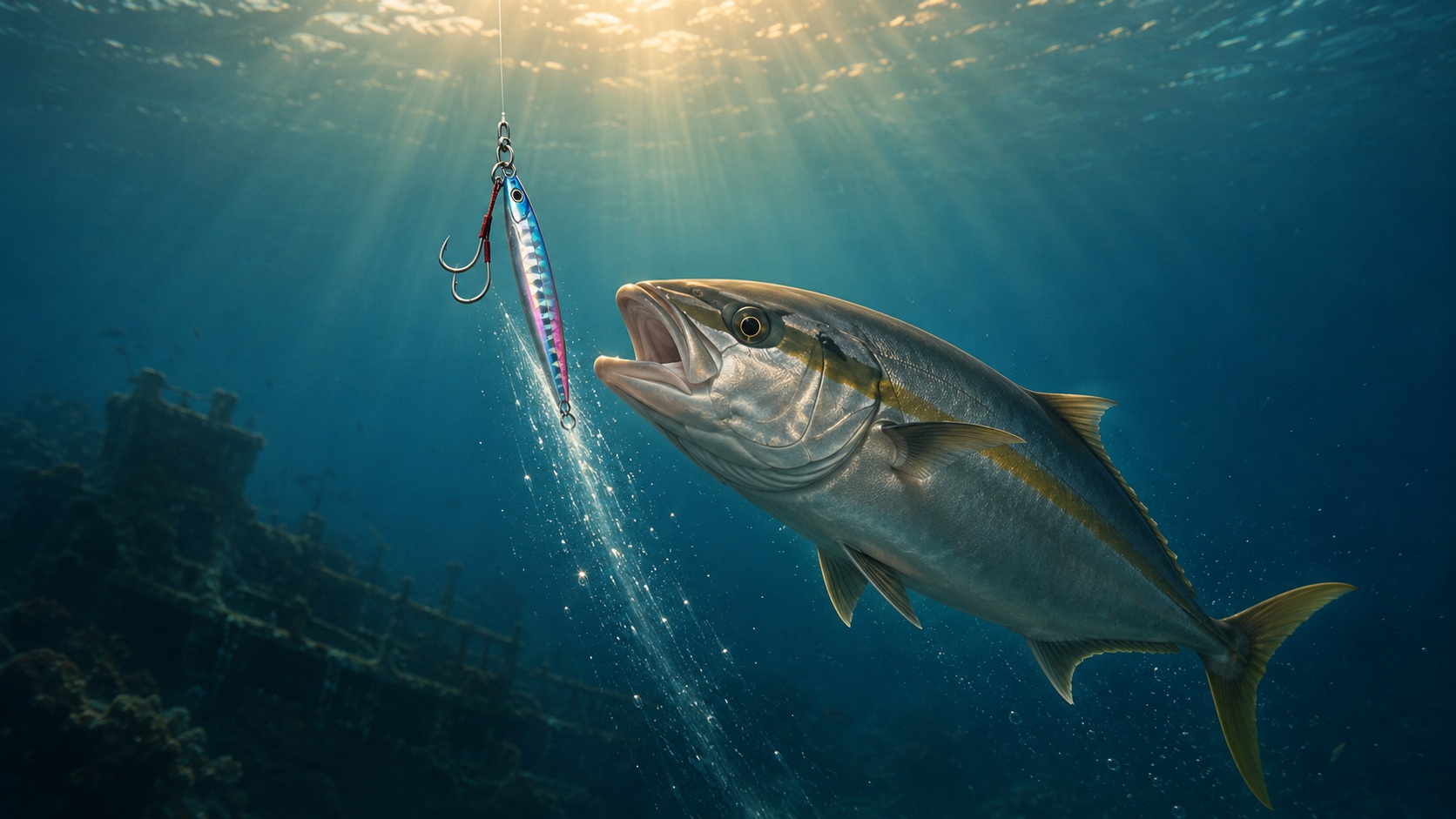
Vertical jigging is exactly what it sounds like: you drop a heavy metal jig straight down to a target depth or piece of structure beneath the boat, then work it back toward the surface with rod sweeps and reel cranks. The jig flashes, darts, and flutters on the way up, imitating a fleeing or wounded baitfish — and a predator holding tight to a reef, ledge, or wreck rarely lets that meal escape.
What sets it apart from casting techniques is the angle of attack. Because the line runs straight up and down, you fish the entire water column directly below the boat with total control. You know exactly where your jig is, you can pin it to a specific depth, and you keep it in the strike zone far longer than a horizontal retrieve allows. That precision is why vertical jigging shines over deep structure where fish stack at a known depth.
There are two distinct sub-styles. Speed jigging (sometimes called knife jigging) uses a stiff, fast-action rod and a high-speed reel to rip a slender jig upward in quick, hard pumps — a power presentation that triggers reaction strikes from fast pelagics like amberjack, tuna, and king mackerel. Slow-pitch jigging uses a soft, parabolic rod that loads and unloads to make a flat, wide jig flutter and dance on a near-slack line, falling enticingly between lifts. Slow-pitch is deadly on bottom fish that won’t chase: rockfish, lingcod, and pressured reef dwellers.
Vertical jigging is mostly a saltwater game over offshore and nearshore reefs and wrecks, but the technique crosses over to freshwater too — striped bass schooling deep on a lake’s main-lake humps and lake trout pinned to the bottom in 60-plus feet both fall to a jig dropped straight down on them.
How to do it
Pick the right jig weight. The classic starting point is roughly 1 ounce of jig for every 30 to 50 feet of water, then adjust up for current or wind. The goal is to feel the jig hit bottom and stay vertical — if your line sweeps out at a sharp angle, you’re too light and losing contact. Go heavier until you’re fishing straight down again.
Rig assist hooks. Most jigs are fished with assist hooks — short, strong hooks on a cord lashed to the top eye of the jig (the end nearest the line) rather than a treble on the belly. Assist hooks sit up by the head where fish strike, hook more cleanly, and reduce snags on structure. Many anglers run a single assist hook for slow-pitch and a twin assist for speed jigging.
Read the sounder. Vertical jigging lives and dies by electronics. Watch your sounder for bait balls, arches, and the structure itself, then drop your jig to the depth where the fish are showing. If marks sit 10 feet off the bottom, work that band; don’t waste the drop fishing empty water.
Work the column. For speed jigging, let the jig hit your target depth, then sweep the rod up hard while cranking, dropping the tip to take up slack between pumps — a steady, rhythmic rip. For slow-pitch, lift the rod tip in short, controlled pitches and let the jig flutter back on a semi-slack line; most slow-pitch bites come on that fall. Either way, cover the whole column on the way up before you reset, because suspended fish don’t always hold where you expect.
When to use it
Vertical jigging is the tool for deep, well-defined structure — reefs, ledges, wrecks, rock piles, and humps where fish concentrate at a known depth. Reach for it when:
- Fish are marking deep and tight to structure. When your sounder shows fish stacked at 80, 150, or 250 feet, a jig dropped on their heads beats dragging bait past them.
- You want to cover the column fast. Jigging lets you check the whole water column quickly and pick out aggressive fish without rigging bait.
- Current is moving. A little current keeps the jig swimming and the bait active — prime jigging conditions.
Match the sub-style to the fish. Use speed jigging for fast, aggressive pelagics — amberjack, tuna, king mackerel, cobia. Switch to slow-pitch for bottom-oriented or finicky fish that prefer a fluttering, falling presentation — rockfish, lingcod, and reef fish that have seen pressure. On slack tide or when the bite goes soft, slow-pitch often saves the day.
Common mistakes
The biggest error is the wrong jig weight — too light and the jig blows off vertical, costing you bottom contact and bite detection. Always size up until you’re fishing straight down. Second is ignoring the sounder and blind-dropping into empty water instead of putting the jig on marked fish. Third is mismatched gear: trying to speed jig with a soft slow-pitch rod (or vice versa) kills the action the jig is designed to produce. Finally, many anglers reel up too soon. Work the jig all the way through the column on each retrieve — the fish that ignored it at the bottom may smash it twenty feet higher.