A note about links: If we include links to retail sites like Amazon or Bass Pro Shops, it's because they're relevant to the topic and, as anglers ourselves, we believe they're worth checking out. As an Amazon Associate we earn from qualifying purchases.
Drop a jig to the bottom of a rocky ledge off the Channel Islands, feel that unmistakable thud as a big vermilion hammers it on the fall, and you understand immediately why this fish sits at the top of every California rockfish angler’s wish list. Vermilion rockfish are vivid, aggressive, and spectacular on the table, which is a rare combination in any fishery. They stack up around rocky reefs from Baja California to Alaska, but the Channel Islands and central California coast produce the biggest fish in the greatest numbers. Whether you are dropping bait from a party boat off San Diego or working a jig from a private skiff above a rocky pinnacle near Monterey, vermilion are the target that makes a rockfish trip.
How to identify one
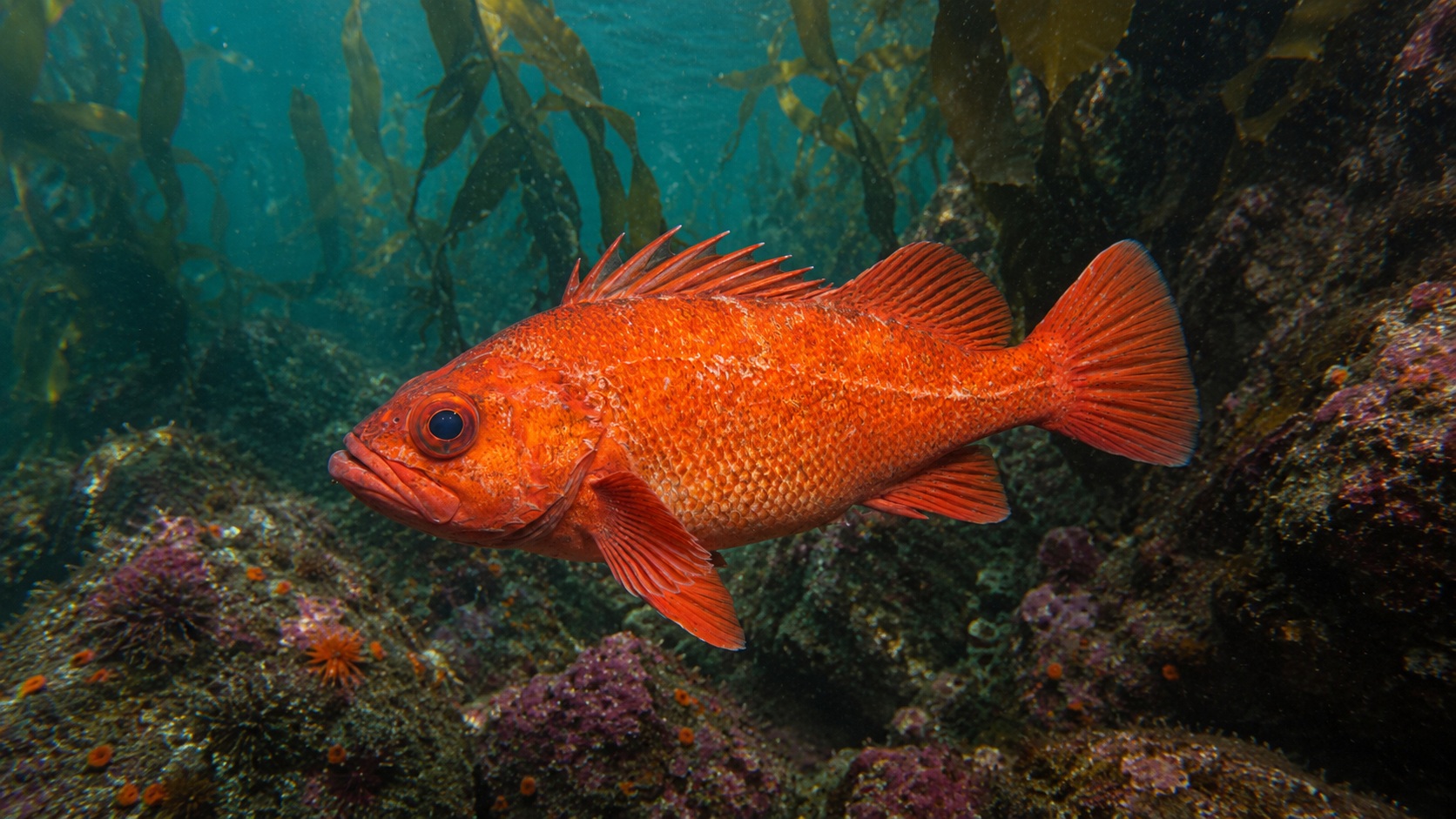
Adult vermilion rockfish are hard to mistake. The body is a vivid orange-red on the back fading to a pale rose-pink on the belly, and the fins carry that same red tone. Look for a moderately deep, compressed body with a large mouth, a slightly curved head profile, and relatively weak head spines compared to some other scorpionfish relatives. Young fish under about 12 inches look completely different: they display a gray-black mottled pattern with dark-edged fins that makes them look like a different species. Two common lookalikes are the canary rockfish, which shows bright orange coloring with distinctive yellow-orange patches and prominent head spines, and the flag rockfish, which has wide dark vertical bars. The sunset rockfish (Sebastes crocotulus) was only recently separated from vermilion as a distinct species and is virtually identical in appearance; the two are managed together as a single “vermilion/sunset rockfish” unit by regulators. All three can share the same reef, so knowing the distinguishing marks of canary rockfish matters because canary carries a tighter sub-bag limit.
Where to find them
Vermilion rockfish are structure addicts. They live on hard, rocky bottom from about 50 feet down to 500 feet, with the best fishing typically between 100 and 350 feet. Look for rocky reefs, pinnacles, ledges, boulder fields, and the edges where hard bottom meets sand. Kelp forests overlying rocky substrate also concentrate fish, particularly in Southern California. They can form loose aggregations near the bottom, hover in small groups mid-water above a pinnacle, or hold in pairs along a ledge edge.
The core of the range is central and Southern California. Prime named locations include the Channel Islands (Santa Cruz, Santa Rosa, Anacapa, San Clemente, and San Nicolas are all productive), the Palos Verdes Peninsula, the reefs off San Diego and Point Loma, the Big Sur coast, and the Farallon Islands off San Francisco. Further north, they appear regularly off Oregon and Washington, with Depoe Bay, Oregon, producing the all-tackle world record fish. In Mexican waters, the upper Baja coast around Ensenada and San Quintin holds good numbers as well.
Oil platforms off Southern California deserve a mention: the shell mound communities and pipeline infrastructure around the platform bases function as artificial reefs and concentrate vermilion along with a mix of other rockfish species.
When to go
The California open season for boat-based anglers runs April 1 through December 31 in most management areas, so the three best seasons are spring, summer, and fall. Spring fishing picks up quickly after the January through March closure as fish that were pushed deeper by winter conditions move back into prime reef structure. Summer is the core of the season, with long fishing days, stable weather, and excellent bait availability. Fall can produce some of the biggest fish of the year as vermilion feed aggressively before winter.
In Southern California, the season has an additional summer restriction: from July 1 through September 30, boat anglers are limited to fishing within 50 fathoms (300 feet) inshore, and the season closes entirely from October 1 through December 31 in the Southern Management Area. Central and northern California maintain the full April-December season at all depths. Shore-based anglers and spear divers are exempt from the seasonal and depth restrictions that apply to boat anglers.
The best fishing within open days happens during slack tide or the first two hours of a tidal movement. First light and late afternoon tend to produce more surface-to-mid-water feeding behavior, though vermilion are catchable throughout the day when you are parked on structure.
What to throw
Live squid is the single most effective bait for large vermilion and should be the first choice when available through bait receivers or party boats. Hook it once through the mantle on a 3/0 to 4/0 circle or octopus hook and fish it close to the bottom.
Live anchovies and sardines are the everyday alternatives on most party boats. Fish them on a dropper loop rig: tie a barrel swivel at the top of a 4-to-6-foot fluorocarbon leader, create two loops spaced about 24 inches apart for hooks, and attach your weight 12 inches below the bottom hook. This puts multiple baits in the strike zone simultaneously.
Salted or fresh-dead squid strips are a step down from live but still very effective, especially when dipped in scent or threaded on a glow-in-the-dark squid skirt.
Lead-head jigs and swimbaits are the tool for targeting bigger fish. A Salas 6X or 6X Jr. in red, scrambled egg, or brownish-red patterns is a proven Southern California standard. A Tady 4/0 or Tady C with a treble hook, tipped with a squid strip for scent, will produce when bait is not available. Work the jig by dropping to the bottom, cranking up four or five turns, then letting it flutter back down. Vermilion frequently bite on the fall.
Diamond jigs and blade-style jigs like the Colt Sniper in 3 to 6 ounces cover ground when you are searching for fish over unfamiliar structure. Add a squid strip or plastic trailer to keep them interested.
Gear is straightforward: a medium-action 7-to-8-foot rod paired with a conventional reel spooled with 50-pound braid and a 20-to-40-pound fluorocarbon topshot handles the depths and the occasional bonus lingcod without being excessive. An Avet MXL or similar level-wind reel is a common choice on California party boats.
Regulations
Vermilion rockfish are managed as part of the RCG Complex (Rockfish, Cabezon, and Greenlings) under a joint state-federal framework in California. The Pacific Fishery Management Council sets the federal framework, and CDFW implements it at the state level.
Key 2026 rules for boat-based anglers:
- Closed season: January 1 through March 31 statewide for boat anglers
- Open season: April 1 through December 31 in the Northern, Mendocino, San Francisco, and Central Management Areas (all depths)
- Southern Management Area: April 1 through June 30 (all depths); July 1 through September 30 (50 fathoms inshore only); October 1 through December 31 (closed)
- Bag limits: Vermilion/sunset rockfish combined sub-bag limit of 4 fish in the Northern Management Area; 2 fish in all other management areas; part of a 10-fish RCG combination limit overall
- Size limit: No minimum size for rockfish
- Shore and spear divers: Exempt from season dates and depth restrictions
Oregon and Washington have separate regulations managed by ODFW and WDFW respectively; check the managing state agency before fishing those waters.
Regulations change in-season and vary significantly by management area and depth zone. Always verify current rules directly with CDFW before heading out: wildlife.ca.gov/Fishing/Ocean/Regulations/Groundfish-Summary
Handling and release
Vermilion rockfish have venomous dorsal and anal fin spines. The venom is mild compared to a scorpionfish, but a careless grip on a flopping fish will produce a painful puncture wound. Grip the fish firmly across the body behind the pectoral fins with your thumb pressing down on the back just forward of the dorsal, compressing the spines. A fish gripper tool works if you are not comfortable with a bare-hand hold.
If you catch a rockfish that has been brought up from significant depth (usually below about 80 feet), it will likely show signs of barotrauma: a bulging stomach pushed out of the mouth, bulging eyes, or a fish that floats belly-up when released. Rockfish cannot self-descend from this condition and will die at the surface without help. Use a descender device (a weighted hook or inverted hook rig that holds the fish closed at depth and releases automatically) to return the fish to the depth where it was caught. Venting with a hypodermic needle is a second option but descending is the preferred method per current guidance.
For fish you are keeping, vermilion are exceptional table fare. The flesh is nearly white, firm, and mild with excellent flavor. Bleed and ice the fish immediately after capture. Skin removal before cooking is strongly recommended because the skin shrinks aggressively under heat and will curl even thick fillets into a tight roll. Pan-seared fillets with a light rice-flour dredge, baked whole (Chinese-style steamed), or in fish tacos are all outstanding preparations. The head and carcass make excellent stock. Medium mercury levels make it appropriate for regular consumption at 2-4 servings per week for most adults.
On the Table
Vermilion rockfish are among the most prized table fish on the Pacific Coast, and anglers who target them regularly keep what limits allow — the flesh is genuinely excellent, not just acceptable.
Taste and texture: The meat is nearly white, lean, and mild with a clean, slightly nutty flavor that avoids the strong “fishy” quality found in oilier species. Texture is firm enough to hold together through most cooking methods yet breaks into large, satisfying flakes once done. The low oil content keeps flavors neutral and versatile, making it a good canvas for bold sauces and seasonings alike.
Best preparation methods:
- Pan-searing: The firm flesh develops a golden crust without falling apart in the pan. A couple of minutes per side in a hot skillet with butter and fresh herbs is a classic approach, and the mild flavor pairs well with lemon-caper or tomato-based pan sauces.
- Baking or roasting: Lean meat benefits from moderate oven heat (350-375 degrees F) that cooks the fish through without driving out moisture. A whole fish roasted with olive oil, herbs, and citrus is a traditional preparation that showcases the clean flavor.
- Steaming: Vermilion can be cooked whole in a steamer, Chinese-style, finished with hot ginger-scallion oil poured tableside. The firm flesh holds its shape through steam heat without turning mushy.
- Batter-frying or rice-flour dusting: Light coatings work well given the low oil content. A rice-flour dredge and pan-fry produces a crisp exterior while the interior stays moist and flaky — a good choice for fish tacos.
Handling for table quality: Quality starts at the catch. Bleed vermilion rockfish immediately after landing by cutting the gill arch or the throat — blood left in the flesh produces an off flavor that no cooking method fully corrects. Transfer to a slurry or ice promptly. The flesh has a notably short freezer life compared to fattier fish, so plan to eat within a few days of the catch or freeze in vacuum-sealed bags with no air. Fillets are straightforward but watch for the prominent pin bones along the lateral line; run a finger down the fillet and pull bones with pliers before cooking.
Eating caveats:
- Parasites: Research on vermilion rockfish documents anisakid nematodes (Anisakis, Pseudoterranova) in the flesh. Thorough cooking to 145 degrees F eliminates the risk entirely. Those eating raw preparations (ceviche, sashimi) should freeze fillets at -4 degrees F for at least 7 days first to kill larvae.
- Mercury: Vermilion rockfish are considered a moderate-mercury species. The FDA/EPA guidance of 2-4 servings per week applies; pregnant women, nursing mothers, and young children should stay toward the lower end. Larger, older fish accumulate more mercury, so smaller fish are a safer choice for frequent consumption.
- Bag limits: California manages vermilion and sunset rockfish as a combined species unit. Sub-bag limits currently run 2 fish in southern and central management areas and 4 fish in northern areas, within the broader rockfish aggregate. Check current CDFW regulations before each trip as groundfish rules adjust seasonally.