A note about links: If we include links to retail sites like Amazon or Bass Pro Shops, it's because they're relevant to the topic and, as anglers ourselves, we believe they're worth checking out. As an Amazon Associate we earn from qualifying purchases.
Few fish on the Pacific coast will rattle your rod tip and make your heart pound the way a lingcod does. These prehistoric-looking predators guard their rocky reefs like territorial landlords, and when one decides to eat your jig, you know it immediately. The sudden, violent slam followed by a head-shaking, bottom-hugging fight gives the species a reputation that keeps anglers booking boats from Morro Bay to Ketchikan. Add table fare that rivals any fish in the Pacific, and it is easy to understand why lingcod are the target species on most NorCal and Pacific Northwest rockfish trips.
How to identify one
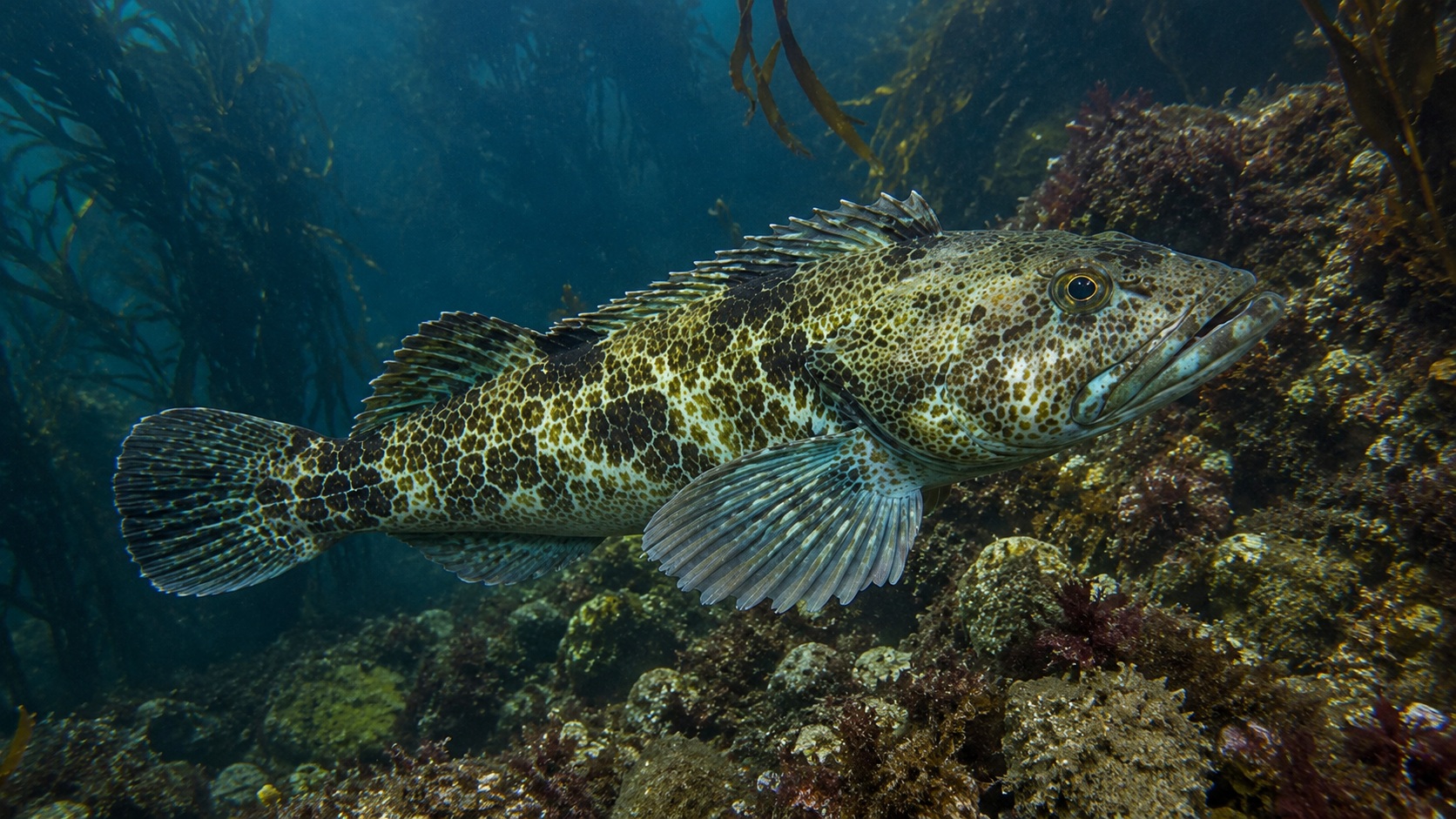
Lingcod are hard to mistake once you have seen one. The body is long and slender, covered in mottled brown, gray, and olive blotches that blend perfectly with kelp and boulder fields. The head is enormous relative to the body, dominated by a wide mouth packed with 18 needle-sharp teeth. The dorsal fin is long and continuous, running most of the length of the back. On a fresh fish, the inside of the mouth and gill plates often flash electric blue-green, and the flesh itself can be a striking blue-green color when filleted. That color is completely normal and caused by a bile pigment called biliverdin. It disappears entirely during cooking. Juveniles can be confused with juvenile greenling or cabezon, but the large mouth and distinct mottling pattern set lingcod apart. Cabezon lack the teeth and have a rounder, blockier head.
Where to find them
Lingcod live on structure. Rocky reefs, pinnacles, submerged ledges, boulder fields, and kelp beds at depths from about 30 feet out to 300 feet are prime real estate. Juvenile fish settle in shallower, sandy transition zones until they reach about 14 inches, then move progressively deeper and harder onto the rocks as they mature. The largest fish tend to hold the deepest, most current-swept structure.
In California, the most productive grounds run from Point Conception north. Monterey Bay and the surrounding reefs produce solid fish year-round for boat anglers targeting the 60–150 foot range. The pinnacles off Bodega Bay and Ft. Ross are legendary. Humboldt County, from the Trinidad Head area north, regularly produces fish in the 20–35 pound class. The reefs around Crescent City at the Oregon border are as good as any in the state. In Oregon, the nearshore reefs off Newport, Depoe Bay, and Gold Beach hold strong populations, and the ODFW has noted healthy lingcod stocks in recent assessments. Washington anglers find quality fish from the Olympic Peninsula coast through the Strait of Juan de Fuca and into Puget Sound. In Alaska, the Kenai Peninsula and Kodiak Island reefs produce the biggest fish on the continent, including the current world record caught off Ninilchik.
When to go
Spring and fall are the prime windows for most of the range. Lingcod spawn in winter, with males guarding egg masses on shallow rocky reefs from roughly December through March. Many states and CDFW impose depth restrictions or closures during this period to protect nesting fish, so check current rules before planning a winter trip. Once the spawn wraps up and fish scatter back to feeding grounds in spring, the action heats up fast. April through June is consistently excellent from California through Washington. Summer produces good fishing but fish can move deeper to find cooler water. Fall, September through November, is arguably the best window for trophy hunting along the entire coast as fish are actively feeding ahead of winter. Tidal movement matters: plan to fish the transition from slack to moving current, when bait gets pushed into ambush zones along reef edges and drop-offs.
What to throw
Heavy metal jigs are the go-to tool for most West Coast anglers fishing from boats over structure. Butterfly-style jigs, knife jigs, and flutter spoons in the 4–12 ounce range cover most situations, with heavier weights needed in depths beyond 150 feet or in strong current. Chrome, white, chartreuse, and root beer are proven colors. Work the jig with sharp upward rod snaps and let it flutter back down on a semi-slack line. Most strikes come on the drop.
Large paddle-tail swimbaits rigged on heavy jig heads have become the preferred method for many serious lingcod anglers. A 6–9 inch swimbait in white, blue, or green on a 2–4 ounce ball head dropped straight to the bottom and hopped with slow, deliberate lifts triggers brutal reaction strikes. The Keitech Swing Impact FAT and similar large-profile swimbaits excel. Match the jig head weight to depth and current, not the fish’s size. You need constant bottom contact.
Live bait and fresh cut bait produce the largest fish consistently. A live small rockfish, greenling, herring, or cabezon dropped near a rocky ledge on a 4–6 ounce dropper loop rig is devastatingly effective. Lingcod will also eat whole squid, octopus chunks, and fresh sardine or anchovy. Fresh is meaningfully better than frozen for bait.
Fly fishing and light tackle in shallow nearshore areas from shore or kayak is a growing method, particularly along rocky Northern California and Oregon headlands at very low tides. Large streamer patterns and 3–5 inch swimbaits on a medium spinning rod work when fish push into the shallows during tide changes.
Use a stout rod, 7 to 8 feet, medium-heavy or heavy, rated for 40–65 lb braid. A 30–50 lb fluorocarbon leader of 2–4 feet prevents bite-offs from those teeth. Monofilament stretches too much to detect strikes at depth and to drive hooks home. High-speed conventional reels handle deep-water jigging better than spinning setups at depths beyond 100 feet.
Regulations
Regulations for lingcod vary by state and in California by management zone, so reading the current rulebook before you launch is non-negotiable.
California (CDFW): The statewide minimum size is 22 inches total length, with a daily bag limit of 2 fish. Lingcod fillets must retain the skin and be at least 14 inches long. Boat-based anglers are subject to seasonal and depth restrictions that align with federally managed groundfish closures, typically closed from January through March in most areas. Shore-based and dive anglers are generally exempt from those depth restrictions. In-season adjustments are common, so always check wildlife.ca.gov for the current year’s specifics before heading out.
Oregon (ODFW): For 2026, the bag limit increased to 3 fish per day with a 22-inch minimum, reflecting strong stock health. Lingcod are managed separately from the rockfish bag limit. The fishery is open year-round at all depths with no seasonal depth restrictions for 2026. Confirm current rules at myodfw.com before your trip.
Washington (WDFW): Season dates, bag limits, and open areas vary by marine area. Most coastal areas opened March 14 through mid-October for 2026 with a 2-fish daily limit. Puget Sound has distinct rules from the coastal areas. Always verify at wdfw.wa.gov for your specific marine area.
Alaska: ADF&G manages lingcod as part of the groundfish complex. Bag limits and seasons vary by region and are separate from federal waters rules. Check adfg.alaska.gov for current personal use and sport fishing regulations.
Regulations across all states are subject to in-season changes based on stock assessments. Never rely on a prior year’s rulebook.
Handling and release
Lingcod teeth are real and will do real damage. Use a long-handled dehooker or a lip-grip tool with sufficient jaw spread for large fish. Gripping the lower jaw like a bass is possible on smaller fish but wear a glove. Avoid putting fingers near the gill rakers. A rubber-coated landing net is the safest option for fish you intend to release.
For released fish, lingcod are generally shallow-water enough that barotrauma is less of an issue than with deeper rockfish. Fish brought up from beyond 100 feet may show bloating or a protruding stomach. Use a descending device (a weighted clip or inverted hook) to return the fish to depth quickly rather than letting it float at the surface. Descending devices are required equipment on many California and West Coast rockfish trips.
On the table, lingcod rank among the finest eating fish on the West Coast. The flesh is lean, firm, and mildly sweet with a clean flavor that works equally well baked, fried, grilled, or in tacos. The blue-green color in the raw fillet cooks out to bright white. Fillets freeze well for up to three months with vacuum sealing. Larger fish over 20 pounds develop slightly coarser texture but remain excellent eating.
On the Table
Lingcod is one of the Pacific Coast’s most prized table fish — a lean, meaty whitefish that holds up well to bold preparations and is widely sought by West Coast anglers specifically for the plate.
Taste and texture: The flesh is mild, clean, and slightly sweet with a buttery quality that sits somewhere between cod and Pacific halibut — juicier than cod, less rich than halibut. Raw fillets are white (or occasionally blue-green; see note below), and the cooked meat is bright white with large, soft flakes and a firm but moist texture that doesn’t fall apart. There is no pronounced “fishy” flavor, making lingcod approachable for a wide range of palates.
Best preparation methods: Pan-searing is the go-to technique — the firm flesh forms a clean golden crust without breaking apart, and a brown butter, lemon-caper, or garlic finish complements the mild sweetness without overpowering it. Baking works especially well for thicker fillets; the meat stays moist at 375 degrees F without drying out the way leaner fish can. Battering and deep-frying is a natural fit given lingcod’s firm, chunky flake — it produces the kind of thick fish-and-chips result that holds its structure inside the crust. Grilling is viable for skin-on fillets with a good oiled grate; the mild flavor picks up char well, and the firm texture survives direct heat.
Handling for table quality: Bleed lingcod immediately at the gills after capture and get the fish on ice. Fillet the same day if possible; loin sections from larger fish benefit from being cut into portions and vacuum-sealed or used within two days. The thick skin is edible but often removed before serving.
Blue-green flesh: Roughly 20 percent of lingcod have blue or turquoise raw flesh caused by biliverdin pigment. The color is entirely harmless and disappears completely upon cooking, leaving normal white flesh. Do not discard a blue-fleshed lingcod — it is safe and tastes identical to white-fleshed fish.
Worm parasites: Lingcod can harbor Anisakis larvae in the muscle tissue. Visual inspection during filleting removes most visible worms, but thorough cooking to an internal temperature of 145 degrees F (63 degrees C) kills any remaining parasites. Raw or lightly cured preparations (ceviche, tartare) require prior blast-freezing at -35 degrees C for 15 hours or -20 degrees C for 7 days per FDA guidance — do not serve lingcod raw without that freeze step.
Regulations: Bag and size limits vary by state and season along the West Coast. Oregon allows 3 fish daily (22-inch minimum as of 2026); Washington and California limits differ by management area. Check current ODFW, WDFW, or CDFW rules before keeping fish — regulations change annually based on stock assessments.