A note about links: If we include links to retail sites like Amazon or Bass Pro Shops, it's because they're relevant to the topic and, as anglers ourselves, we believe they're worth checking out. As an Amazon Associate we earn from qualifying purchases.
Few fishing experiences match the moment a Pacific halibut takes hold at 200 feet down and refuses to come up. These are powerful, flat-bodied giants that fight in long, bulldogging circles, and when you finally swing one over the gunwale you understand immediately why Alaska charter captains build their entire season around them. A 50-pound halibut is a genuine workout; a 150-pound fish is a full-body event. And the reward at the table, white flaky fillets with a clean, mild flavor, is as good as saltwater fishing gets anywhere in North America.
How to identify one
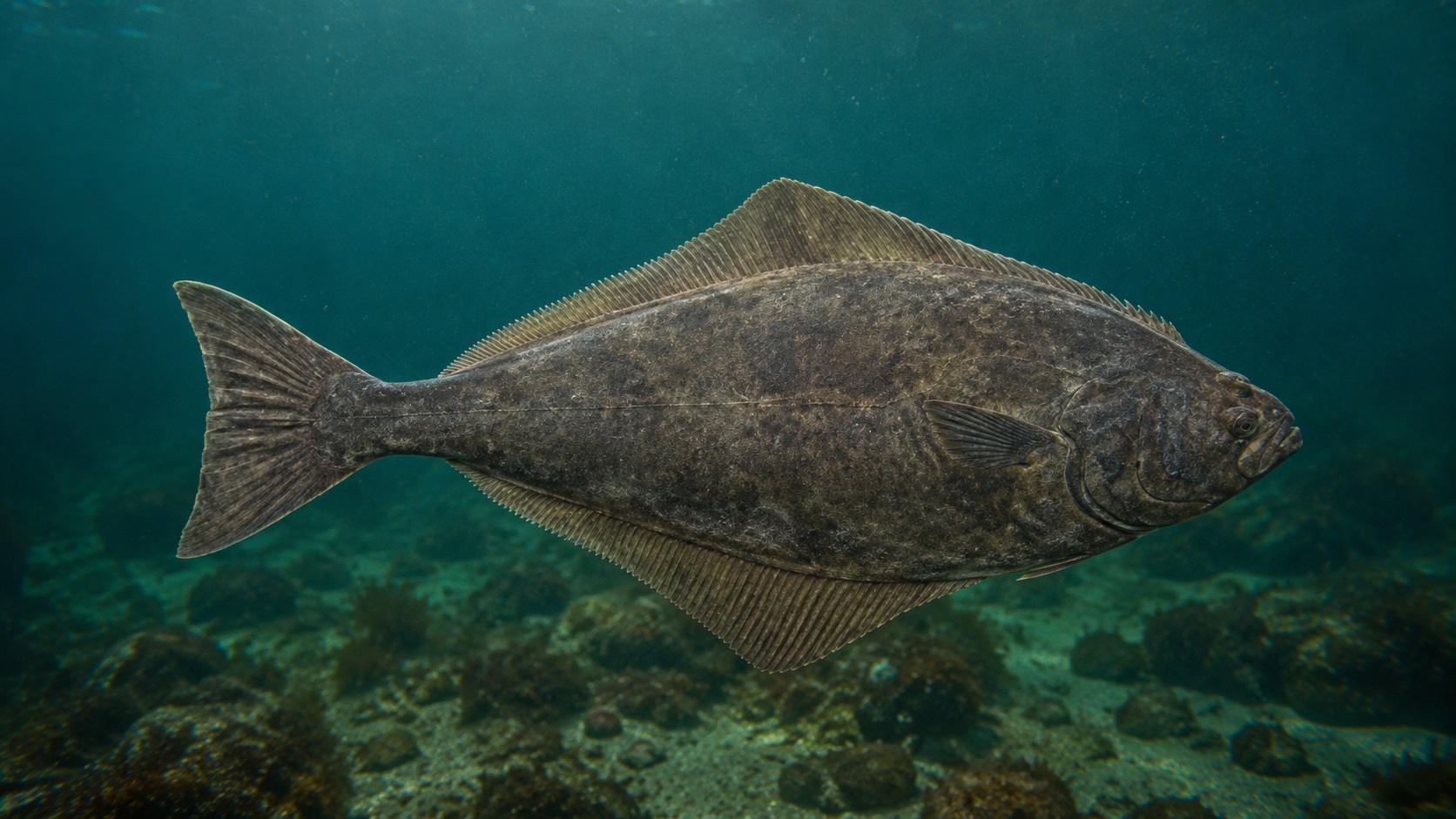
Pacific halibut are right-eye flatfish, meaning both eyes sit on the upper, dark-brown to olive-green side of the body. The underside is bright white. The body is roughly diamond-shaped and significantly wider than other Pacific flatfish, and the lateral line forms a pronounced arch over the pectoral fin. Unlike Pacific sanddab or other small flatfish, adult halibut have a nearly symmetrical tail with a slight fork, a key field mark that distinguishes them from other flounder species whose tails are more rounded. Juveniles under a few pounds are sometimes called “chickens,” while fish over roughly 50 to 100 pounds earn the nickname “barn doors” for obvious reasons. The similar-looking California halibut (Paralichthys californicus) is a left-eye flounder and reaches a much smaller maximum size, so a right-eyed flatfish in Pacific waters that is approaching or exceeding 30 pounds is almost certainly a Pacific halibut.
Where to find them
Pacific halibut range from Santa Barbara, California north through the Oregon and Washington coasts, up through British Columbia and Southeast Alaska, across the Gulf of Alaska, and into the Bering Sea and Aleutian Islands. The densest recreational fisheries are anchored in Alaska, with Homer, Kodiak, Seward, Sitka, Juneau, and Ketchikan serving as the primary jump-off points. Homer on the Kenai Peninsula is widely considered the halibut capital of the world, offering access to both sheltered Kachemak Bay waters and the open Gulf of Alaska. In Washington and Oregon, productive grounds exist off the outer coast and in Puget Sound, though quotas for those areas are tighter than in Alaska.
Halibut are strict bottom dwellers. They prefer sandy or muddy substrate on the continental shelf, typically at depths between 100 and 1,200 feet, though fish have been found as deep as 3,600 feet. Juveniles occupy shallow nearshore waters; adults migrate seasonally, feeding aggressively in shallower summer grounds before moving to deeper water to spawn in winter. Tidal rip lines, underwater ridges, and the edges of underwater plateaus consistently hold fish because halibut ambush prey moving with the current.
When to go
The prime window runs from late May through August, with June and July delivering the most consistent action across Alaska’s major fishing ports. The halibut season in Alaska’s IPHC Areas 2C and 3A (Southeast Alaska and the central Gulf) runs February through December, but water temperatures and baitfish concentrations make summer the far more productive period for sport anglers. Tidal changes are important: halibut feed actively during the transition between tides, when currents slow and baitfish concentrate near the bottom. Slack-water periods at the beginning and end of a tide are often the most productive windows of a given day. Washington and Oregon season dates vary by subarea under the annual catch sharing plan, with many areas open from late April or May through fall.
What to throw
Herring is the single most effective bait for Pacific halibut, used whole or as cut strips threaded onto a 16/0 circle hook. Its combination of scent, action, and widespread availability makes it the default starting point on almost every charter boat from Kodiak to Ketchikan. Octopus is favored when herring is not available or when bait theft is a problem, since it is tough, aromatic, and stays on the hook in strong current. Combining a chunk of octopus with a strip of herring on the same hook maximizes both durability and scent output.
Metal jigs in the 8- to 16-ounce range with a strip of bait or a soft-plastic trailer are devastatingly effective, especially in areas with heavy current where soaking bait is difficult. Work them with a moderately fast upstroke followed by a deliberate slow fall; halibut almost always strike on the drop. Popular jig profiles include large shad bodies, swimbaits, and squids in white, chartreuse, or pink. Hoochie rigs and glow-tube attractors rigged above a baited hook add visual appeal in deeper or darker water.
For hardware, the standard halibut rig runs a heavy conventional rod rated for 80- to 100-pound-class line, spooled with 80- to 100-pound braided line for minimal stretch and maximum sensitivity. A sliding sinker from 1 to 4 pounds (current in Cook Inlet can demand the heavier end) rests above a 6- to 8-foot fluorocarbon leader terminating in a 16/0 circle hook. Suspend your bait 2 to 4 feet off the bottom rather than dragging it on the seafloor: halibut can see it, and the movement kicks off more scent. Hanging a mesh chum bag off the bow anchor line with salmon scraps or commercial scent amplifies the attractant corridor considerably.
Regulations
Pacific halibut are managed by the International Pacific Halibut Commission (IPHC) in cooperation with NOAA Fisheries and state agencies. Regulations vary by IPHC regulatory area and are updated annually.
Alaska (IPHC Areas 2C and 3A): The 2026 daily bag limit for unguided sport anglers is two halibut of any size per person. Season runs February 1 through December 31, 2026, though practical fishing concentrates in the warmer months.
Washington: Bag limits and open dates vary by subarea. In 2026, most Washington coastal subareas allow one halibut per day and operate on selective open days (often Thursday through Sunday) during spring and early summer, with potential fall reopeners depending on quota.
Oregon: Most Oregon subareas allow two halibut per day during the open season, which runs roughly May through October depending on subarea and inseason quota adjustments.
California: Generally one halibut per day. Northern California opens April 1; south of Point Arena the fishery runs April 1 through December 31.
Regulations change annually based on IPHC quota-setting. Always verify current rules, open dates, and any inseason closures before leaving the dock. NOAA Fisheries manages federal regulations at fisheries.noaa.gov and maintains a Pacific halibut hotline at (800) 662-9825. For Alaska-specific rules, consult the Alaska Department of Fish and Game at adfg.alaska.gov.
Handling and release
Halibut in the 10- to 30-pound range can be lifted aboard by hand or with a net, but larger fish require a gaff and immediate dispatch before bringing them over the gunwale. Large halibut are legitimately dangerous: a thrashing 100-pound fish can break bones and damage gear. On charter boats, the captain will typically iki-spike or shoot larger fish at the surface before gaffing. If you are releasing a halibut, minimize air exposure and keep the fish in the water as much as possible, supporting the body horizontally. Pacific halibut destined for the table are exceptional. The white, firm, mild flesh is lean and versatile; fish in the 20- to 40-pound range are considered ideal eating size, with finer texture and more delicate flavor than the larger specimens. Larger fish are still excellent but benefit from soaking fillets in salted water overnight before cooking to draw out excess moisture.
On the Table
Pacific halibut is widely regarded as one of the finest table fish in North American waters, and it is the primary reason most anglers fish for it. The combination of mild, clean flavor and a firm yet tender flake puts it in the same conversation as the best ocean whitefish available.
Taste and texture: The flesh is bright white, lean, and mild with a slightly sweet flavor and no fishiness when handled well. The texture is firm but not rubbery — it flakes in large, moist segments that hold together well under heat. Larger fish (over 50 pounds) tend toward a slightly coarser flake, while “chicken halibut” in the 10-30 pound range are prized for the most delicate texture.
Best preparation methods:
- Pan-searing or pan-frying: The firm, low-fat flesh sears beautifully without falling apart. A butter-basted sear with a simple seasoning lets the natural sweetness of the fish stand out. The lean flesh benefits from basting to prevent dryness.
- Battered and deep-fried: Halibut is the gold standard for fish and chips throughout the Pacific Northwest and Alaska. The dense, flaky flesh holds up inside a crispy batter without turning mushy.
- Grilling: Thick halibut steaks or large fillets grill well over medium-high heat. Because the fish is lean, a light oil coat and close attention to cook time prevent it from drying out. Cedar-planking is a popular regional variation.
- Ceviche or crudo: Very fresh halibut is excellent prepared raw or acid-cured. The clean flavor and firm texture make it ideal for citrus-forward ceviche — it firms up quickly in lime juice and retains good texture throughout.
Handling for table quality: Halibut quality drops fast without proper care. Best practice is to bleed the fish immediately after landing by cutting the gill arch, then place it on ice or in a seawater slush as soon as possible. Avoid letting it flop on a hot deck. Fillet as soon as practical and keep fillets cold and dry — excess moisture softens the texture. Halibut skin has a slightly tough texture and is typically removed before cooking unless crisping skin-on in a pan.
Size and bag limit notes: Pacific halibut fisheries are strictly managed by the International Pacific Halibut Commission (IPHC) with annual catch limits, slot sizes, and closed periods that vary by region. Always check current IPHC and state regulations before keeping fish — regulations change year to year and differ significantly between Alaska, British Columbia, Washington, Oregon, and California waters.