A note about links: If we include links to retail sites like Amazon or Bass Pro Shops, it's because they're relevant to the topic and, as anglers ourselves, we believe they're worth checking out. As an Amazon Associate we earn from qualifying purchases.
Few fish are more satisfying to hunt than flounder. The take happens in slow motion: a twitch, a weight, a pause while the fish repositions its meal, then a firm pull that tells you it is time. Add one of the finest fillets in the sea and you have a fish that rewards patience with a payoff that holds up on both ends of the rod. From the tidal creeks of the Carolinas to the grass flats of the Gulf Coast, from the surf of New Jersey to the bayous of Louisiana, flounder occupy some of the most accessible and productive inshore water along both coasts — within reach of every angler willing to slow down and fish the bottom.
How to identify one
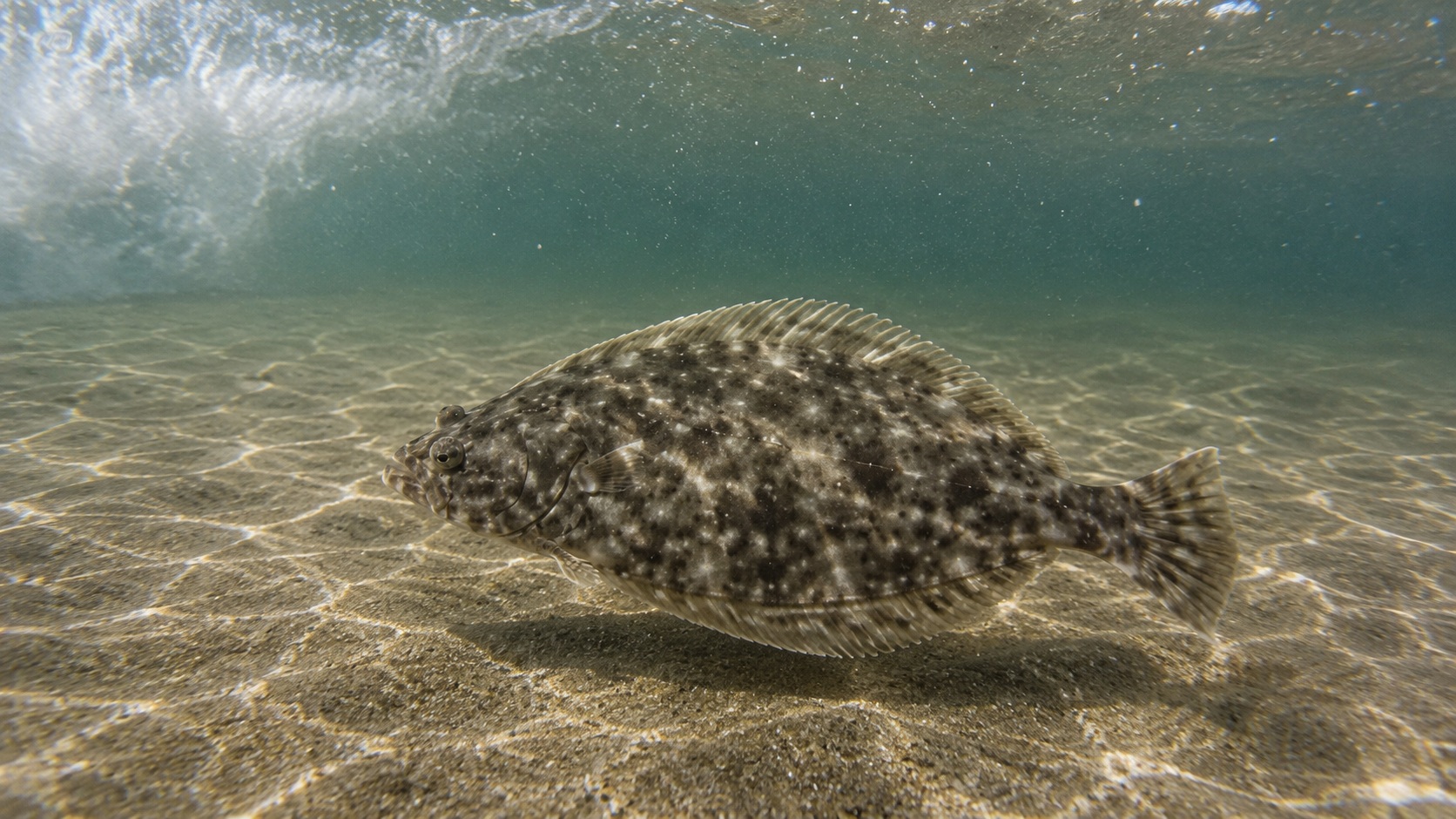
Pick up a flat fish off the bottom near a grass edge, dock piling, or inlet mouth and you almost certainly have a flounder. No other inshore species in coastal waters shares this body plan: both eyes on the same side of the head, a body flat enough to slide under a closed door, and skin that shifts color and pattern to match whatever it is lying on.
Gulf flounder are “left-eyed,” meaning the eyes and the dark topside face left when the tail points away from you. The upper surface ranges from olive-brown to gray and is heavily mottled with pale blotches and three distinctive ocellated spots arranged in a rough triangle near the tail. The underside is white. The mouth is large, turned upward, and lined with sharp teeth built for gripping prey rather than grinding it.
Along the Atlantic coast from the Carolinas north through New England and into the Mid-Atlantic, summer flounder (Paralichthys dentatus) — called “fluke” from New Jersey northward — is the dominant inshore species. Summer flounder are right-eyed and carry five or more distinct eyespots on the upper body compared to the Gulf flounder’s three-spot pattern. Southern flounder (Paralichthys lethostigma), which lack the bold spotting of their relatives, are the primary species across much of the Gulf from Texas through the Carolinas. All three species share the same basic body plan, habitat preferences, and table quality.
Where to find them
Flounder do not wander. They pick a spot with good ambush geometry and wait. That geometry is almost always a transition: the edge where sand meets seagrass, the lip of a channel drop, the base of a jetty rock, the shadow line under a dock, or the seam where tidal current meets slower water. Current concentrates baitfish, and wherever baitfish funnel past a hiding spot, flounder will be there to collect them.
This pattern holds coast to coast, but the specific habitats vary by region.
Gulf Coast (Texas, Louisiana, Mississippi, Alabama, and the Florida panhandle): Shallow bay systems, tidal creek mouths, pass and inlet channels, and the edges of oyster reefs are the prime locations. The bays along the Texas coast — Galveston Bay, Corpus Christi Bay, and the Laguna Madre — are renowned for consistent flounder fishing, particularly during the fall run when fish stage near the passes connecting back bays to the Gulf. Louisiana’s marsh systems offer extraordinary access to fish in shallow, brackish water.
Southeast Atlantic coast (Georgia and the Carolinas): Tidal creek systems with strong current, marsh grass edges, and the rock faces of jetties at major inlets produce reliable catches. The Cape Fear River area in North Carolina and the tidal systems around Beaufort and Morehead City are well-known flounder grounds. Fish are present spring through fall, with the best numbers during the fall staging period.
Mid-Atlantic (Virginia, Maryland, Delaware, and New Jersey): The Chesapeake Bay system is one of the most productive flounder fisheries on the East Coast, holding both summer flounder and a significant fall run. Inlets along the Delmarva Peninsula, the back bays behind the Outer Banks of North Carolina into Virginia, and the nearshore wrecks and reefs of New Jersey all hold good numbers of summer flounder (fluke) during warmer months.
Dock pilings throughout all coastal regions produce year-round fish, particularly on tidal movement. Flounder park in the shadow, pointed into the current, and intercept bait that washes past.
In the surf, sandy troughs parallel to the beach between the shoreline and the outer bar hold flounder when bait is present. This is more of an autumn pattern when summer flounder push into the nearshore zone along the Mid-Atlantic and Northeast.
When to go
Water temperature is the true trigger for flounder activity, regardless of where you fish. Flounder are most aggressive when water temperatures are in the mid-60s to low 70s Fahrenheit. They slow down in water below 55 degrees and become much harder to catch when temperatures fall into the upper 40s. The practical consequence is that optimal timing shifts significantly by latitude — anglers on the Gulf Coast may see good action from early spring through late fall, while those in the Mid-Atlantic and Northeast have a shorter window concentrated from late spring through October.
The best flounder fishing of the year, across nearly every region, is the fall run. As water temperatures drop from summer highs toward the mid-60s, flounder that have been scattered across grass flats and backcountry areas begin moving toward passes and inlets, staging for an offshore spawning migration. This concentrates fish in numbers that simply do not exist at other times of year. On the Gulf Coast, this movement peaks from October through December. Along the Atlantic coast, the fall run arrives earlier — September and October in the Mid-Atlantic and Carolinas — as water temperatures cool faster at higher latitudes.
Spring fishing picks up as waters warm back through the mid-50s and fish return to inshore areas. Summer flounder enter bays and estuaries from the Carolinas northward during warmer months and offer good action through August and September before the fall run consolidates fish near the inlets.
Winter fishing is largely a Gulf Coast phenomenon; in most of the Mid-Atlantic and Northeast, flounder move offshore or into deeper bay channels and become difficult to target effectively until spring.
What to throw
This is the section that matters most. Flounder eat from the bottom, almost never chase bait more than a foot or two up in the water column, and respond best to slow, deliberate presentations. Speed kills your hookup rate.
Live mud minnows (killifish) are the classic flounder bait and still the most effective option available. Rig one on a 1/0 to 2/0 kahle hook with just enough weight to keep it near the bottom: an egg sinker on a fish-finder rig, a knocker rig, or a simple split-shot setup in shallow water. Cast to the edge of grass or structure and let the mud minnow work on a slow retrieve or a very gentle drift. Flounder find the erratic swimming of a struggling killifish irresistible.
Live finger mullet produce large flounder. They are harder to keep lively on the hook but worth the effort when fish over three pounds are the target. Rig through the nose on a circle hook sized to match the bait.
Live shrimp work well, especially around dock pilings and in back-bay grass systems. Hook through the horn on a jig head or a light Carolina rig and bounce it slowly across the bottom near structure.
Soft plastic paddle tails on a jig head are the lure choice. Use a 3 to 4-inch shad-style paddle tail in natural colors (white, chartreuse, or a darker mullet pattern) on a 1/4 oz jig head in water shallower than three feet and a 1/2 oz head in current or deeper water. The technique is a slow, deliberate lift-and-drop: raise the rod tip eight to ten inches, let the bait fall back to the bottom on a semi-tight line, and pause for two full seconds before the next lift. The strike almost always comes on the fall or during the pause. Most missed fish on soft plastics are the result of lifting too quickly and pulling the bait away before the flounder commits.
Cut bait (fresh mullet strips or squid) rigged on a bottom rig is a viable option when live bait is hard to come by and works particularly well for gigging at night in shallow water.
One technique worth mastering is fishing the downcurrent side of structure. Position yourself upcurrent of a dock piling, jetty rock, or grass point, cast beyond and past the structure, and work the bait back through the calm pocket directly behind it. Flounder orient nose-into-current and sit in those low-energy pockets waiting for the current to deliver a meal.
Regulations
Flounder regulations vary significantly by state and have tightened in many areas in recent years as managers work to rebuild population numbers. There is no single set of rules that applies coast to coast.
Gulf Coast states (Texas, Louisiana, Mississippi, Alabama, and Florida) each set their own size and bag limits. Many have implemented minimum size limits in the 12–14 inch range and daily bag limits; several states including Florida have also instituted seasonal closures during peak fall spawning periods to protect staging fish at inlets. Check your state fish and wildlife agency before fishing.
Atlantic coast states from North Carolina through Maine manage summer flounder cooperatively through the Atlantic States Marine Fisheries Commission (ASMFC), and NOAA Fisheries sets federal rules for the summer flounder (fluke) stock in federal waters. Size and bag limits under this management framework can vary by state and change annually based on stock assessments — the rules in effect in New Jersey may differ from those in Virginia or Connecticut. Always verify current season rules with your state marine fisheries agency or the ASMFC before your trip.
As a general note: flounder management has been an active area of regulatory attention in many states. Regulations that were standard a decade ago have been revised in multiple places. Do not rely on memory or word of mouth — verify current rules each season.
Handling and release
Flounder are durable fish by inshore standards. They tolerate brief handling well, but they should be kept wet and horizontal if you are photographing a catch-and-release fish. Grip them firmly across the body just behind the head; the teeth are sharp enough to draw blood, so avoid placing fingers near the mouth. A flounder kept for the table should go directly on ice, as the flesh degrades quickly in warm temperatures. The fillets are sweet, mild, and white with a firm texture that holds up to nearly any cooking method, and they are consistently rated among the best-eating fish in coastal inshore waters.
On the Table
Flounder ranks among the finest eating fish in coastal waters, and anglers who target them almost universally keep their limit. The combination of mild, clean flavor and versatile flesh makes flounder a premier table fish that needs little embellishment.
Taste and texture: Flounder has snow-white flesh with a delicate, mildly sweet flavor that lacks any fishy or gamey quality. The texture is fine-flaked and tender — almost buttery — yet holds together well during cooking. Its low fat content keeps the flavor clean and light, which is why flounder is a go-to for diners who prefer subtlety over richness.
Best preparation methods:
- Pan-frying or sauteing: The thin, flat fillets are ideal for quick, high-heat cooking in butter or oil. A light dusting of seasoned flour creates a golden crust that contrasts beautifully with the silky interior — this is the classic Gulf Coast preparation for a reason.
- Broiling or baking: Whole flounder or skin-on fillets broiled with butter, lemon, and herbs stay moist and let the natural sweetness come forward. The flat body shape makes whole-fish presentation straightforward and impressive.
- Battering and deep-frying: Flounder’s thin fillets cook through quickly in hot oil, producing a light, crispy result. The mild flavor pairs exceptionally well with remoulade or tartar sauce.
- Stuffed flounder: A Gulf and Mid-Atlantic regional specialty — the pocket between the top fillet and backbone is filled with crab, shrimp, or breadcrumb stuffing. The delicate flesh absorbs surrounding flavors without being overwhelmed.
Handling for table quality: Flounder are fragile once out of the water and degrade faster than denser fish. Keep them alive in a livewell as long as possible, then dispatch quickly and transfer immediately to an iced cooler — do not let them bake in the sun on a boat deck. Flounder bruise easily, which can soften the flesh; handle gently. Fillet as soon as possible after icing. The skin peels cleanly and most cooks remove it, though skin-on preparations are fine for broiling. Rinse fillets in cold water and pat dry before cooking.
Eating caveats: Flounder taken from documented closed or restricted harvest areas (common in urbanized estuaries along the Northeast and Mid-Atlantic) may carry contamination advisories — check local health department guidelines before keeping fish from harbors, industrial waterways, or posted areas. No significant mercury or ciguatera concerns apply to flounder at typical catch sizes.