A note about links: If we include links to retail sites like Amazon or Bass Pro Shops, it's because they're relevant to the topic and, as anglers ourselves, we believe they're worth checking out. As an Amazon Associate we earn from qualifying purchases.
What it is
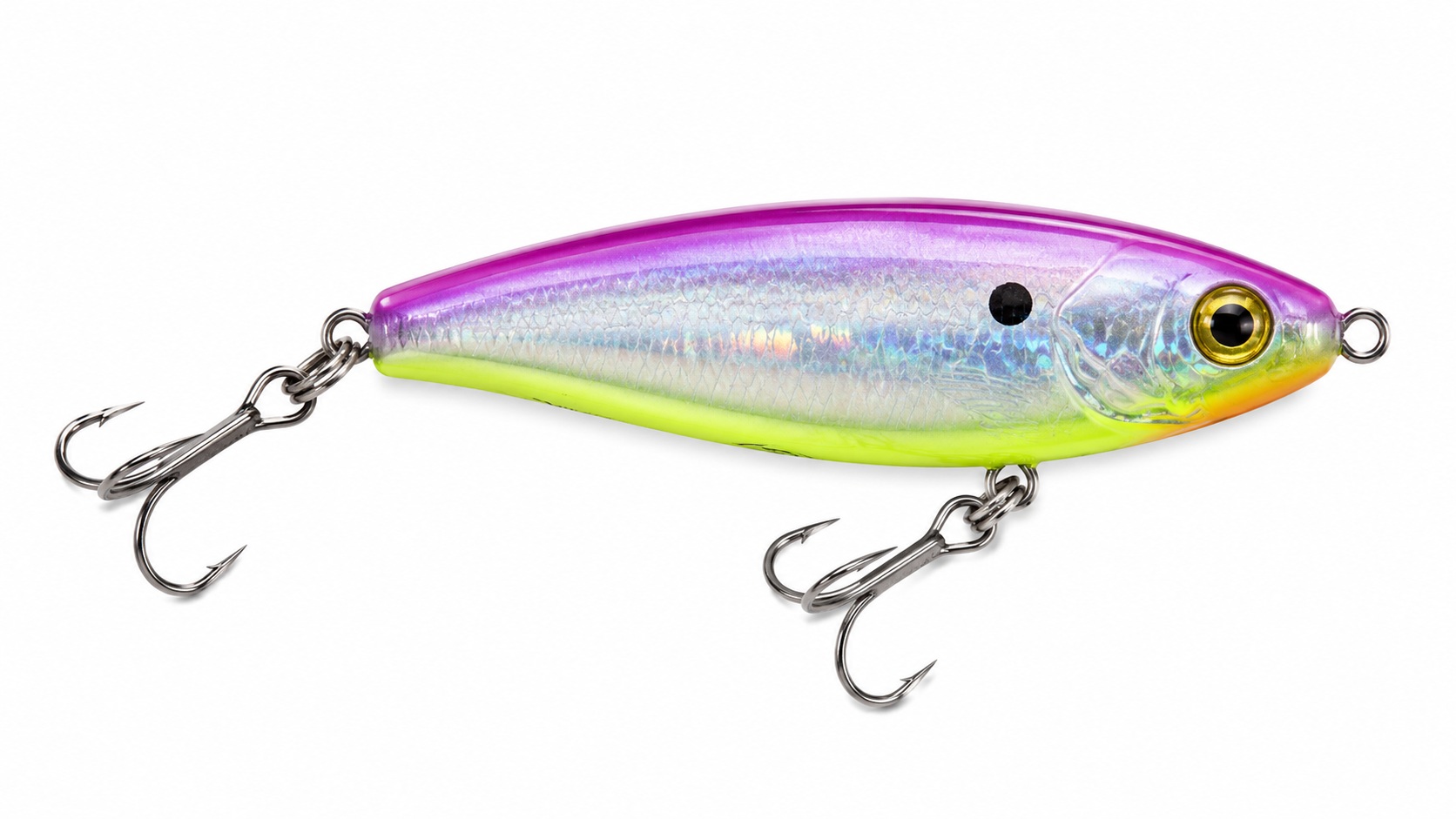
A suspending twitchbait is a hard plastic minnow-style lure built to sit in the water column — neither sinking to the bottom nor floating to the surface — when you pause the retrieve. That pause-and-hold behavior is the whole point. Predatory fish like spotted seatrout and common snook key on baitfish that are struggling, hovering, or dying. A bait that stops and hangs in place after each twitch looks exactly like that.
On inshore saltwater flats, this style of lure has been productive for decades. The clear shallow water over grass beds gives fish a wide sightline, and a slow-moving subsurface bait in the strike zone gets noticed. MirrOlure made their name almost entirely on this concept — their MirrOdine and Lil John models have been the benchmark for Florida inshore fishing since the 1970s.
How it’s rigged
Suspending twitchbaits come out of the package ready to fish. Most are fitted with two or three treble hooks attached to split rings — a front belly hook and a rear tail hook is the standard two-treble configuration. No additional rigging is required.
A few practical notes:
- Upgrade the stock hooks on budget models. Owner ST-36 and VMC 9649 short-shank trebles are the most common replacements — sharper and stronger than factory hardware.
- Split ring pliers make hook swaps much easier and prevent cut fingers.
- For areas with heavy bluefish traffic, a short single-strand wire leader (around 6 inches) prevents cutoffs. Otherwise, fluorocarbon leader material is preferred — it disappears in clear water and has enough abrasion resistance for snook around structure.
How to fish it
The standard presentation is a twitch-twitch-pause. Cast past your target, engage the reel, and give two or three short snaps of the rod tip — just enough to dart the bait forward and flash the sides. Then stop. Let it hang. That pause, usually one to three seconds, is when the vast majority of strikes happen. The bait just sits there, and fish that tracked it during the twitches commit.
A few adjustments worth knowing:
- Slow it down in cold water. When water temperatures drop below 65°F, seatrout become lethargic. Stretch the pause to five or even ten seconds. The bait holds right where the fish are sitting and they will eventually eat it.
- Speed it up for spanish mackerel and bluefish. Both species are aggressive and respond better to a faster cadence — shorter pauses and quicker twitches.
- Work dock lights at night. The hard plastic body catches ambient light effectively, and both snook and seatrout stage under lights after dark. Use a slow, nearly deadstick retrieve with minimal twitching.
- Target grass edges, channel cuts, and points where current moves bait. Cast upcurrent and work the lure through the seam.
When to use it
Suspending twitchbaits perform best in clear to lightly stained water where the fish can see them from a distance. Murky water or heavy chop reduces their effectiveness — at that point a paddletail swimbait or chartreuse-skirted jig does a better job because it produces vibration and scent.
Some key windows:
- Winter and early spring: The most productive time of year for seatrout on suspending twitchbaits. Cold water concentrates fish on warm, shallow grass flats and in deep holes alongside them. A slow twitch-pause retrieve worked over these areas is hard to beat.
- Fall: As water cools and baitfish schools compress, seatrout and redfish push onto flats in numbers. The twitchbait covers water efficiently and locates fish.
- Early morning summer: Before the sun climbs and heats shallow flats, fish are actively feeding. Get there early, work grass edges, and expect strikes during the first two hours of light.
Color and size selection
Match color to water clarity and light conditions:
| Condition | Color |
|---|---|
| Clear water, bright sun | Bone, silver/white, natural mullet |
| Overcast or low light | Chartreuse/white, gold, pink/white |
| Stained water | Chartreuse, firetiger |
| Night / dock lights | Black/purple, dark olive |
Size selection by target species:
| Bait size | Best for |
|---|---|
| 3–3.5 inch (1/4–3/8 oz) | Seatrout, finesse snook, redfish |
| 4–4.5 inch (1/2–5/8 oz) | All-around inshore; snook, larger trout |
| 5 inch and up (3/4 oz+) | Nearshore spanish mackerel, larger snook |
Gear setup
Standard inshore twitchbait gear is not heavy. A moderate-action spinning rod in the 7-foot range handles the casting weight and still loads well on the hookset. Pairing with a 2500–3000 size reel is ideal.
Line: 10–20 lb braided mainline with a fluorocarbon leader is the most common setup for clear inshore water. Use a 20–30 lb fluorocarbon leader in 18–24 inch length, connected to the braid via a double uni or Alberto knot. The fluorocarbon disappears in clear water and handles the abrasion of snook around dock pilings and oyster bars.
Avoid mono as a mainline — it stretches too much to feel the subtle twitchbait action and delays hooksets at distance.
Brands worth knowing
MirrOlure is the starting point for Florida inshore. The MirrOdine (also sold as the 17MR) and the Lil John are the two models most consistently mentioned by guides working the Space Coast, Tampa Bay, and Charlotte Harbor. The 52MR is a slightly heavier sinking version with a long track record on seatrout. The TT series (Suspending) offers tight action at slow speeds — effective when fish are sluggish.
Rapala X-Rap is a strong freshwater crossover that performs in brackish and nearshore environments. The aggressive rattle and durable hardware make it a solid choice around bluefish and spanish mackerel.
Yo-Zuri Crystal Minnow is made for saltwater and has outstanding hardware out of the box. The holographic finish catches light well in clear conditions.
Bomber Long A is an older design with a proven reputation in the Gulf Coast surf and inshore pass fishing. Heavier than most twitchbaits in its size class — casts well in wind.