A note about links: If we include links to retail sites like Amazon or Bass Pro Shops, it's because they're relevant to the topic and, as anglers ourselves, we believe they're worth checking out. As an Amazon Associate we earn from qualifying purchases.
Few fish will straighten you out on a light spinning rod faster than a Spanish mackerel. They show up in dense, frenzied schools that blow bait to the surface, birds pile on overhead, and if you get a cast into the melee, the hit is instant and the first run is all razor wire and speed. They are accessible from the beach, a kayak, or a center console, they eat readily on simple lures, and a cooler of fresh Spaniards is one of the better reasons to get on the water before sunrise. From the spring blitzes off the Outer Banks and Chesapeake Bay to the fall runs along the Gulf Coast, Spanish mackerel deliver some of the most fast-paced nearshore action available anywhere on the Atlantic seaboard.
How to identify one
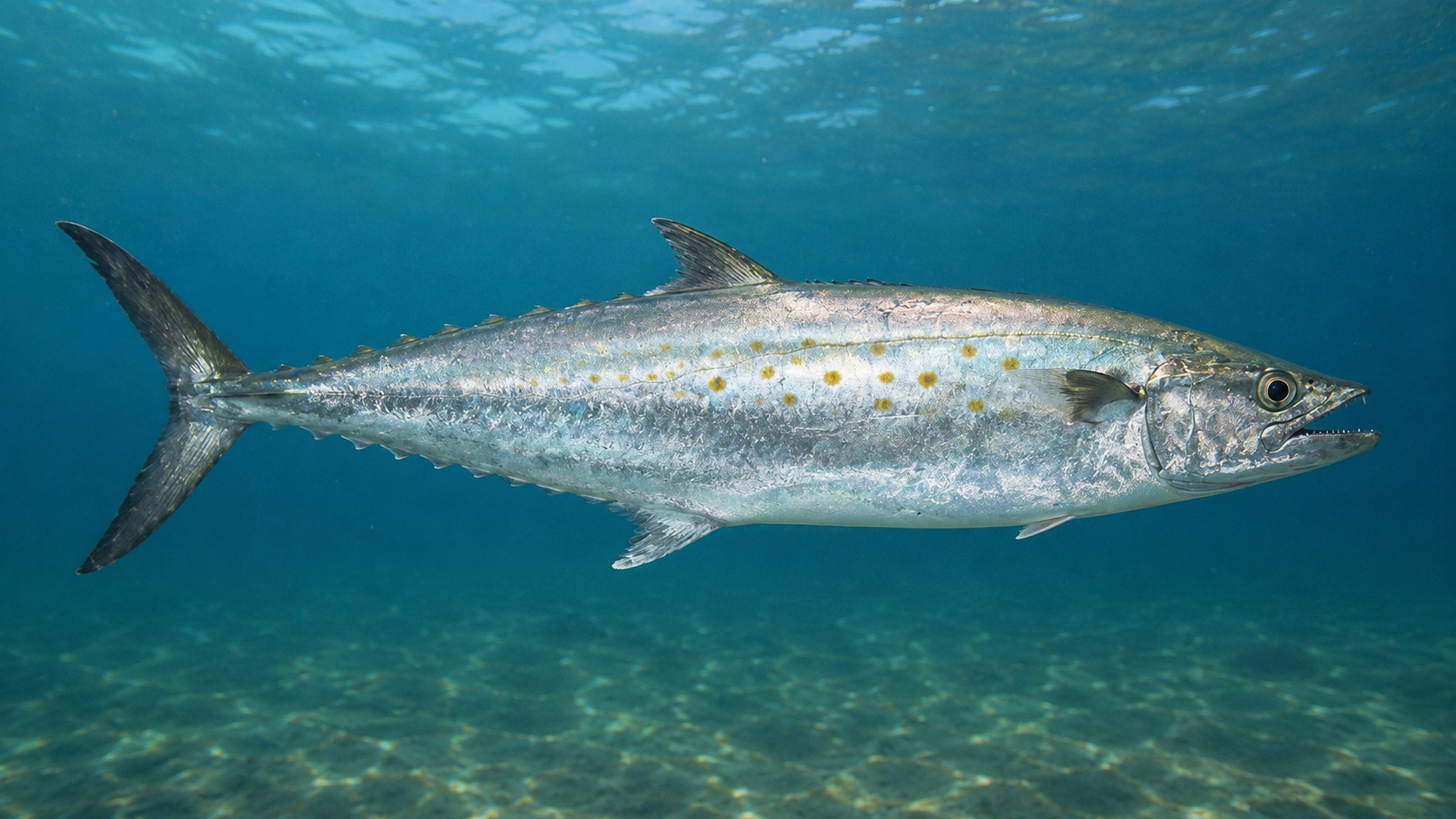
Spanish mackerel are built like torpedoes: streamlined, fork-tailed, and clearly designed to go fast. The back is blue-green fading to bright silver on the flanks, with three irregular rows of large, oval bronze-gold spots running from behind the pectoral fin to the tail. Those spots are the key field mark. The first dorsal fin is dark blue-black at the front, fading to white at the rear, and the two dorsal fins sit close together. The teeth are small but extremely sharp triangles, evenly spaced.
The most likely lookalike is king mackerel. Kings lack the yellow-gold spots entirely and grow much larger, typically starting where big Spanish leave off. Cero mackerel, found more commonly in South Florida and the Keys, do have spots but also show a bronze stripe running the length of the body that Spanish mackerel do not have. If you are holding a 2-pound fish with gold spots and no lateral stripe, it is almost certainly a Spaniard.
Where to find them
Spanish mackerel range the entire Atlantic coast from Nova Scotia to the Yucatan, following two distinct migratory populations. The Atlantic population winters in South Florida and the Keys, then pushes north in spring, reaching the Carolinas, the Chesapeake Bay, and the mid-Atlantic coast by late spring and early summer before retreating south again in fall. The Gulf population follows a parallel pattern, moving along the Gulf Coast from wintering grounds in South Florida and the Yucatan toward Alabama, Mississippi, Louisiana, and Texas as waters warm.
Along the mid-Atlantic coast, some of the best-known concentrations occur around Cape Hatteras and the Outer Banks of North Carolina — the world-record fish came from Ocracoke Inlet — as well as in the lower Chesapeake Bay, near the Virginia Beach oceanfront, and off the Delaware and Maryland coasts. In the Southeast, inlets, jetties, beach troughs, and nearshore reefs from the South Carolina coast through Georgia and into northeast Florida hold fish reliably during the spring push. Along the Gulf Coast, passes and inlets, nearshore structure in 10 to 30 feet of water, and areas with strong baitfish concentrations draw Spanish mackerel throughout the warmer months.
Wherever you fish for them, the search pattern is similar: look for birds diving, surface commotion, and the telltale silver flashes of a feeding school pushing bait. Schools are often visible and can be run down with a quick cast or a trolling pass. Nearshore reefs, ledges, inlet mouths, and color changes a few miles offshore are consistent producers coast to coast.
When to go
Spring and fall are the two peak windows, though the exact timing shifts significantly by latitude. Water temperature is the trigger: Spanish mackerel become active and begin moving as water climbs through the mid-60s°F, and fishing heats up as temperatures approach and exceed 68°F. In the Gulf states and South Atlantic, that can happen as early as February or March. In the mid-Atlantic — the Chesapeake, the Carolinas — the spring run typically peaks from April through June. The fall migration reverses the pattern; as water cools below 68°F, fish move south, and the fall run progresses from the mid-Atlantic southward through October and November.
Within any given day, first light and the last two hours before dark are most productive. Moving tides pull baitfish into the water column and trigger feeding. Overcast days often keep fish feeding longer into the morning than bright, flat-calm days.
What to throw
Silver spoons are the foundation of Spanish mackerel fishing. A half-ounce Clark or Drone spoon on a 20-pound fluorocarbon leader behind a small inline planer covers water fast and finds fish efficiently when trolled at 5 to 7 knots. Gold spoons outperform silver in low-light and overcast conditions.
Gotcha lures and metal jigs in the half-ounce to one-ounce range are go-to casting options when fish are on top. Cast past the breaking school, let the lure sink a second, and retrieve fast. Spanish mackerel can match nearly any retrieve speed, so the faster the better when fish are in a frenzy.
DOA CAL shads in 3-inch paddle-tail versions do exceptional work when fish are keyed in on glass minnows or small sardines. Match the hatch with a white or chartreuse paddle tail on a 1/4-ounce jighead, and vary the retrieve between fast and stop-and-go until they commit.
Live bait accounts for some of the biggest fish in the school. A free-lined pilchard, scaled sardine, or finger mullet under a light spinning rod with no weight needs no extra convincing.
Wire leader is the standard for Spanish mackerel. A 4- to 6-inch section of 20-pound single-strand wire or a small length of 30-pound titanium connected to a barrel swivel above the lure will save you from the constant bite-offs that come with a bare fluorocarbon connection. In very clear water, scale back the wire to a small trace of 4 inches at the hook end only, and extend your fluorocarbon leader to 18 to 24 inches. You will get more strikes. When fish are less leader-shy, go straight to 30-pound fluorocarbon for maximum action.
Regulations
Spanish mackerel are managed at the federal level by NOAA Fisheries under the Fishery Management Plan for Coastal Migratory Pelagic Resources, which covers both the Atlantic and Gulf migratory groups. State regulations apply in state waters and vary by state; federal regulations apply beyond the 3-mile limit (9 miles off Florida and Texas).
As a general reference, federal recreational regulations for the Atlantic group have historically included a minimum size (fork length) and a daily bag limit per angler, but these details are subject to change. State rules may differ from federal minimums. Always verify current regulations before you fish by checking your state fish and wildlife agency and NOAA Fisheries at fisheries.noaa.gov. The Atlantic States Marine Fisheries Commission (ASMFC) also tracks the Atlantic population and publishes current management information at asmfc.org.
Handling and release
Spanish mackerel are exceptional table fish, but only if handled correctly from the moment they come aboard. Bleed them immediately by cutting the throat right behind the gills, then place the fish in an ice slurry rather than dry ice or ice alone. Warm, unbled mackerel go soft and develop a strong flavor within an hour. Cold, bled fish filleted the same day are a completely different product: firm white meat with a mild, clean taste that holds up well grilled, blackened, or smoked.
For catch and release, Spanish mackerel are hardy and recover well when not kept out of water unnecessarily. Wet your hands before handling, support the fish horizontally, and return it headfirst into the current. Avoid squeezing or dropping fish on a hard deck surface. Most Spaniards show zero hesitation on release.
On the Table
Spanish mackerel are a solid table fish that many coastal anglers keep specifically for eating, though their rich, oily flesh is a love-it-or-leave-it proposition — those who know how to handle them rate them highly, while anglers who neglect the cooler often dismiss them unfairly.
Taste and texture: Spanish mackerel have a moderately rich, full flavor with a slight sweetness that sets them apart from stronger pelagics like king mackerel. The flesh is light pink to tan, firm yet flaky, with a higher oil content than mild white-fleshed species. That oil is the key to their flavor: it carries the taste well under high heat and makes them excellent candidates for bold seasonings and smoke.
Best preparation methods:
- Grilling or broiling: The natural oil content keeps fillets moist over direct high heat, where a light char complements the savory flesh. A simple rub of olive oil, garlic, and citrus zest is all they need.
- Blackening: Spanish mackerel’s firm texture and oily flesh stand up perfectly to the intense heat of a cast iron skillet and a heavy Cajun spice crust. This is one of the most popular preparations along the Gulf Coast for good reason.
- Smoking: High fat content makes this species ideal for a hot smoke. The flesh absorbs smoke flavor readily and stays moist throughout the process; smoked Spanish mackerel dip is a regional staple across the Gulf and South Atlantic coasts.
- Ceviche or crudo: Very fresh fish can be used raw or cured in citrus. The firm texture holds up well, and the clean brininess of fresh Spanish mackerel works nicely in acid-based preparations.
Handling for table quality: Spanish mackerel are among the most handling-sensitive fish in inshore saltwater. The oily flesh degrades quickly when the fish is left to die in a livewell or on a stringer. Best practice: bleed the fish immediately at the gill arch as soon as it is landed, then place it on ice. Fillets should be skinned — the dark lateral bloodline runs strong and contributes most of the gamey flavor; remove it with a shallow V-cut along the centerline of each fillet. Eat within 24-48 hours for best quality; the flesh does not freeze as cleanly as leaner species.
Mercury note: Spanish mackerel carry moderate mercury levels — lower than king mackerel but higher than inshore species like flounder or trout. The FDA and EPA recommend that pregnant women and young children limit consumption. For healthy adults, occasional meals pose no practical concern, but regular daily consumption is not advised.