A note about links: If we include links to retail sites like Amazon or Bass Pro Shops, it's because they're relevant to the topic and, as anglers ourselves, we believe they're worth checking out. As an Amazon Associate we earn from qualifying purchases.
There is a moment that converts casual saltwater anglers into devoted kingfish hunters: the line that was sitting still a breath ago screams off the reel at a speed you were not ready for, and a chrome missile launches clear of the surface 40 yards behind the boat. King mackerel do not ease into the strike. They attack, and that aggression is what fills tournament weigh-in docks from the Outer Banks to the Texas Gulf Coast each year. Whether you are watching the fall migration stack fish on nearshore ledges off North Carolina’s Cape Hatteras, working wrecks in the northern Gulf off Alabama and Louisiana, or chasing schoolies along the Atlantic seaboard in summer, kings are large enough to test your tackle, fast enough to humble your drag, and just common enough in range-wide coastal waters to reward anglers who learn the patterns.
How to identify one
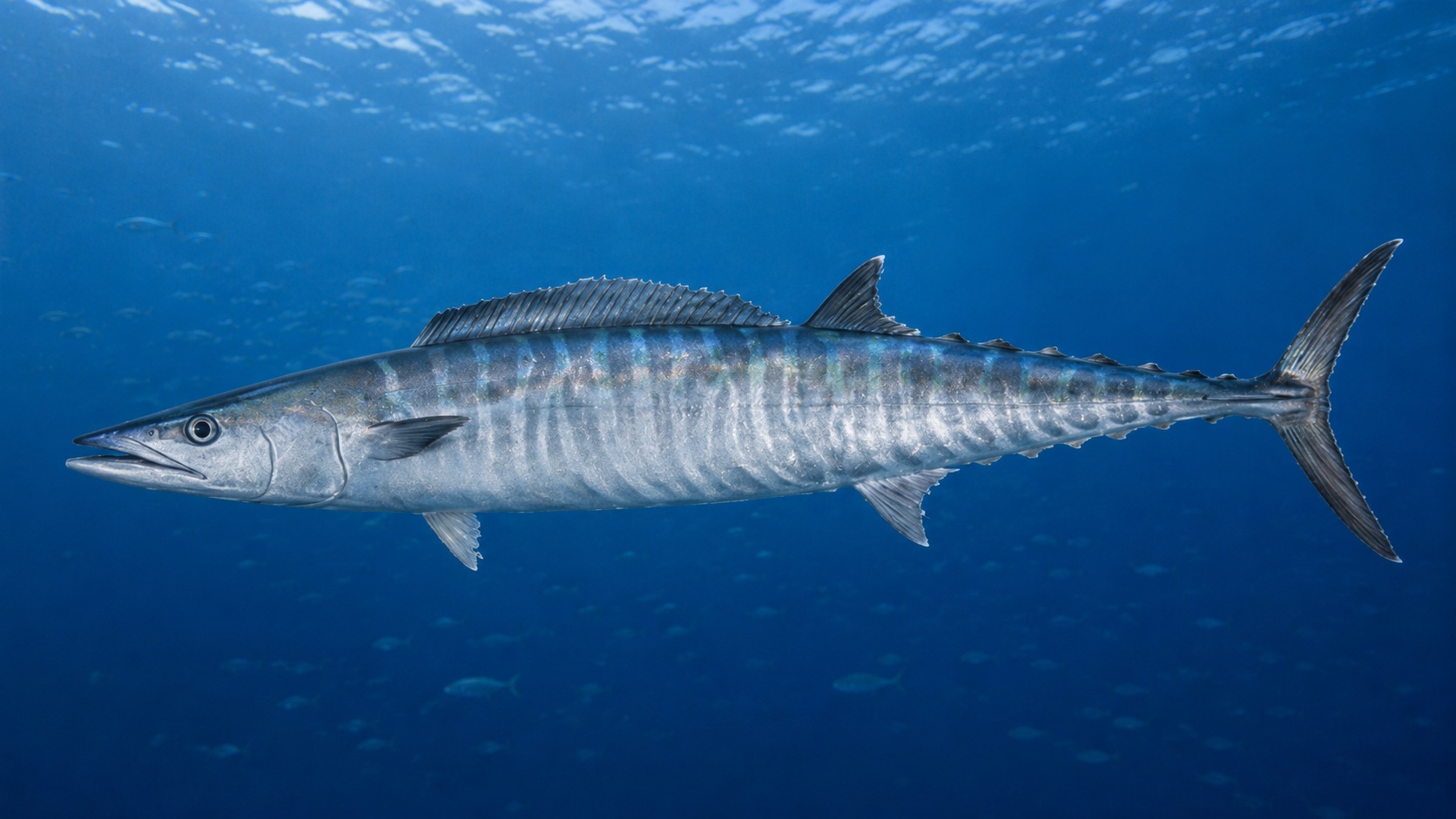
King mackerel are long, slender, and built like a torpedo. The body is silver-blue along the back, fading to silver-white on the sides and belly, with no spots on juveniles and a distinctive sharp lateral line that dips abruptly downward at mid-body. The first dorsal fin is dark at the front and clear toward the rear. The most reliable field mark is the teeth: large, flat, knife-sharp, and set in a lower jaw that closes with enough force to cut clean through monofilament. Smaller kings under 10 pounds are sometimes confused with Spanish mackerel (Scomberomorus maculatus), but Spanish mack carries bronze-gold spots along its sides that king mackerel lack. The lateral line dip on kings is also sharper and more pronounced than on Spanish mack. Any fish with an unspotted side, a hard lateral-line drop, and teeth that look like they belong in a horror film is almost certainly a king.
Where to find them
King mackerel are coastal pelagic fish, spending their lives in open water near the surface rather than hugging the bottom. They range from Massachusetts to Brazil but concentrate along the US Atlantic coast and Gulf from spring through fall, preferring water temperatures above 68 degrees Fahrenheit. Kings are drawn to temperature breaks, color changes, and any edge where currents concentrate bait — nearshore reefs, live-bottom ledges, wrecks, and artificial reef complexes are the most reliable producers throughout the range.
On the Atlantic coast, Cape Hatteras and the Outer Banks of North Carolina are one of the most celebrated kingfish destinations in the country. The combination of the Gulf Stream’s warm edge and bait-rich nearshore structure draws both migrating fish and large resident smoker kings throughout the season. The entire North Carolina coast, from Morehead City south to Wrightsville Beach, sees consistent action. South Carolina and Georgia anglers find kings working wrecks and reefs in 30 to 100 feet of water from spring through fall, and South Florida’s Atlantic reefs serve as winter staging grounds where both Atlantic and Gulf stocks overlap.
In the Gulf of Mexico, Alabama’s artificial reef program has made Gulf Shores and Orange Beach a hub for king mackerel fishing, with a dense network of wrecks and reefs holding fish from spring through late fall. Mississippi, Louisiana, and Texas all host robust Gulf populations, with kings following bait migrations along the coast and staging over offshore structure. The northern Gulf’s king mackerel tournament circuit — stretching from Pensacola to Corpus Christi — is one of the most competitive in the country.
Larger fish, sometimes called smoker kings, often hold over deep wrecks in 90 to 140 feet while smaller schoolies patrol shallower nearshore reefs at 20 to 50 feet. During the winter months, Atlantic and Gulf stocks converge off South Florida and the Keys.
When to go
King mackerel timing shifts significantly by latitude — fish arrive earlier in the southern part of the range and later in the north, with water temperature being the primary trigger. Kings become consistently active once surface temperatures climb above 68 degrees Fahrenheit and tend to peak in the 72 to 82 degree range.
Along the Atlantic coast, the spring run moves northward as water warms, typically reaching the Carolinas by March or April and pushing into mid-Atlantic waters by late spring. The fall migration is often the most exciting window: as water temperatures cool through September and October, fish that spent the summer farther north stage up and begin moving south. Off Cape Hatteras and the Outer Banks, October and November can produce some of the heaviest concentrations of the year as migrating fish pile up on nearshore structure while following bait schools southward.
In the Gulf of Mexico, action picks up from March through May as fish spread out across nearshore reefs and wrecks, with a second peak in fall. Summer can be productive at depth over offshore structure, especially for larger fish. Dawn and dusk bites tend to be sharpest regardless of region, but actively feeding migrating fish can be found throughout the day around structure that holds bait.
What to throw
Wire leader is not optional. King mackerel teeth cut monofilament and fluorocarbon in a single swipe. Use No. 5 single-strand wire, 12 to 18 inches in length, connected to your main line via a quality ball-bearing swivel using a haywire twist. In very clear water, some anglers run 40-pound fluorocarbon leader with only a short 6-inch wire bite tippet near the hooks, joined with an Albright knot.
Live bait on a stinger rig is the most productive overall approach. Rig a 5/0 J-hook through the nose of the bait, then trail a 4X treble stinger hook back toward the dorsal fin or just behind it on a short dropper of wire. King mackerel attack the rear half of bait fish, and the trailing hook converts slashes into landed fish. Blue runners, menhaden (pogies), threadfin herring, and cigar minnows are the top live bait choices. Slow-troll these rigs at 1.5 to 3 knots across reefs and over structure, staggering lines at 30, 60, and 100 feet behind the boat to cover the water column. Keep bait lively: a dying bait draws far fewer strikes.
Trolling spoons and diving plugs cover ground efficiently when scouting for schooling fish. A Clark Spoon in silver or gold behind a trolling sinker or planer is a proven producer at 5 to 7 knots. Drone spoons and large Rapala X-Rap plugs in sardine or mullet patterns also work well. When kings are schooled and blitzing bait on the surface, metal jigs cast into the melee and retrieved fast at the surface produce explosive strikes. Speeds and depths matter: jig erratically, pause briefly, and stay near the upper third of the water column.
Bump trolling is worth knowing. Idle the engine in and out of gear while pulling live bait in a staggered spread. The start-stop motion makes bait act erratically, which triggers strikes from fish that ignore a steady troll. This technique shines over wrecks and tight structure.
Drag settings deserve attention. King mackerel have relatively small mouths for their body size, and hooks pull easily under heavy pressure. Keep drag pressure under 5 to 8 pounds during the initial run, then increase gradually once the fish turns.
Regulations
King mackerel are federally managed as a Highly Migratory Species (HMS) by NOAA Fisheries. Because they cross state and federal waters throughout their migratory range, regulations are set at the federal level and administered through the Gulf of Mexico Fishery Management Council and the South Atlantic Fishery Management Council, with individual states enforcing rules in their respective state waters.
Minimum size limits and bag limits vary by zone (Atlantic vs. Gulf) and by whether you are fishing in state or federal waters. Rules can also change mid-season when quotas are reached. Always check current regulations with NOAA Fisheries’ Atlantic HMS program and your state fish and wildlife agency before fishing. Key resources:
- NOAA HMS regulations: fisheries.noaa.gov/atlantic-highly-migratory-species
- Gulf states (Texas, Louisiana, Mississippi, Alabama, Florida Gulf): check your state agency and NOAA Gulf HMS rules
- Atlantic states (Florida Atlantic, Georgia, South Carolina, North Carolina): check your state agency and NOAA Atlantic HMS rules
Fork length is the standard measurement: tip of the lower jaw to the center of the tail fork, not the tip of the tail.
Handling and release
King mackerel thrash violently at boatside and can inflict serious lacerations with their teeth. Use a long-handled dehooker or jaw spreader to manage the fish, and keep hands away from the mouth. For fish you are releasing, minimize air exposure: keep the fish in the water as much as possible, support the body horizontally, and revive the fish at the surface by moving it forward and back to push water across the gills before releasing. Most kings caught on a stinger rig are hooked in the corner of the mouth and release well.
For fish destined for the table, bleed them immediately after landing by cutting the artery behind the gills, then ice them hard. King mackerel is a dark, oily, high-flavor fish with a thick bloodline running along each fillet. The reputation for being “fishy” comes almost entirely from poor handling. Bled, iced, and filleted same-day, with the dark lateral meat trimmed away, king mackerel is excellent as fish steaks on the grill, smoked, or made into croquettes. The flesh does not freeze particularly well, so fresh preparation is always the better option.
On the Table
King mackerel is edible, but its table reputation is genuinely divided — fresh, smaller fish handled well are worth eating, while large or poorly iced fish will disappoint. Opinions among anglers run from enthusiastic to dismissive, and the spread reflects real variation in quality depending on size, handling, and preparation.
Taste and texture: The flesh is dark-tinged, oily, and rich with a bold, pronounced flavor that sits closer to the “fishy” end of the spectrum compared to mild inshore species. A prominent dark red bloodline runs along the lateral midline of each fillet and carries the strongest flavor. Texture is firm and moist when fresh, with a moderately coarse flake.
Best preparation methods:
- Smoking — The most popular approach, especially for larger fish (10 lbs and up). The high oil content keeps the flesh moist under low heat, and smoking mellows the bold flavor. Mild woods such as apple, cherry, or alder work well; avoid hickory or oak, which can overpower the fish.
- Grilling — Works best for smaller kings (under 10 lbs). Score the skin, oil generously, and use high direct heat to char the outside quickly. The firm texture holds up well on grates without falling apart.
- Blackening — A cast-iron skillet with a heavy blackening rub (paprika, cayenne, garlic, thyme) complements the oily flesh and masks any residual strong notes. A go-to technique across Gulf Coast kitchens.
- Fish cakes and croquettes — Flaked cooked or smoked king mackerel mixed with binder and pan-fried is a traditional preparation that stretches the fish and softens the intensity of the raw flavor.
Handling for table quality: King mackerel degrades fast at ambient temperature. Bleed the fish immediately at the gills after landing and get it on ice as soon as possible — quality drops sharply within an hour if left in the sun. When filleting, remove the dark bloodline by making shallow cuts on each side and pulling it free; this single step does more for flavor than any marinade. Soaking fillets in ice water or milk for 30-60 minutes in the refrigerator before cooking further tames the oiliness.
Mercury warning: King mackerel carries some of the highest methylmercury levels of any commercially or recreationally caught fish. The FDA explicitly advises pregnant women, women who may become pregnant, nursing mothers, and children to avoid king mackerel entirely. Larger, older fish accumulate the most mercury. All other consumers should eat it sparingly and infrequently. This mercury concern is the primary reason many anglers practice catch-and-release on this species despite its edibility.