A note about links: If we include links to retail sites like Amazon or Bass Pro Shops, it's because they're relevant to the topic and, as anglers ourselves, we believe they're worth checking out. As an Amazon Associate we earn from qualifying purchases.
What it is
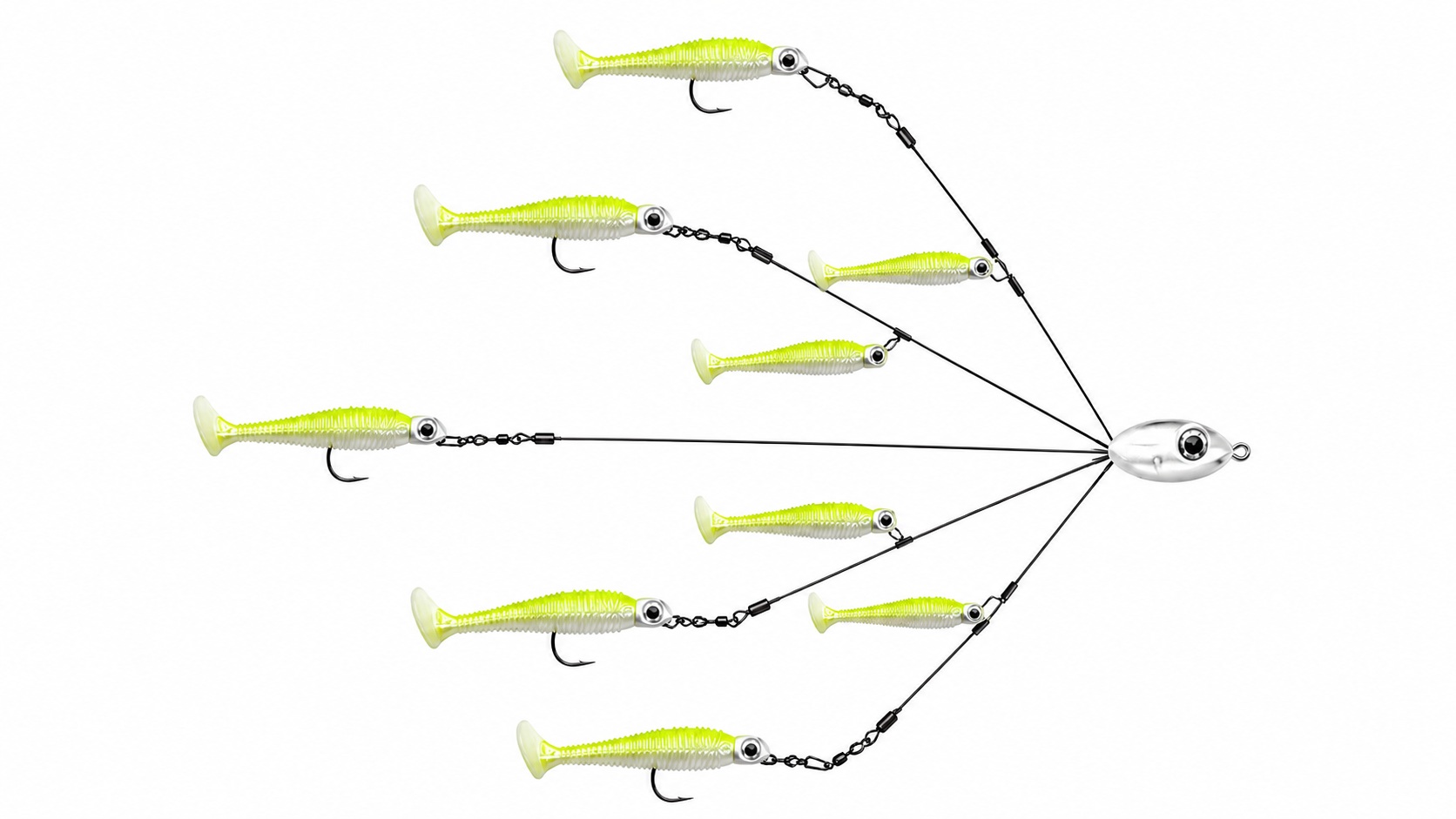
The umbrella rig — better known as the Alabama rig or A-rig — does something no single lure can do on its own: it puts a school of baitfish in the water with one cast. A central wire frame branches into three to five arms, and each arm carries a paddletail swimbait. When you retrieve it, what the fish sees is a loose group of shad moving together, not a single bait. That difference is enormous.
The rig was invented by Andy Poss out of Walker, Alabama, and its debut on the tournament bass circuit in 2011 was disruptive enough that Bass Anglers Sportsman Society (B.A.S.S.) and most major tournament organizations quickly moved to limit it. The original design ran five arms with five swimbaits — a full school. The tournament-legal standard today is three arms carrying three swimbaits (sometimes three hooks total, sometimes three baited and two unbaited trailers, depending on jurisdiction). Check local rules before competing; several states restrict total hook count regardless of tournament affiliation.
The logic behind why it works comes down to competition. A largemouth bass that might ignore a single swimbait will attack the umbrella rig because it perceives multiple fish eating — and the instinct to compete for food overrides hesitation. You are manufacturing urgency.
The setup
Components:
- Umbrella rig frame (3- or 5-arm wire; 3-arm for tournament compliance)
- 3/4 oz to 1.5 oz weighted central head (usually comes with the frame)
- Three paddletail swimbaits: 3.5 to 5 inch, matching local shad size
- Swimbait hooks or jig heads: 1/8 to 1/4 oz per arm (lighter heads let baits flutter)
- Heavy monofilament or fluorocarbon leaders on each arm (usually pre-rigged on quality frames)
Assembly:
- Attach the frame to your mainline directly — most quality frames have a line tie welded to the central head. Use a Palomar or loop knot.
- Slide a jig head or swimbait hook onto the arm snap or loop at each wire tip.
- Thread a paddletail swimbait onto each jig head. Keep the hooks weedless if you are fishing around grass; use exposed hooks over clean bottom.
- On 5-arm rigs where tournaments allow only 3 hooks, rig 2 of the outer arms with hook-free soft plastics. Those baits still add to the visual school effect without adding prohibited hooks.
Trailer choice matters: Match the hatch as closely as possible. A natural shad color — pearl white, silver, or gizzard shad gray — on a 3.5 to 4 inch paddletail is the standard starting point. In stained water, move toward chartreuse or white. In clear water, go natural and size down to 3 inches.
How to fish it
The foundational retrieve is a slow roll at mid-depth. Cast past your target, count down until the rig reaches the desired depth (15 to 25 feet over main-lake structure is the typical zone), then retrieve with a steady, medium-slow cadence. The goal is to keep all three baits swimming evenly at the same depth plane — that is what makes the school illusion convincing.
Vary your depth: The A-rig does not have to fish deep. In fall when bass are blowing up on shad near the surface, cast it to the commotion and burn it back just below the surface. The same rig that crawls through 20 feet of water in January can be retrieved fast over the tops of grass flats in October.
Rod tip down: Keep the rod tip low during the retrieve to maintain depth control and maximize feel. If the tip is high, the rig rises toward the surface. A low tip also helps absorb the significant resistance this rig creates on the retrieve.
Strikes: Because the rig is heavy and there is already resistance during the retrieve, bass often hook themselves. Most missed fish happen when an angler sets the hook too soon on feel. Wait until the rod loads and then sweep — a straight-back hookset with a heavy rod is more effective than a sharp snap.
When to use it
Fall schooling season is the primary window. When largemouth bass and striped bass are actively herding shad schools against banks, points, or over open water, the umbrella rig matches the situation perfectly. Multiple baits moving together at the same speed as a real school is about as accurate an imitation as you can present.
Winter deep structure is the second major application. Bass that have pushed to 18 to 25 feet over main-lake humps and channel bends are often grouped tightly and less willing to chase. A slow-rolled umbrella rig gives them multiple targets at once and can draw fish that would never fire on a single presentation.
Saltwater applications: Northeast striper anglers have fished multi-shad wire rigs for decades — the concept predates the Alabama rig in saltwater. Trolled or cast near rock piles and along current edges, these rigs produce striped bass in the same way: schooling instinct. The rig also scales up for king mackerel trolling along the Southeast and Gulf coasts.
Gear setup
This rig is heavy, creates significant drag in the water, and puts stress on tackle that would bend or break lighter gear. There is no light-tackle version of a properly fished umbrella rig.
Rod: 7’6” to 8’ heavy power, moderate-fast action. The extra length helps with the sweep hookset and provides leverage when the rig is deep. A glass or composite heavy-power rod with some flex handles the rig’s in-water resistance better than a tip-heavy fast-action stick.
Line: 50 lb braided mainline is the standard choice. Braid’s zero stretch transmits feel through the heavy rig and handles the load at depth. If you prefer monofilament, 20 lb fluorocarbon is the minimum — lighter line will fatigue on repeated long casts with this much weight.
Reel: A large-capacity baitcasting reel (size 300 or equivalent) with a strong drag and a 6.3:1 or 7.1:1 retrieve ratio. The faster retrieve helps pick up line quickly when a fish turns toward you. Spinning reels are not well suited to the A-rig’s weight on baitcasting-style rods; some anglers use large saltwater spinning gear, but most stick with baitcasting.
Tip: A swivel snap at the line tie allows quick frame swaps without retying. Given how taxing repeated casts are on the connection, a quality heavy-duty snap also protects the knot.
Brands worth knowing
Andy Poss (A.R.C. / original designer) — the origin point. His frames and subsequent collaborations set the template for what the rig is today.
Strike King produces widely available tournament-legal 3-arm frames with consistent wire gauge and arm spacing, paired well with their Rage Swimmer paddletails.
Booyah makes durable, budget-accessible frames that hold up to repeated hard casts. A good entry point if you want to try the rig before committing to premium hardware.
Greenfish Tackle is a smaller, specialty producer favored by guides and tournament anglers who want customizable arm length, head weight, and wire stiffness. Their frames are notably popular in the striper fishery along the Northeast coast.
Match any frame with a quality paddletail swimbait that swims correctly at slow speeds — if the tail kicks lazily on a slow retrieve, you have the right bait. If it requires speed to activate, it is too stiff for the slow-roll approach that defines this rig.