A note about links: If we include links to retail sites like Amazon or Bass Pro Shops, it's because they're relevant to the topic and, as anglers ourselves, we believe they're worth checking out. As an Amazon Associate we earn from qualifying purchases.
The largemouth bass is the fish that turned a lot of people into anglers, and for good reason. It is found in every state. It hits hard. It jumps. It lives in places almost anyone can reach: a farm pond, a city reservoir, a slow river bend with a fallen tree in it. You do not need a boat or a guide to catch largemouth bass. You need to understand where they sit and why.
That is what makes bass fishing genuinely compelling. These are patternable fish in patternable locations. Once you learn to read a shoreline and predict where a bass should be, and then you put your bait there and it gets crushed, the puzzle aspect of the sport clicks into place. The largemouth is the fish that teaches you how to fish.
It also drives the largest tournament circuit in freshwater sport. The Bassmaster Elite Series and Major League Fishing run events February through October on reservoirs from one end of the country to the other — Sam Rayburn in Texas, Guntersville in Alabama, Table Rock in Missouri, Lake Oroville in California, the St. Lawrence River in New York. The same fish, the same principles, on radically different water.
How to identify one
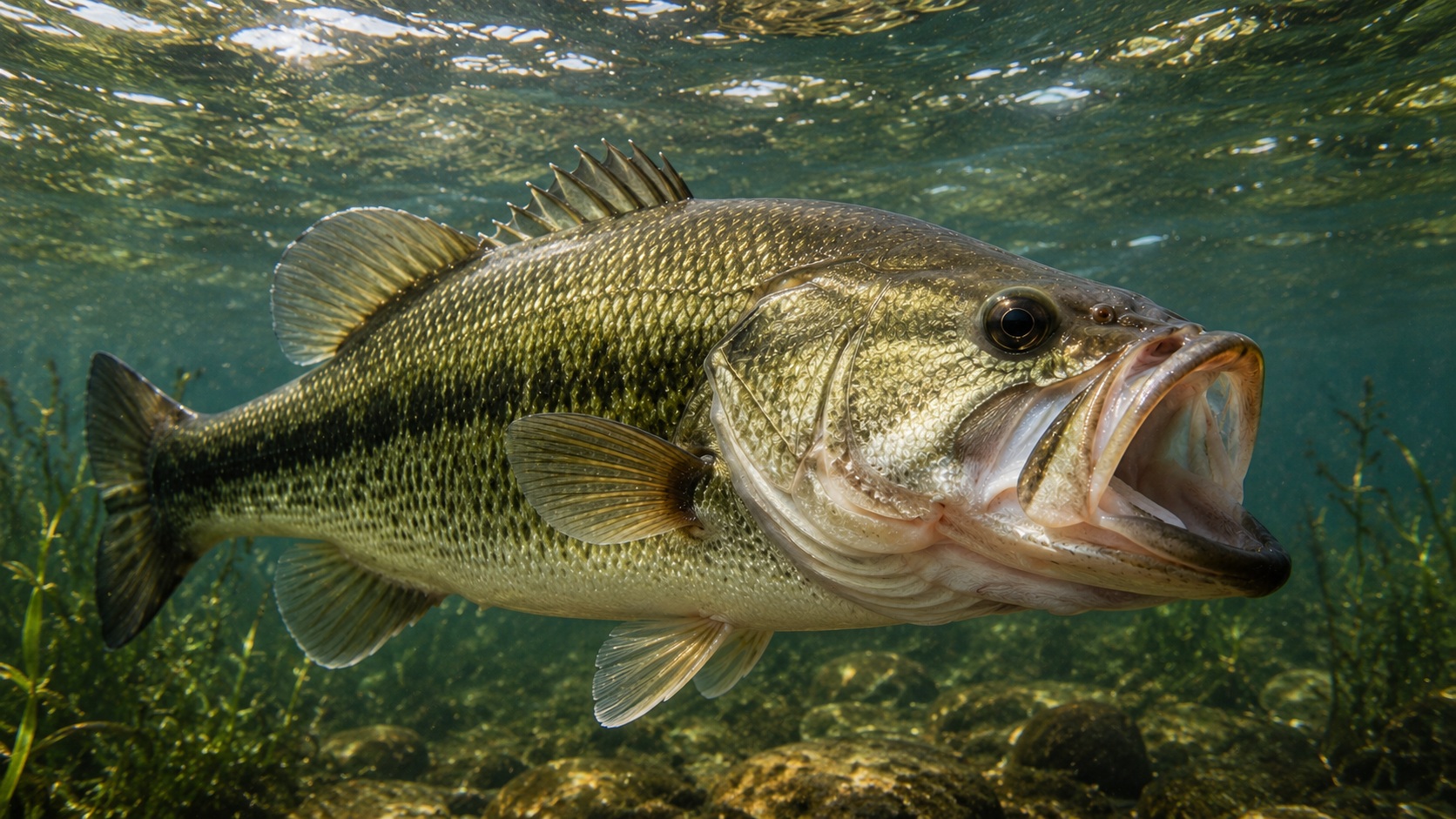
The jaw is the quickest tell. A largemouth’s jaw extends past the rear edge of the eye when the mouth is closed. Hold the fish up and check the jaw hinge: if it sits clearly behind the eye, that is a largemouth. On a smallmouth bass, the jaw aligns roughly with the middle of the eye.
Beyond the jaw: greenish body, a dark horizontal stripe running from the gill plate to the tail, and a lighter cream-to-white belly. The stripe is the consistent marker across the color variation you will encounter. Some fish run dark olive; others are nearly chartreuse depending on water clarity, light levels, and local genetics. The stripe stays.
Where to find them
Largemouth are structure fish. They do not cruise open water the way a striper or bluefish does. They position against something and wait for food to come close. Every piece of cover that can shade a fish, narrow an ambush lane, or create an edge holds potential: dock pilings, laydowns, weed edges, rip-rap banks, bridge shadows, points where shallow meets deep, submerged timber from old flooded shorelines.
When you are reading a shoreline, ask yourself where a small baitfish would inevitably swim past. Wherever the answer is “right there, and it cannot easily avoid it,” that is where a largemouth positions.
They are primarily shallow-water, warm-water fish. Most productive bass fishing happens in less than 15 feet. Even on deep reservoirs, the transition zone from 5 to 12 feet where vegetation, structure, and depth converge is where fish spend most of their feeding time.
When to go
Spring is the best season. As water temperatures climb from the low 50s toward 60°F, bass leave their deep winter holding areas and move toward the shallows. Their metabolism fires up and they need to eat heavily to fuel spawning. Pre-spawn bass staging on points and secondary channel transitions are aggressive, catchable throughout the day, and often the largest fish of the year.
Spawning begins around 59 to 60°F and peaks from 65 to 75°F. Timing tracks latitude closely: Gulf Coast fisheries see spawning activity as early as February and March. Anglers on reservoirs in Tennessee, the Carolinas, and the mid-Atlantic see peak activity in April and May. In the northern tier — Minnesota, Wisconsin, Michigan, upstate New York — spawning peaks in late May through June as water finally climbs into the trigger range. Males fan circular nests in 2 to 5 feet of water over firm bottoms and guard them aggressively. A fish protecting a nest will strike out of territorial reflex, not hunger. Females recover quickly after spawning and return to feeding almost immediately. Post-spawn in late spring is excellent and underrated.
Fall is the second prime window. As water cools from the 70s into the 60s and low 50s, bass feed hard to pack on weight for winter. They follow shad, which school in massive numbers in most lakes through the fall. Seeing schooling bass crash baitfish on the surface in October is one of the most exciting things in freshwater fishing, and the techniques are straightforward: match the shad size with a crankbait, lipless bait, or swimbait and work it through the school.
Summer rewards the early and late angler. Once surface temperatures push above 80°F, bass pull off the shallows in the heat of the day. The two-hour windows at dawn and dusk are when they push shallow and hunt aggressively. Night fishing is excellent in summer; bass move into water after dark that they vacate during daylight. A black plastic worm worked slowly along the bank at 11 PM in July catches fish that ignore everything at 11 AM.
Winter is slow but possible. Below 50°F, bass metabolism slows sharply and they stack in the deepest available water. Finesse presentations worked very slowly on main-lake points and channel bends can still produce. This is patience fishing, and it rewards anglers who slow down completely.
What to throw
The right bait depends on conditions. A few categories cover most situations:
Spinnerbait is the most versatile bait in the box and the first thing to reach for in stained or off-color water. A tandem willow-Colorado setup in white or chartreuse, slow-rolled near structure or through shallow cover, produces year-round. The rotating blades create both flash and vibration, giving fish something to zero in on when visibility is limited.
Crankbait covers water fast and triggers reaction strikes. A medium-diving crawfish pattern over points and transitions is a pre-spawn staple. A shad-pattern crankbait worked through fall schooling fish converts active fish quickly.
Jig for maximum precision. A flipping jig pitched to dock pilings, laydowns, and heavy cover is the presentation for fish that are holding tight. Black/blue in stained water, green pumpkin in clearer conditions. Work it slowly and let it sit. The jig rewards finesse as much as it rewards accuracy.
Finesse rigs (drop shot, ned rig) are the go-to after a cold front or in high-pressure clear water. Small soft plastics, worked slowly near the bottom, produce when faster presentations get ignored.
Topwater at low-light windows. A popper or walking bait at dawn in summer, a frog over lily pads, a buzzbait along a dark bank. The strike is violent and visible. These are the moments anglers remember for years.
The single most consistent adjustment any angler can make, regardless of what is on the line: slow down. Bass are ambush hunters. They do not chase baits across open water. The lure needs to be in the strike zone long enough for the fish to decide to eat.
The world record
The all-tackle world record stands at 22 pounds 4 ounces, caught by George W. Perry on Montgomery Lake in Georgia on June 2, 1932. That record held unbroken for 77 years before a Japanese angler, Manabu Kurita, caught a fish on Lake Biwa in 2009 that weighed the same amount. Under IGFA rules, a record requires exceeding the standing mark by at least 2 ounces; Kurita’s fish was 0.97 ounces heavier, resulting in a co-record rather than a new one. The Perry record still stands, tied but never clearly broken.
A 5-pound largemouth is a genuinely good fish in most fisheries. A 10-pound fish is exceptional anywhere.
Handling and release
Catch-and-release is widely practiced in bass fishing, especially for larger fish. Proper handling makes a real difference in survival:
- Keep air exposure under 30 seconds for photos.
- Support larger fish horizontally with both hands rather than hanging them by the jaw alone.
- Do not grip or press on the gill plates.
- Revive exhausted fish in the water, moving the fish gently forward and back until it swims out of your grip on its own.
With careful handling, catch-and-release survival rates for largemouth bass exceed 95 percent.
On the Table
Largemouth bass is edible and worth keeping on occasion, but most anglers practice catch-and-release with this species — prizing it far more as a sport fish than a table fish. That said, smaller fish from cold, clean water can make for a respectable meal.
Taste and texture: Largemouth bass has white, mildly flavored flesh with a slightly firm texture that holds up well to heat. Fish from warm, murky, or weedy water can develop a muddy or grassy taste that some find off-putting. Cold, clear lakes and rivers produce noticeably cleaner-flavored fish. The flesh is lean, low in fat, and flakes into moderate-sized pieces when cooked.
Best preparation methods:
- Pan-frying: The most popular approach. Lightly breaded fillets fried in butter or neutral oil highlight the mild flavor without masking it. Works especially well for smaller fish with thinner fillets.
- Battering and deep-frying: A heavier beer batter or cornmeal crust adds flavor and texture that compensates for any mild earthiness in the flesh, making this a reliable method for fish from warmer water.
- Baking or broiling: Works well for larger fillets. A simple seasoning of butter, lemon, and fresh herbs lets cleaner-flavored fish shine without adding competing flavors.
- Blackening: A Cajun spice rub cooked in a hot cast-iron skillet adds bold flavor and a charred crust that pairs well with the lean, firm flesh and effectively masks any off-notes from the fish’s environment.
Handling for table quality: Table quality drops fast if the fish is not handled well. Kill the fish immediately after deciding to keep it — live-well stress degrades flesh. Ice the fish whole as soon as possible and keep it cold until filleting. Trim away the lateral line and any reddish or dark-colored flesh before cooking, as these areas carry the strongest flavor. For fish from warm or murky water, soaking fillets in salted water or milk for 30—60 minutes in the refrigerator can draw out some of the earthy taste.
Eating notes: Slot limits and size regulations are common for largemouth bass in many states, and the regulations vary widely by water body. Check local rules before keeping any fish. Medium-sized fish (1—2 pounds) generally eat better than trophy-sized bass, which tend to be older and can carry stronger flavor. Large fish are almost universally released by serious bass anglers.