A note about links: If we include links to retail sites like Amazon or Bass Pro Shops, it's because they're relevant to the topic and, as anglers ourselves, we believe they're worth checking out. As an Amazon Associate we earn from qualifying purchases.
What it is
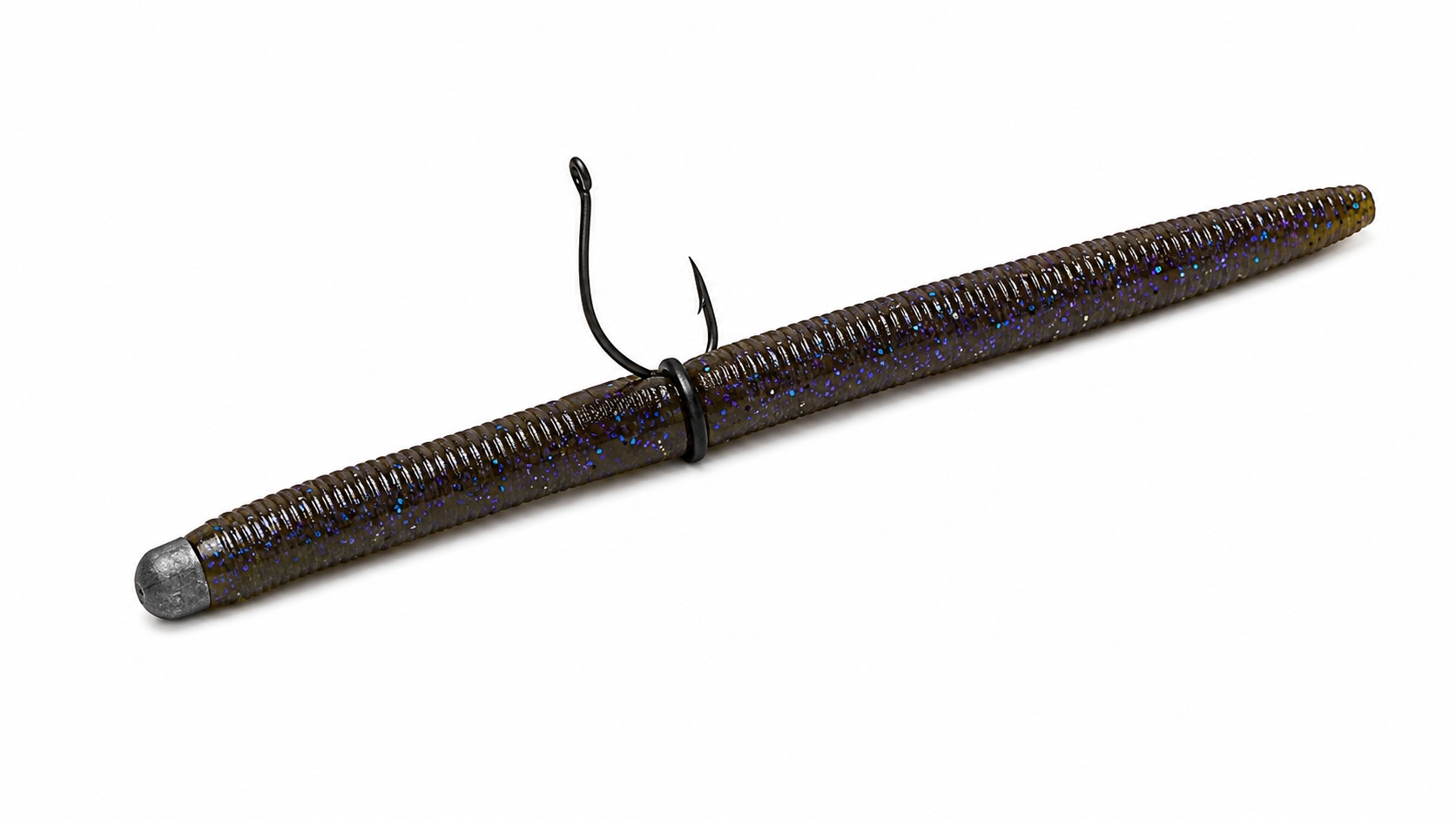
The neko rig is a single modification away from a wacky rig — you push a small nail weight into the head of the worm — and that one change completely transforms the way the bait behaves. Where a wacky rig falls horizontally and flutters both ends equally on the way down, the neko rig falls head-down at a steep angle and then stands vertically on the bottom with the tail end waving above the sediment. That posture is unlike anything else in bass fishing, and in clear water where bass can get a long look at a bait before committing, it produces when other rigs do not.
The name comes from Japan, where this style of finesse fishing was refined before making its way into American tournament circuits. It is now one of the most reliable post-spawn and clear-water weapons in a finesse angler’s lineup.
The setup
What you need:
- Straight stick worm, 5–6 inches (Yamamoto Senko is the benchmark bait)
- Nail weight: 1/32 oz or 1/16 oz for shallow water; 1/8 oz for depth or wind
- Finesse wacky hook or dedicated neko hook: size 1 to 2/0
- Optional: wacky O-ring at the hook insertion point
- 6–8 lb fluorocarbon mainline
Assembly:
- Insert the nail weight into the head (the smaller, denser end) of the worm. Push it straight in with needle-nose pliers or a nail weight tool until it sits flush. No glue needed — the plastic grips it.
- If using an O-ring, slide it onto the worm at the center or just past center toward the tail. The O-ring acts as a saddle for the hook and takes the wear so the worm lasts multiple fish.
- Hook through the worm wacky-style at the midpoint (or through the O-ring if using one). The hook bend should ride up.
- In open water, an open wacky-style hook works fine. Around docks, laydowns, or any soft cover, switch to a finesse weedless wacky hook — the Owner Mosquito Weedless and VMC Neko Hook both have a small weed guard that threads through the plastic to ride hook-point-up without snagging.
The nail weight does all the work. Do not overweight it — if the bait sinks too fast and hits bottom hard, you lose the slow-fall action that triggers bites.
How to fish it
The neko rig is a bottom-contact finesse bait. Cast it to your target, give slack as it sinks on a controlled fall, and watch your line for bites on the drop — that is when a significant number of fish eat it.
Once it hits bottom and stands up, shake the rod tip. Short, sharp twitches make the tail flutter while the weighted head stays anchored. The bait looks alive. Pause between shakes and let it settle. Inch it forward slowly with occasional hops rather than dragging it — you want the bait to stand back up after each move, not skate along the bottom like a Texas rig.
Working structure: The neko rig excels around visible structure in clear water. Target dock posts, submerged rocks, log ends, and isolated grass clumps. Cast past the target, shake it in toward the object, and let it sit directly beside or under structure for several seconds. Bass holding tight to cover in pressured lakes have seen every reaction bait on the market — the subtle, standing posture of a neko rig looks different enough to get bit.
Managing the fall: In clearer water, open the bail and feed the bait on a controlled slack fall rather than a tight line. Bass intercept it mid-column more often than you might expect, and a tight line restricts the natural action on the way down.
When to use it
Post-spawn: This is the neko rig’s strongest season. After the spawn, bass suspend near dock shadows, main-lake points, and visible structure in 4–12 feet of water. They are recovering, visible, and often finicky. The neko rig’s subtle action draws strikes from fish that have backed off more aggressive presentations.
Clear-water fisheries: Anytime visibility exceeds three or four feet, finesse presentations outperform power fishing under neutral conditions. The neko rig’s realistic bottom-standing posture holds up to scrutiny better than most rigs.
Pressured lakes: Tournament-pressured bass have seen more jigs and Texas rigs than a bait should ever have to handle. The neko rig’s action is distinct enough that it registers as different to educated fish.
Depth range: Most productive from 4 to 15 feet. Deeper than 15 feet, the drop shot rig handles the presentation more efficiently. Shallower than 4 feet, the wacky rig often outproduces because a weight is less necessary for casting distance and fall speed control.
Size and weight guide
| Nail Weight | Best Use |
|---|---|
| 1/32 oz | Shallow docks, calm days, 4–8 ft |
| 1/16 oz | General purpose, slight wind, 6–12 ft |
| 1/8 oz | Wind, deeper targets, 10–15 ft |
A 5-inch Senko is the most versatile choice for largemouth bass in most situations. Drop to a 4-inch for heavily pressured fish or when targeting smallmouth bass. Z-Man’s ElaZtech stick baits are stiffer and more durable than salt-loaded plastics, which is useful if O-rings are not in the kit.
Gear setup
Rod: Medium-light or light power spinning rod, 6’10” to 7’2”, with a fast tip. The light tip telegraphs the subtle head-down shakes to the bait without overworking it. A rod with too much backbone kills the action.
Reel: 2500-series spinning reel with a smooth drag. The drag needs to perform reliably on light line because neko rig fish often run toward cover when hooked.
Line: 6–8 lb straight fluorocarbon is standard. Fluorocarbon sinks, reducing surface bow that interferes with sensing subtle bites, and its near-invisibility matters in clear water. If casting distance is an issue, use 10–15 lb braid to a 6–8 lb fluorocarbon leader of 12–18 inches.
Brands worth knowing
Hooks: The VMC Neko Hook and Owner Mosquito Weedless are the most widely used dedicated neko hooks. The Decoy Nail Hook works well for open water. Size 1 covers most 5-inch worm applications; go to 1/0 for thicker plastics.
Nail weights: VMC and Decoy both make pre-packaged nail weight assortments with multiple sizes. Tungsten nail weights are smaller in profile than lead for the same weight class, which matters when punching into the head of a smaller bait.
Plastics: The Yamamoto 5-inch Senko is the benchmark — its salt content and soft body produce action no stiffer plastic fully replicates. Z-Man’s Finesse WormZ and Berkley Powerbait MaxScent Flat Worm are strong alternatives with different action profiles.
The neko rig is not a replacement for the wacky rig or the ned rig — each has a specific lane. But in clear water, around visible structure, with post-spawn or pressured bass that have backed off reaction baits, the neko rig’s head-down posture and standing bottom action fills a gap that few other rigs can.